

Most of what is written about scrap brokering stops at "buy low, sell high." The margin is real, but it is only the top line, and a first deal is where most people find out how much sits between the top line and what they keep. This article follows one invented broker through one deal, with every number shown, then shows what happens when the sale goes well, when the buyer pushes back and when the buyer cancels. The point is not the exact figures, which are invented. The point is the shape: a margin, a short list of costs and one risk that can wipe out the first two. It describes the broker role as ScrapTrade publishes it and does not promise any income.
The role in one paragraph
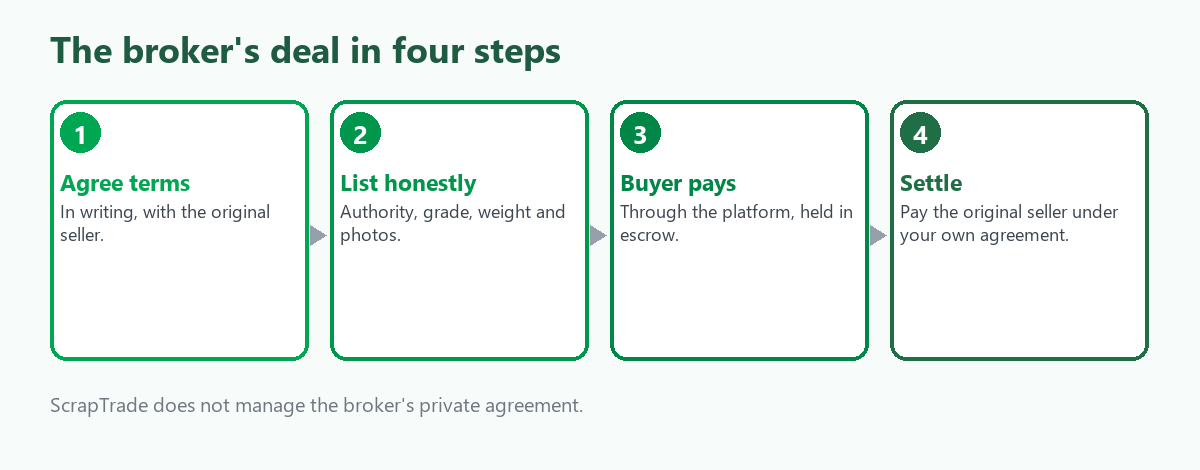
On ScrapTrade a scrap broker sources scrap from an original seller and lists it as a seller, with a broker classification on the account and a reference to the original seller on each listing. The margin is arranged privately with the original seller, and ScrapTrade does not calculate, deduct or distribute it. Standard platform fees apply to the sale [1][2]. For the roles side by side, see Who Is Who in Scrap. For a first look at whether it suits you, ScrapTrade's is scrap brokering right for you page is a plain check.
Meet Mia and the brass (invented)
Mia knows a plumbing supplier who has about 300 kg of mixed brass offcuts and old fittings in the back shed and no time to sell them. Mia is not a yard and has no stock room. She offers to take the load off the supplier's hands and resell it. They agree in writing:
- Mia has authority to sell the material.
- The supplier will be paid A$1,500 for the load.
- Mia may list it for what she can get.
Mia photographs the brass, weighs it and lists it on ScrapTrade as the seller, naming the supplier as the original seller. She sets the price at A$1,950. These figures are invented. They are not a price guide, and we do not state a yard price for brass. What brass is worth against the world benchmark is explained in Scrap Brass Price Per Kg in Australia.
The margin on paper
| Amount | |
|---|---|
| Listed selling price | A$1,950 |
| Agreed price to the original seller | A$1,500 |
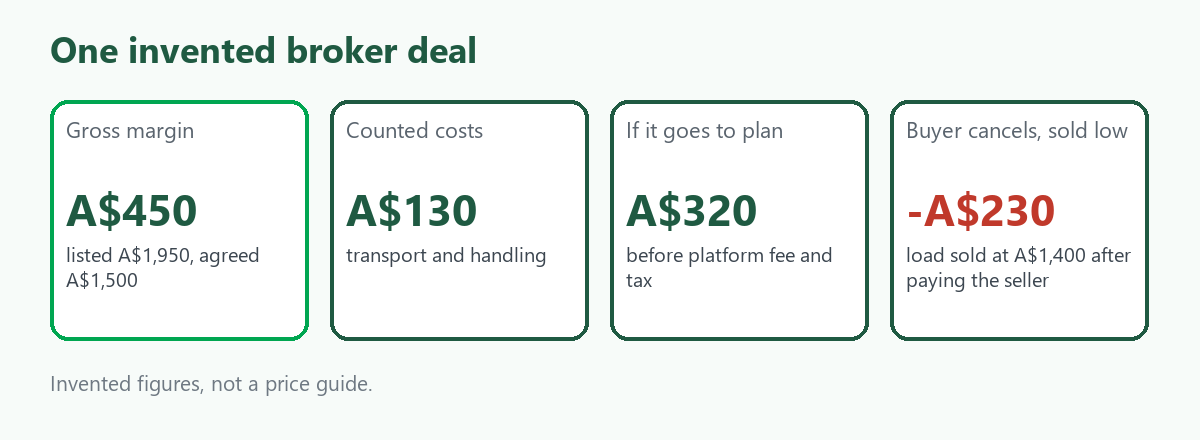
| Gross margin | A$450 |
That is the number that gets people excited. It is also the margin before anything else comes out of it. ScrapTrade's own margin page says the same: a potential gross margin before expenses [3].
The costs that come out of it
Mia works out what the load costs her to move and handle.
| Cost | Amount (invented) |
|---|---|
| Transport from the supplier to the buyer | A$90 |
| Handling and storage while waiting for a buyer | A$40 |
| ScrapTrade platform fee | Standard fee applies; we do not assume a rate |
| Tax on the margin | Ask a registered tax agent |
Costs she can count come to A$130, so her result before the platform fee and tax is A$450 minus A$130, which is A$320. That is the number to carry into the first conversation with the seller, not A$450. If the costs had been A$300 instead, the same deal would leave A$150, and the supplier's price would have been too high. The advice on the margin page is to work out your costs before you agree a price with the original seller [3].
Ending 1: it goes to plan
A buyer purchases through the platform at A$1,950. Payment is held in escrow from the moment the deal is confirmed and released once pickup or delivery is confirmed, as the Trust & Safety page says. Mia pays the supplier A$1,500 under their agreement, which ScrapTrade does not manage, and keeps A$450 less A$130 in costs, so A$320 before the platform fee and tax.
Ending 2: the buyer says the grade is lower than listed
The buyer inspects and says part of the load is not brass but plated fittings. They agree to take it at A$1,750, A$200 less. Mia's margin falls from A$450 to A$250, and after her A$130 of costs she is left with A$120 before fees and tax. If Mia had not seen the whole load, her listing should have said so and described only what she had been told, because ScrapTrade's broker page says listings that overstate grade, quantity or condition lead to disputes and refunds, and they put the broker in the position of the party who sold it [4]. This ending is the most common reason a broker's margin shrinks, and it is avoided by weighing, sorting and photographing before you list.
Ending 3: the buyer cancels after Mia has paid
This is the ending that makes brokering different from working as an agent. Suppose Mia paid the supplier A$1,500 up front, as some sellers will insist on. The buyer then cancels, and Mia is holding 300 kg of brass she has paid for and has not sold.
- If she re-lists and sells for A$1,700, her margin is A$200, less A$130 costs, so A$70 after a delay.
- If she has to sell for A$1,400, she makes A$1,400 minus A$1,500 minus A$130, which is a loss of A$230.
The third outcome is why the margin page lists "a buyer cancelling or disputing after you have paid the original seller" as a risk to think through, and why it also flags agreeing a price with the original seller before you have a buyer [3]. One protection is in the terms with the seller. If you can agree that you pay the original seller after the buyer's payment is confirmed, you carry less risk. ScrapTrade does not manage that agreement, so it is up to you and the seller to put it in writing. We cannot say whether a given seller will accept that.
What the three endings show
| Ending | Gross margin | Costs | Result before fees and tax |
|---|---|---|---|
| 1. As planned | A$450 | A$130 | A$320 |
| 2. Grade dispute | A$250 | A$130 | A$120 |
| 3a. Cancel, re-sold at A$1,700 | A$200 | A$130 | A$70 |
| 3b. Cancel, sold at A$1,400 | -A$100 | A$130 | -A$230 |
The same load produced four results, from a good return to a loss. The skill in brokering is mostly in making Ending 1 likely and Endings 2 and 3 survivable: sort and photograph before you list, price in your costs, and agree payment timing with the seller.
A checklist before your first deal
- Written authority from the person who owns or controls the material. ScrapTrade's listing requirements page asks for it.
- The original seller's details and a reference you can record on the listing.
- Material details: type, grade, quantity, condition and location, with photos that match.
- Your costs worked out before you agree a price.
- Payment timing with the seller in writing.
- Your state's rules. Brokering and agency sit under state rules on dealing in scrap, and we could not verify whether a broker who never holds the material counts as a dealer. See Scrap Business Rules in Australia by State and ask your regulator.
- An ABN and GST view from a registered tax agent. The Australian Business Register says not everyone is entitled to an ABN.
If you would rather not carry the risk
Many people like the idea of brokering and the idea of Ending 3 less. An agent role works the other way: you are paid a commission for your effort, you do not buy the material, and the risk of a cancelled sale falls on the client, though your time can go unpaid if a deal fails. We explain it in Who Makes a Good Scrap Agent?.
Where ScrapTrade fits
ScrapTrade is where Mia lists the load, a buyer pays through the platform and escrow protects the payment, as How It Works and Trust & Safety describe. If you want to try the role, see become a scrap broker and create a free account. ScrapTrade has a commercial interest in the scrap trade.
What we could not verify
- The platform fee percentages and payment timing.
- What brokers earn in practice. The figures here are invented.
- Whether your state treats a broker as a dealer.
- The tax treatment of a broker's margin. Ask a registered tax agent.
Frequently asked questions
How does a scrap broker make money?
By the difference between the price agreed with the original seller and the price the material sells for, less costs, fees and tax. The margin is arranged privately [2][3].
Does ScrapTrade take part of a broker's margin?
No. It does not calculate, deduct or distribute it. Standard platform fees apply to the sale [2][3].
What is the biggest risk for a broker?
A buyer cancelling or disputing after the broker has paid the original seller, and material that differs from what was described [3].
Do I need my own stock?
You list material you have sourced and have the right to sell. Whether you pay the seller first is part of your private agreement with them [4].
Sources
- ScrapTrade Australia, Scrap broker, as published in October 2026.
- ScrapTrade Australia, Scrap agent versus scrap broker.
- ScrapTrade Australia, Scrap broker margin explained.
- ScrapTrade Australia, What a scrap broker is responsible for.
Mia, the supplier and every figure are invented. They are not a price guide. This is general information, not legal, tax or financial advice. ScrapTrade operates a scrap marketplace and has a commercial interest in the scrap trade.