

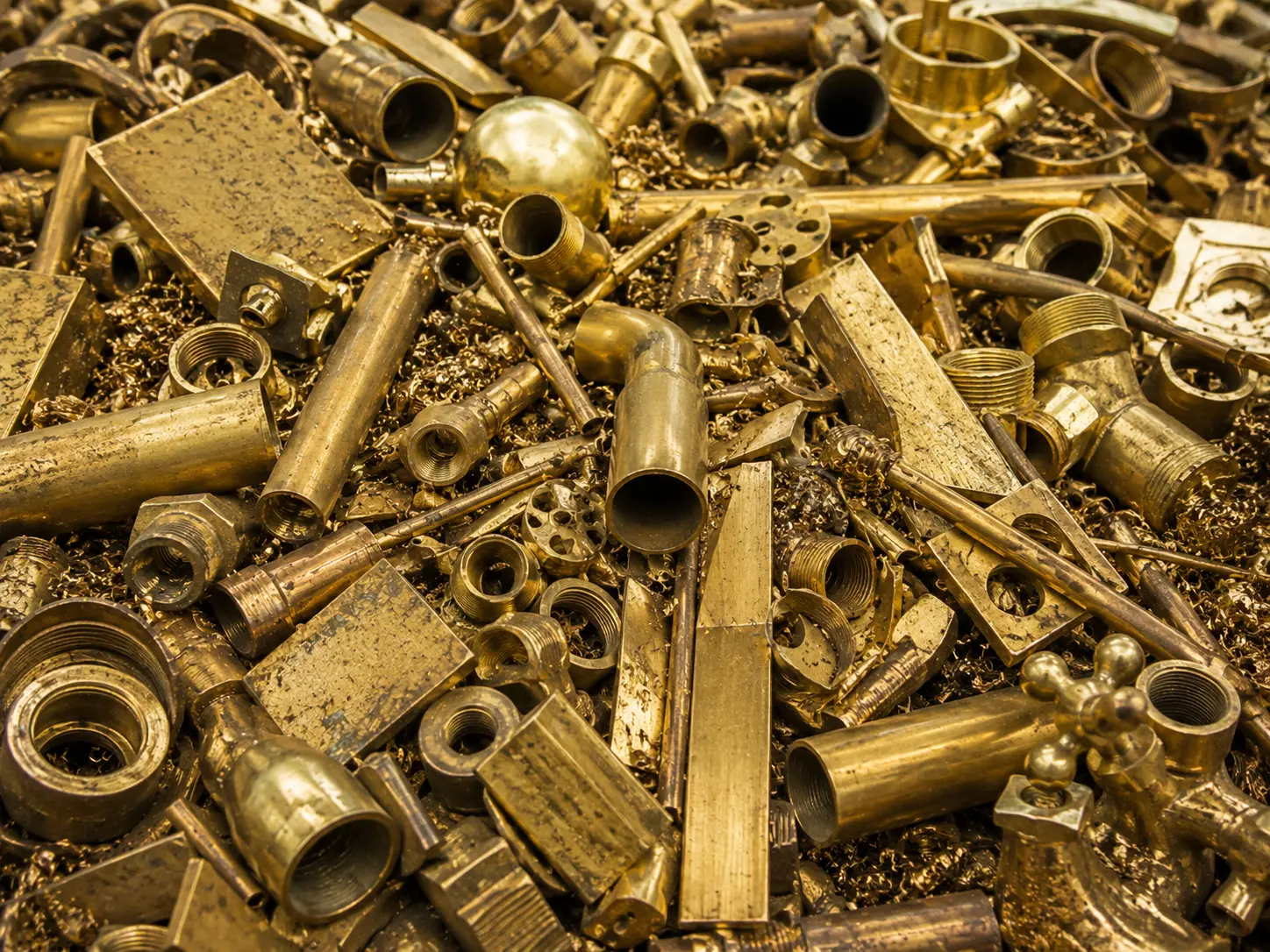
Brass is one of the more valuable scrap metals you are likely to hold. Taps, valves, fittings and rod all carry real value, but only if they are sorted from the steel, rubber and plastic they come attached to. This guide explains what sets the price, shows how to put a number on the metal content, and says plainly what we could not verify. For your own load, use the scrap calculator.
What brass is, and what sets its value
Brass is an alloy of copper and zinc. Its value follows both metals. On 29 October 2026 the official London Metal Exchange (LME) cash settlements were US$14,560 a tonne for copper and US$3,980 for zinc [1]. The Reserve Bank of Australia's rate was US$0.7053 per A$1 [2], so copper was about A$20.64 a kilogram and zinc about A$5.64.
Common yellow brass is roughly 60 to 70% copper, with most of the rest zinc. On a 60/40 mix, the metal in a kilogram is worth about 0.6 x 20.64 + 0.4 x 5.64, or roughly A$14.60. At 70/30 it is about A$16.10. That is the value of the metal content, not a scrap price. A buyer pays less for the cost of sorting, melting and risk, and we found no sourced figure for how much less. The mix of copper and zinc is general metallurgy and varies by alloy.
What moves the payout
- Cleanliness. The ScrapTrade Price Index defines its brass grade as clean yellow brass with no iron attachments. Steel fittings, rubber seals and plastic parts on taps and valves reduce what a buyer pays, either by lowering the rate or by deducting weight.
- Form. Rod, solid fittings and mixed plumbing parts can be graded differently by a yard. Ask how yours does it.
- Quantity. Sorted lots are easier to price and quote.
- Which buyer. A yard that tests composition may separate brass from similar-looking metals more accurately.
- The copper and zinc markets and the dollar, which move daily.
When we checked on 30 October the index said it was showing reference estimates while live pricing was temporarily unavailable, so we do not print its figures. The index lists only clean yellow brass, so we give no rate for mixed or contaminated brass. Bronze, which is mainly copper and tin, is a different alloy with its own price, as we explain on Bronze vs Brass Scrap.
How to check an offer
- Ask the yard what it is paying for your type, and what it deducts.
- Compare the offer per kilogram with the metal value above, as a rough sense of scale only.
- Compare two or three buyers, and look at the date on any price you are shown.
Sorting before you sell
- Separate steel fittings from brass with a magnet. Brass is not magnetic, so anything that sticks is not brass.
- Separate yellow brass from other copper alloys where you can see the difference in colour.
- Take off rubber, plastic and steel where it is safe and quick to do so.
- Keep it dry and free of oil.
What customs data says about brass
Australian customs records report brass scrap under its own code (copper-zinc base alloys). In 2025-26 exporters declared 13,418 tonnes of it at an average of A$12,049 a tonne, up from A$4,152 in 2017-18 [3]. That is a financial-year average across grades, destinations and shipment sizes. It is not a yard price, and it should not be compared with a single day's benchmark.
Selling brass on ScrapTrade
According to ScrapTrade's How It Works page, sellers list with photos and pricing preferences, review buyer offers and accept one, and buyers can also post what they need. The Trust & Safety page says payment is held in escrow from the moment a deal is confirmed and released once pickup or delivery is confirmed on both sides. For small loads you do not want to list, Quick Sale arranges pickup on most loads across Australia, but you do not set the price: the value is assessed against current prices after collection. Create a free account to try either.
If you sell as a business, the ATO's scrap code expects an ABN or the buyer withholds 47% unless a valid exception applies [4]. See What If Every Scrap Trade Were on the Books?. For copper, see Who Buys Australian Aluminium and Copper Scrap. ScrapTrade has a commercial interest in the scrap trade.
What we could not verify
- A sourced Australian yard price for brass, or how much below the metal value yards pay.
- Mixed or contaminated brass rates, which the index does not list.
- Live ScrapTrade index figures, which were unavailable when we checked.
- City differences.
Frequently asked questions
What is the scrap brass price per kg in Australia?
It depends on grade and the day. The metal in yellow brass was worth roughly A$14.60 to A$16.10 a kilogram on 29 October 2026, but scrap sells below its metal value and we found no sourced yard price [1][2].
Why is brass worth less than copper?
Brass is a copper and zinc alloy, and zinc is worth far less per kilogram than copper [1].
How do I tell brass from copper?
By colour: brass is yellow and copper is reddish. A composition test is the reliable method.
Do I need an ABN to sell brass?
If you sell as a business, the ATO expects one, or the buyer withholds 47%, unless a valid exception applies [4].
Sources
- Westmetall, Official LME prices, 29 October 2026.
- Reserve Bank of Australia, Exchange rates, 29 October 2026 (US$0.7053 per A$1).
- Department of Climate Change, Energy, the Environment and Water, waste exports data (ABS records), AHECC 74040022 (copper-zinc base alloys, brass), ScrapTrade calculations. 2025-26 figures are provisional.
- Australian Taxation Office, GST and scrap metal: code of compliance (3 July 2023).
Figures are indicative and not an offer or advice. The metal-content figures are an illustration, not a scrap price. ScrapTrade operates a scrap marketplace and has a commercial interest in the scrap trade.