

Updated 26 October 2026. Most coverage of copper is written in US dollars and from the point of view of New York and London. This one is written for people who buy and sell in Australia. On 26 October COMEX copper closed at US$6.49 a pound, which is US$14,306 a tonne, and at an exchange rate of 70.3 US cents that is about A$20,350 a tonne, or A$20.35 a kilogram. Over the past year copper has risen 27% in US dollars and 18% in Australian dollars, because the Australian dollar rose about 8% against the US dollar over the same period and shaved off part of the gain [1].
The global story behind the price, tight mines, a war that has squeezed the acid many operations rely on, and a US tariff decision that is pulling metal across the Atlantic, is told in Copper Prices: Analysis, Risks and Outlook. This article does something different. It looks at what the price means in Australian dollars, how Australia fits into the copper chain, what local policy does and does not say about scrap, and what a seller of copper scrap should do. It is general information and not investment advice.
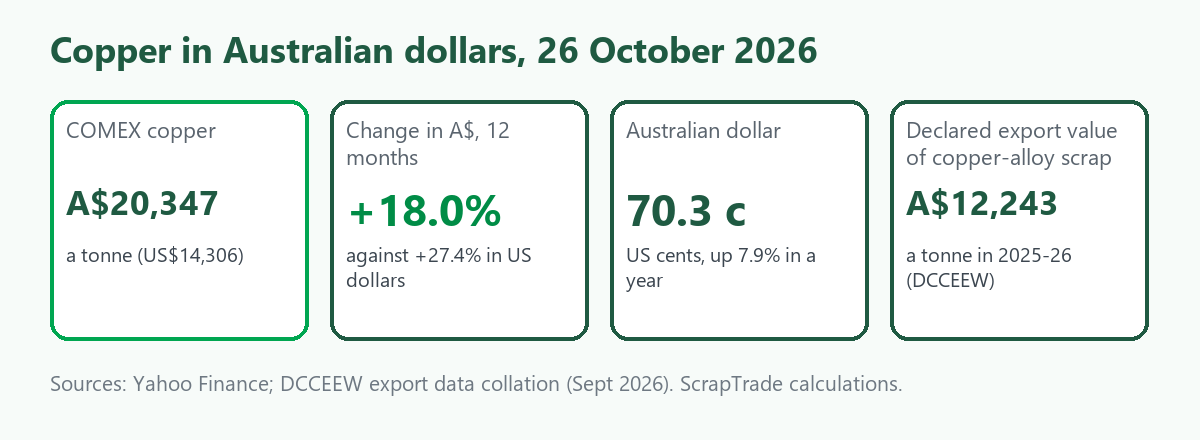
The exchange rate is half the story
The chart shows the same copper price in both currencies. The two lines move together, but the gap between them changes with the Australian dollar, and that gap matters to anyone paid in Australian dollars.
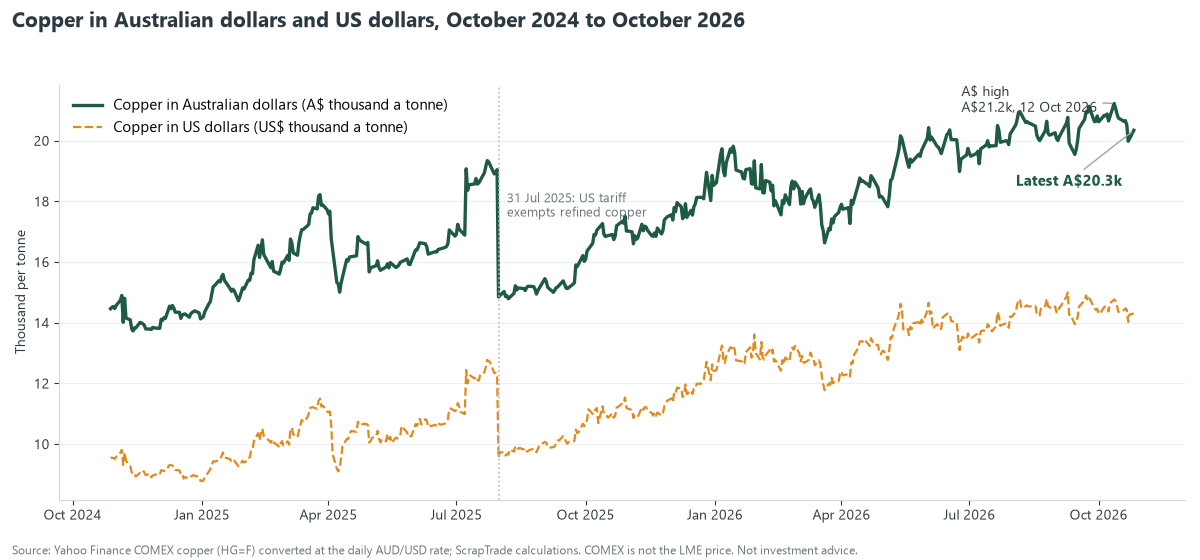
Copper in Australian dollars reached about A$21,230 a tonne on 12 October, its highest close of the past year, and is now 4% below that. The July 2025 cliff on the chart is the US decision to exempt refined copper from its new tariff, which knocked 22% off the COMEX price in a day. The rest of the move has been an uneven climb.
The exchange rate is worth understanding in numbers. A one US cent move in the Australian dollar changes the Australian dollar copper price by about 1.4%. With copper at US$14,306 a tonne:
| Australian dollar | Copper in A$ a tonne |
|---|---|
| 68 US cents | A$21,038 |
| 70 US cents | A$20,437 |
| 70.3 US cents (26 October) | A$20,347 |
| 72 US cents | A$19,869 |
| 73 US cents | A$19,597 |
Over the past 52 weeks the Australian dollar has traded between about 64.2 and 72.8 US cents [1]. That range alone is the equivalent of roughly A$2,600 on a tonne of copper, before the copper price itself moves. For exporters, a rising dollar is a headwind. For importers and domestic buyers it is the opposite.
Where the technical picture stands
The chart indicators for copper are unchanged by the currency. In US dollars, COMEX copper closed at US$6.49 a pound, below its 20-day average (6.55) and 50-day average (6.57) but above its 100-day (6.46) and 200-day (6.19) averages. The RSI is 46 and the MACD has turned slightly negative. In plain English, copper is pulling back inside a longer uptrend, and the lines that matter are the 200-day average around US$6.19 a pound (about A$19,400 a tonne) and the September high of US$6.80 (about A$21,300). The full indicator analysis is in the global piece.
Australia's place in the copper chain
Australia is a major miner and an exporter, but its position in the processing chain is thin, and recent events show how fragile that is.
- Mount Isa and Townsville. Glencore's Mount Isa copper smelter and Townsville copper refinery are Australia's main primary copper processing assets. Glencore put them under strategic review in April 2025, and in October 2025 signed a Heads of Agreement with the federal and Queensland governments for up to A$600 million to keep them running for three years, covering about 600 workers [2]. A detailed agreement was still being negotiated when that was announced.
- Scrap leaves the country. Australia exported 113,411 tonnes of copper and copper-alloy scrap worth A$1.23 billion in 2025-26. China took 56% of that by value, Thailand 17%, India 11% and South Korea 10%. The declared export value of copper-alloy scrap averaged A$12,243 a tonne, 153% higher than the A$4,833 of 2017-18 [3].
- Prices followed the metal. The Australian average is a mixed bag of grades, so it is not a price for any one lot. But it shows how much more a tonne of copper scrap is worth than a tonne of steel scrap, roughly 18 times at the 2025-26 averages [3].
What Australian policy says about copper scrap
Copper and aluminium are on the government's Strategic Materials List, and the list page does not mention recycling or scrap. The Critical Minerals Strategy 2023-2030 does not mention scrap metal or metal recycling anywhere in its 18 pages. Australia's waste export bans cover glass, plastics, tyres and paper and cardboard, but not metals, and the Senate's 2025 waste inquiry made 19 recommendations, none of which deals with scrap metal [4]. We set out the evidence in Australia's Scrap Metal Exports: 2025-26 Data.
That does not mean there are no rules. Buying scrap from the public is regulated in states and territories, usually through identity checks, record-keeping and payment rules, and what applies to you depends on where you are. The point is narrower: the question of whether and how Australia should keep copper scrap onshore has not been answered in the federal documents we checked.
What this means for people selling copper scrap
Scrap is not sold at the benchmark. Buyers pay a discount that depends on grade, form, quantity, location and the state of the market. The illustration below is not a quote. It shows how much a percentage of the benchmark is worth on 100 kilograms at the 26 October price of A$20.35 a kilogram.
| Share of the benchmark paid | Value of 100 kg |
|---|---|
| 70% | A$1,424 |
| 80% | A$1,628 |
| 90% | A$1,831 |
The discount rate is the number to find out. It varies from buyer to buyer and week to week, and weekly reviews from Shanghai Metals Market described scrap discount rates holding at high levels outside China in July when supply was tight [5]. ScrapTrade's own price index is an AI-generated indicative estimate and, on 26 October, put bare bright copper wire at A$11.67 a kilogram, which is about 57% of the benchmark. That gap is wider than a buyer's margin alone would suggest, so treat the index as a conservative reference and ask for firm offers. See how the calculator works.
A few habits protect sellers:
- Sort by grade. Bare bright, Copper 1 and Copper 2 sell at different prices. See how to grade scrap metal and the guide to copper scrap grades, prices and demand.
- Price on the day. Copper moves about 1.3% on an average day, which on A$50,000 of material is about A$650.
- Compare offers. List on the marketplace and let several buyers respond, or use Quick Sale if convenience matters more than the last dollar.
- Keep records. Note where each lot came from and what you were paid.
What to expect
Two large banks have published recent calls, and both are bullish for 2027 in US dollars. Goldman Sachs raised its 2027 average LME forecast to US$15,400 a tonne and its year-end 2026 forecast to US$14,700. UBS expects a deficit widening from 219,000 tonnes in 2026 to 379,000 tonnes in 2027, with prices reaching about US$15,500 in 2027 [6]. At today's exchange rate those translate to about A$20,900 (Goldman, end of 2026), A$21,900 (Goldman, 2027 average) and A$22,000 (UBS, 2027).
Other forecasts are lower, and the global piece sets out the range. For Australian sellers the exchange rate is the wild card: if the Australian dollar rises to 73 US cents, even a bullish forecast of US$15,400 is only about A$21,100 a tonne.
Signposts to watch: the US decision on refined copper tariffs, due since mid-year; the COMEX and LME price gap; Hormuz and sulphuric acid supply; Chinese smelter cuts; mine restarts at Escondida and elsewhere; the Reserve Bank's next steps, which affect the Australian dollar; and the 200-day average near A$19,400.
Frequently asked questions
What is the copper price in Australian dollars today?
About A$20,350 a tonne, or A$20.35 a kilogram, on 26 October 2026, based on COMEX at US$14,306 a tonne and an exchange rate of 70.3 US cents.
Why has copper risen less in Australian dollars?
Because the Australian dollar has risen about 8% against the US dollar in a year, which reduces the local price of a US-dollar commodity.
What is copper scrap worth in Australia?
It depends on the grade and the buyer's discount to the benchmark. Declared export values averaged A$12,243 a tonne for copper-alloy scrap in 2025-26. ScrapTrade's indicative index showed A$11.67 a kilogram for bare bright wire on 26 October, which is an estimate, not a quote.
Does Australia have a policy on copper scrap?
Copper is on the Strategic Materials List, but the list and the Critical Minerals Strategy do not mention scrap, and waste export bans do not cover metals [4].
Where is copper going?
Goldman Sachs and UBS expect higher prices in 2027, while other forecasts are lower. Nobody knows.
Sources
- Yahoo Finance, COMEX copper futures (HG=F) and AUD/USD, daily history to 26 October 2026. Conversions and indicators are ScrapTrade calculations.
- Glencore Australia, Agreement reached on Mount Isa Copper Smelter and Townsville Copper Refinery (October 2025).
- Department of Climate Change, Energy, the Environment and Water (DCCEEW), Waste exports data collation, September 2026 (Australian Bureau of Statistics records), ScrapTrade calculations.
- Department of Industry, Science and Resources, Critical Minerals List and Strategic Materials List and Critical Minerals Strategy 2023-2030; Senate Environment and Communications References Committee, No time to waste, checked 21 October 2026.
- SMM, Ex-China copper scrap weekly review (July 2026).
- Tradingpedia, UBS projects deeper copper shortfall and higher prices by 2027 (9 October 2026); Mining.com, Goldman Sachs raised its 2027 average LME copper forecast to US$15,400, reporting Reuters.
This article is general information, not investment, financial or tax advice. Prices, forecasts and exchange rates are as reported on 26 October 2026 and change quickly. COMEX prices are not LME prices. ScrapTrade operates a scrap marketplace and has a commercial interest in the scrap trade.