

Updated 26 October 2026. Every few years, somewhere in the world, a government looks at the scrap leaving its ports and asks a fair question: why are we selling the raw material for our own steel, aluminium and copper industries to someone else? The answer in policy form usually comes as a ban, a duty, a quota or a rule that says local buyers get the first look. Australia is having that conversation now. The Australian Steel Institute wants limits on exports of unprocessed ferrous scrap, while the Australian Aluminium Council argues for capital support instead [1][2].
Three countries have already run the experiment. This article looks at what each did, what the evidence says happened, and what a seller or policymaker can reasonably take from it. The main source for the outcomes is a March 2026 report by L.E.K. Consulting for the Australian Aluminium Council. That report is commissioned by an industry body that has a view, and it focuses on aluminium, so the lessons may not transfer directly to steel. We flag that where it matters.
Case study 1: South Africa's price preference system
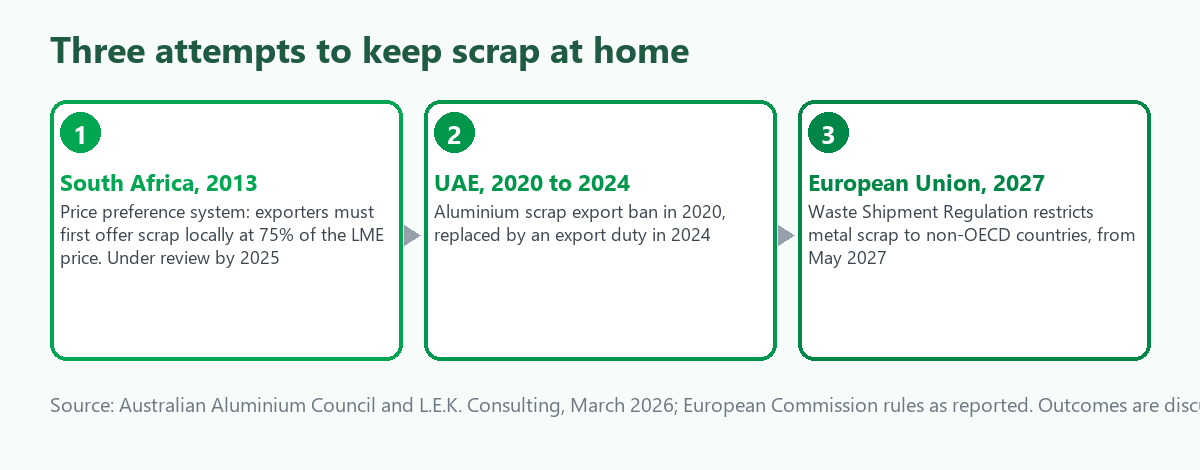
What it did. In 2013 South Africa introduced a Price Preference System that required scrap exporters to first offer their material to domestic buyers at 75% of the London Metal Exchange (LME) price. The idea was to give local processors a supply of cheaper scrap.
What happened. The L.E.K. report says the scheme did reduce export volumes and provided local processors with cheaper scrap. But it did not trigger large-scale domestic investment, because South Africa's processing capacity was limited, and many exporters faced profitability challenges that ended in business closures. By 2025 the scheme was under formal review, which the report takes as a sign of its instability [2].
The lesson. Forcing scrap onto the local market at a discount transferred money from collectors and exporters to buyers, but it did not create new buyers.
Case study 2: the UAE's aluminium ban and duty
What it did. In 2020 the United Arab Emirates imposed a full ban on aluminium scrap exports to guarantee supply for its domestic smelters and rolling mills, which had struggled to secure low-cost raw materials as global demand rose.
What happened. The ban succeeded in diverting scrap into the local market, but it put pressure on traders and collectors, whose margins suffered. After industry concerns, the ban was lifted and in 2024 replaced with an export duty system. The report says the duty produced a more predictable supply of scrap and helped catalyse the construction by Emirates Global Aluminium of a 170,000 tonnes a year recycling plant. It also says the duty compressed the margins of scrap exporters and of the downstream consumers that process the aluminium, making the industry more uncompetitive [2].
The lesson. The UAE already had large smelters that wanted scrap, which is the condition under which retention policies work best, and even there the cost fell on collectors and traders. A duty was gentler than a ban, but it was not free.
Case study 3: the European Union's waste shipment rules
What it did. The EU's revised Waste Shipment Regulation restricts exports of non-hazardous waste, including metal scrap, to non-OECD countries unless the destination can show it can manage the waste in an environmentally sound manner. A draft list published in September 2026 would authorise only five countries to receive EU metal scrap, with the new rules applying from 21 May 2027. See Europe Is Keeping Its Scrap. Who Pays?.
What the debate shows. The rules are not yet in force, so the outcome is unknown. The arguments are already instructive. The European Recycling Industries' Confederation (EURIC) argues that restricting exports may depress the prices paid for scrap, undermining investment in sorting and quality upgrades and ultimately reducing supply quality for European remelters. In August 2025 the industry body European Aluminium expressed support for introducing export fees to mitigate those downsides, though they had not been introduced at the time of the L.E.K. report [2].
The lesson. Even the people the policy is meant to help are debating its side effects before it starts.
What the evidence adds up to
| Case | Tool | Short-term effect | Longer-term effect |
|---|---|---|---|
| South Africa | Forced local offer at 75% of LME | Cheaper scrap for local buyers | No large investment, exporter closures, under review |
| UAE | Ban, then duty | Scrap diverted locally | Smoother supply, a 170,000 tonne a year plant, but thinner margins |
| EU | Destination restrictions | Not yet in force | Contested, with industry split on export fees |
The L.E.K. report's own conclusion is that scrap retention measures have not stimulated sustainable industry growth, and in most cases harmed exporters. In its words, retention measures fail without existing domestic capacity, because they depress prices but do not build industry. It also finds that mandates for recycled content are hard to apply in a small, open economy like Australia, because imports can meet the standard more cheaply, and that direct public co-investment has worked better elsewhere: Canada committed C$110 million to a Rio Tinto smelter expansion in 2023, the United States committed more than US$100 million in 2024 to recycling projects, and the EU funds remelting trials [2].
What it means for Australia
Australia's situation is different from each of these cases, and the two sides of its own debate reflect that.
- Steel. The Australian Steel Institute estimates that more than 1.05 to 1.1 million tonnes of unprocessed steel scrap, from vehicles and appliances, is exported each year, including over 250,000 tonnes of materials that are banned from export on their own, and that local mills will need more scrap in the years ahead. It wants strong limits or a ban [1]. Those are the Institute's own estimates. Australian export data cannot verify them, because they do not separate processed from unprocessed material.
- Aluminium. The Australian Aluminium Council says that almost all of the roughly 440,000 tonnes of aluminium scrap generated each year is exported, because Australia has no remelting capacity, and that scrap prices sit above 90% of the LME, leaving no margin for a local remelter. It argues for co-investment and not for a ban [2].
- The data gap. Neither side can show how much scrap each grade Australia generates and processes, because there is no published series for it. Our analysis of what is known is in Australia's Scrap Metal Exports: 2025-26 Data.
Nothing in these case studies proves that a ban would fail in Australia, or that it would succeed. They show what happened elsewhere when the conditions were different, and they suggest the questions to ask first: is there domestic capacity to take the scrap, who bears the cost of a lower price, and would money for capacity achieve the goal more cheaply?
What it means for sellers
If a restriction comes, the first-order effect on a seller is usually lower prices for the material that is held at home, and higher buyer power for the few local processors. For anyone selling scrap today, the practical steps do not change: sort carefully, know your buyers, and compare offers. See how to grade scrap metal, the live price calculator (indicative only), and the marketplace.
Frequently asked questions
Has any country banned scrap exports?
The UAE banned aluminium scrap exports in 2020 and replaced the ban with an export duty in 2024. South Africa required exporters to offer scrap locally first at 75% of the LME price [2].
Do scrap export bans work?
According to an industry-commissioned 2026 report, they have not built sustainable recycling industries where processing capacity was lacking, and often harmed exporters [2].
Does Australia ban scrap metal exports?
No. Its export bans cover glass, plastics, tyres and paper and cardboard, not metals [3].
What does the EU rule do?
It restricts metal scrap exports to non-OECD countries unless they are authorised, with new rules from 21 May 2027.
What do Australian industry groups want?
The Steel Institute wants limits on unprocessed ferrous scrap exports, while the Aluminium Council wants capital support for remelting [1][2].
Sources
- Australian Steel Institute, updated submission to the Senate inquiry into waste reduction and recycling policies (September 2024), published by the Institute.
- Australian Aluminium Council and L.E.K. Consulting, Enabling Development of Aluminium Recycling Capability in Australia (March 2026), including its citations of South African, UAE and EURIC sources.
- Senate Environment and Communications References Committee, No time to waste, chapter 7.
This article is general information, not legal, policy or trading advice. The main outcome evidence comes from an industry-commissioned report on aluminium. ScrapTrade operates a scrap marketplace and has a commercial interest in the scrap trade, including exports.