

A car battery is one of the most recycled things you will ever own, and also one of the most dangerous to get wrong. It is a plastic box filled with lead and sulphuric acid, so it cannot go in a bin. This guide follows one dead battery from your car to a workshop or scrap collector, through the yard, to a lead recycler and back into a new battery. It is written for people who just want to know where their old battery goes, and for collectors and yard owners who handle them in numbers. We cover the standard lead-acid battery that starts a petrol or diesel car. The lithium batteries in electric cars and many small devices follow a different route, and the comparison at the end shows why it matters. ScrapTrade has a commercial interest in the scrap trade.
Step 1: The battery dies and comes out of the car
A starter battery typically lasts a few years, then struggles to start the engine and gets replaced. Most people never think about the old one. A mechanic, a battery shop or a tyre and auto retailer takes it out, and the old battery usually stays with them. Some drivers take their own battery off and look for somewhere to sell it, and that is where scrap collectors and yards come in.
Two safety points apply at this step. A used battery still contains acid, so keep it upright and do not tip, crush or drill it, and never put it in the household bin or the recycling bin. If a battery is cracked or leaking, wear gloves and eye protection and ask the place you are taking it to how they want it carried.
Step 2: A workshop, retailer or collector gathers it
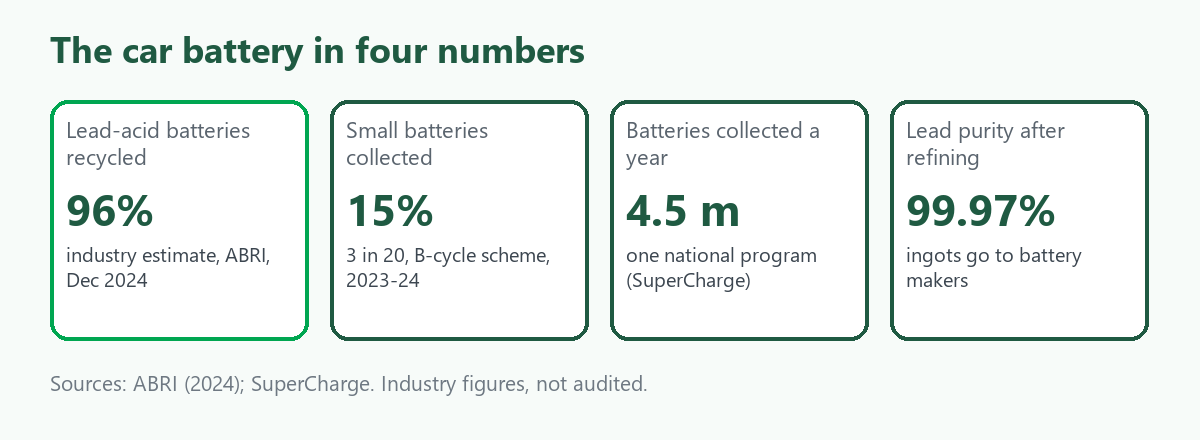
Used batteries are collected from three kinds of places. The first is retailers and workshops, which swap them as part of a sale and store the old ones in a tub or on a pallet. The second is scrap collectors and wreckers, who pull batteries out of cars they are taking apart. The third is the public drop-off network. SuperCharge describes an accredited national program that collects nearly 4.5 million used batteries a year through a network of agents with more than 12,000 collection points. That is the company's own figure and we have not checked it.
This is also where the money is, because a battery is worth something. A yard pays by weight or by the amount of lead it expects to recover, so a bigger battery pays more. We cover the ranges in How Much Are Scrap Car Batteries Worth in Australia?, and the price moves with the world lead market.
Step 3: The yard sorts and stores it
At a scrap yard or battery depot, a worker sorts the batteries by type, checks that none is leaking, and stacks them upright on pallets. Lead-acid batteries are kept apart from lithium batteries, which are a fire risk if they end up in the wrong pile. The yard weighs the load, pays the seller, and holds the batteries until it has enough to send. Because the contents are hazardous, they are normally moved by a transporter set up to carry them.
This is a good place to look at the loop from the yard's side. A battery that arrives intact is worth more than a cracked one that has lost its acid, and a yard that keeps its stock tidy and dry has fewer accidents. For how a yard fits into the wider chain, see How Scrap Metal Recycling Actually Works.
Step 4: The recycler breaks it apart
At the recycler, the process is similar from plant to plant. The Battery Council International, a United States industry body, and SuperCharge describe it like this:
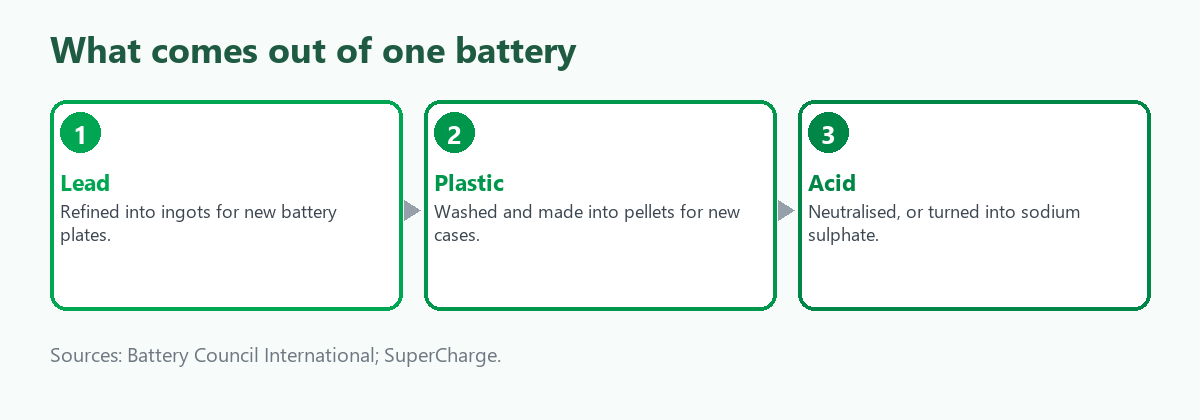
- Break. A hammer mill, which is a machine that smashes the battery into small pieces, breaks the case open.
- Separate. The pieces go into a vat of water. Lead and other heavy parts sink, the plastic casing floats, and the liquid is drawn off.
- Clean the plastic. The plastic, called polypropylene, is washed, dried, melted and turned into small pellets.
- Smelt the lead. The lead grids and lead oxide are cleaned and melted in a furnace. The impurities that float to the top, called dross, are skimmed off, and the lead is poured into ingots. SuperCharge says the lead is refined to 99.97 percent purity.
- Handle the acid. The acid is either neutralised and treated, or converted into sodium sulphate, a salt used in detergent, glass and fertiliser. The Battery Council also says acid can be reclaimed for use in new batteries.
In Australia, one of the best-known plants is at Wagga Wagga in New South Wales. The SuperCharge program says its batteries are processed at a recycling facility there. The NSW Planning Portal lists an approved expansion of a battery recycling facility at Wagga Wagga, determined in February 2019, to process up to 120,000 used lead-acid batteries a year, with an adjoining plant that recovers plastic. We cannot tell you from these sources that the two are the same plant, and we do not know what any plant handles today.
Step 5: The lead and plastic go back to a battery maker
The lead ingots are sold to battery makers, who remelt them into new plates and parts. The plastic pellets go to companies that make battery cases. The Battery Council says recovered lead and plastic are used to make new batteries, though it gives no share. So the main materials go back into the same kind of product, which is why the industry describes the loop as closed.
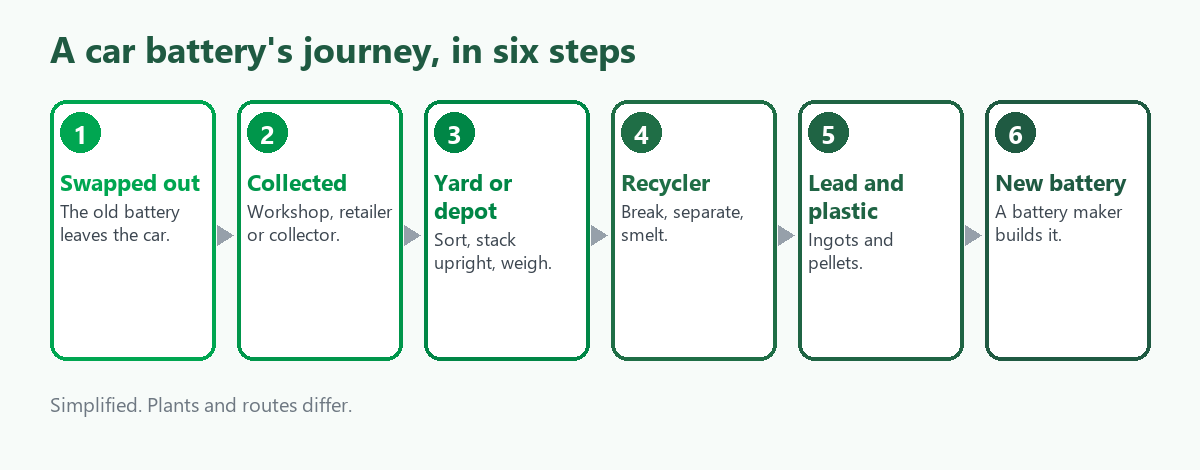
Step 6: Back to you
The next time you buy a battery, it may contain lead that was in a battery on the road a few years earlier. We could not find a figure for how much of a new Australian battery is recycled lead, so we do not give one. The simple version is that the loop is real, and that it runs through the yards and recyclers described above.
How long does it take? We found no reliable time from the dead battery to the new one, and it depends on how long the battery sits in a workshop or yard before collection.
How many batteries really get recycled?
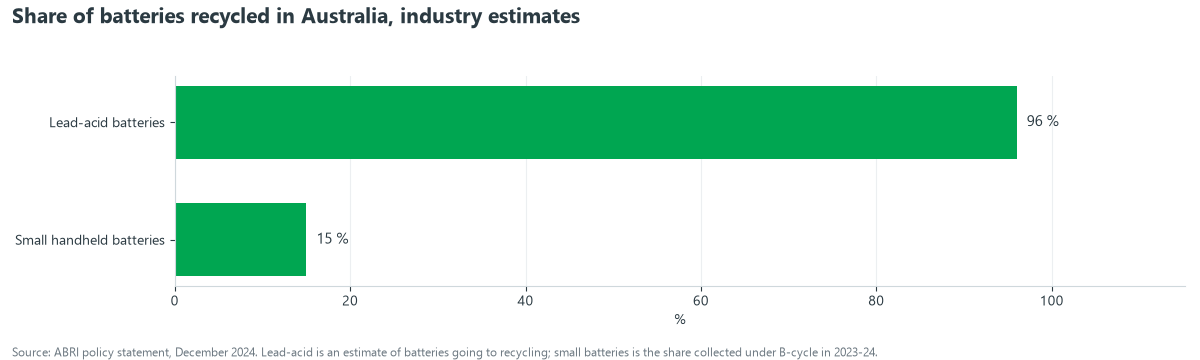
The Association for the Battery Recycling Industry (ABRI) estimates that about 96 percent of lead-acid batteries in Australia go to recycling, which it calls a clear standout. Industry claims elsewhere go as high as 98 or 99 percent, but they are self-reported and measured in different ways, so treat them as the industry's view and not an audited figure.
Compare that with small batteries. ABRI says almost 20,000 tonnes of small batteries were available for collection under the voluntary B-cycle scheme in 2023-24, and only about 15 percent, or three in every 20, were collected and recycled. We cannot say from these sources why the gap is so wide, but one likely reason is that lead-acid batteries come with a payment for the metal and an established collection route.
The lesson for anyone handling batteries is to sort them. A lead-acid battery has a value and a route. A lithium battery needs a different one, and the wrong pile is where fires start.
What this means for you
- If you are a driver: leave the old battery with the shop that fits the new one, or take it to a battery retailer or a scrap yard that accepts it. Keep it upright, and do not put it in a bin.
- If you collect batteries: keep lead-acid batteries upright, dry and separate from lithium ones, and ask your buyer how they weigh and price them. Our price guide explains what moves the figure.
- If you run a yard, workshop or fleet: compare buyers before you sell a pallet, since bulk loads often get better rates. You can list your batteries on the ScrapTrade marketplace or create a free account.
For the other half of a car's scrap value, see End-of-Life Vehicle (ELV) Scrap: How Auto Scrap Is Recovered.
To follow one steel food can from the bin to a magnet, a bale, a steel mill and back to the shelf, read Where a Tin Can Goes After You Recycle It.
To follow one length of copper wire from the wall to the yard, a chopper, a refinery and back into new cable, read Where Old Copper Wire Goes After You Sell It.
To follow one converter from the exhaust to a refiner and back into a new car, read Where an Old Catalytic Converter Goes.
What we could not verify
- Where your own battery goes. Yards sell to different recyclers, so there is no single route for every battery.
- How much used lead-acid battery Australia recycles at home and how much it exports. We found no current official figure.
- What any Australian plant handles today. The Wagga Wagga capacity figure is a planning approval, not output.
- The recycling rates. The 96 percent figure is ABRI's estimate, and the 98 and 99 percent claims are the industry's own.
- What yards pay today. We publish no yard prices.
Frequently asked questions
Can I put a car battery in the recycling bin?
No. It contains lead and acid. Take it to a battery retailer, a workshop or a scrap yard that accepts lead-acid batteries.
Why are car batteries worth money as scrap?
Lead is a valuable metal and the recycler can recover it, so yards pay for batteries by weight or by recoverable lead. The price follows the world lead market.
What happens to the acid in a car battery?
It is either neutralised and treated, or converted into sodium sulphate, a salt used in detergent, glass and fertiliser, according to the recyclers' own descriptions.
Are electric car batteries recycled the same way?
No. Electric cars use lithium-ion batteries, which need a different process and carry a fire risk. They should never go in the same pile as lead-acid batteries.
Sources
- Association for the Battery Recycling Industry (ABRI), Producer Responsibility to Improve Battery Safety and Resource Recovery, policy statement, December 2024.
- Battery Council International, How a Lead Battery Is Recycled.
- SuperCharge, World Leading ULAB Recycling (Australian collection and recycling program).
- NSW Department of Planning, Housing and Infrastructure, Planning Portal, Enirgi Battery Recycling Facility (SSD-6619), determined 20 February 2019.
- ScrapTrade, How Much Are Scrap Car Batteries Worth in Australia?
This is general information, not financial, safety or legal advice. Process steps are simplified, and plants differ. ScrapTrade operates a scrap marketplace and has a commercial interest in the scrap trade.