

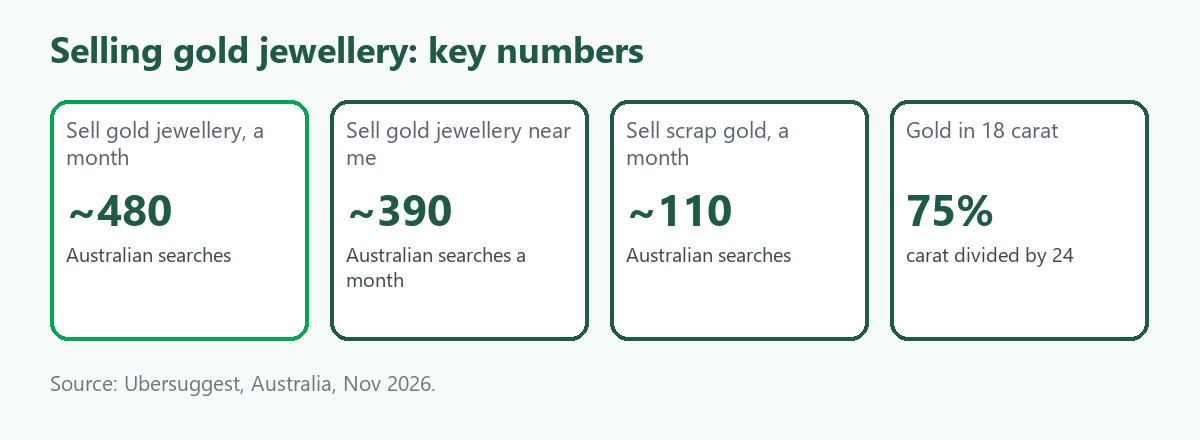
"Sell gold jewellery" is searched about 480 times a month in Australia, according to Ubersuggest, "sell gold jewellery near me" about 390, "where to sell gold jewellery in melbourne" about 480, "sell gold jewellery sydney" and "sell gold jewellery brisbane" about 170 each, and "sell scrap gold" about 110. "How to sell gold jewellery" is only about 70, which says most searchers already know they want to sell and want to find a buyer. The decision that matters is how the buyer arrives at a number. This guide explains the arithmetic, the carat marks, how to compare quotes and when a lot belongs on a trade marketplace. It is part of our guide to selling old gold, silver and jewellery. We quote no gold prices, because the spot figures we found online conflicted and many were stale, and ScrapTrade has a commercial interest in the scrap trade.
The melt-value arithmetic
Australian dealer sites describe the same method: weight in grams, times purity, times the spot price of gold per gram, times the buyer's payout percentage. Spot is quoted per troy ounce, so divide by about 31.1 to get a price per gram. Purity is the carat divided by 24:
- 24 carat is essentially pure gold.
- 18 carat is 75 percent gold.
- 14 carat is 58.5 percent.
- 10 carat is 41.7 percent.
Common stamps include 375, 585, 750 and 916, which indicate 9, 14, 18 and 22 carat. The result is the melt value, which is a ceiling. Buyers deduct their margin and the cost of refining, because scrap jewellery has to go through several steps before it becomes pure gold again. We did not find a source for how buyers test purity, so ask what test was used and ask to watch the weighing.
What buyers pay as a percentage
Dealer websites quote very different payouts: about 91 percent of spot value for every carat at one Australian buyer, 93.5 percent for scrap and jewellery and 98 percent for certified bars at another, while a general guide says buyers usually pay 70 to 95 percent. Pawn shops commonly pay 30 to 60 percent of the gold value, according to one source. These are dealers describing their own offers, so treat them as examples. The practical lesson is that the percentage matters as much as the spot price, so ask for it and compare it, not only the dollar figure.
Step by step to a fair quote
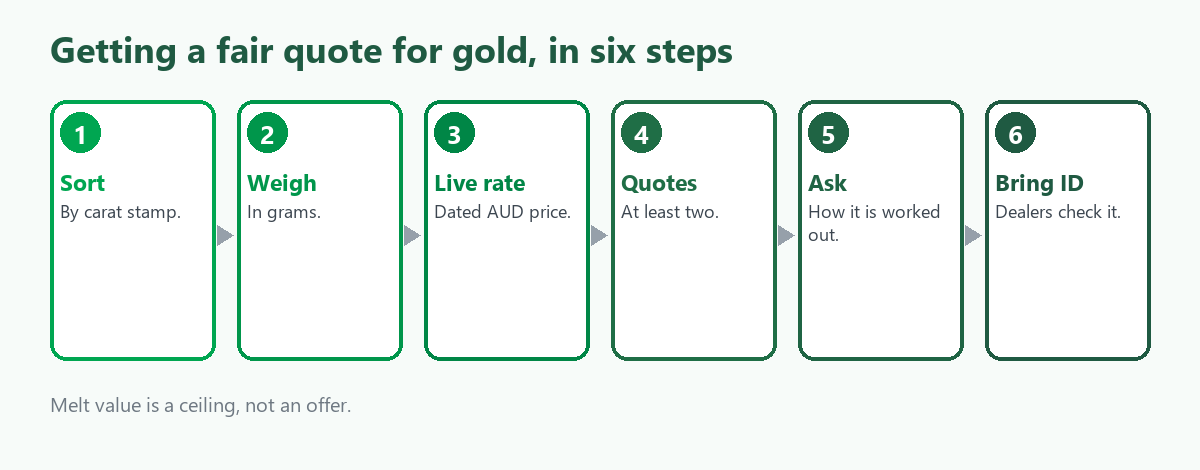
- Sort by carat. Group pieces by stamp and set aside anything unmarked, plated or set with stones.
- Weigh in grams. A kitchen scale works for rough numbers. Note stones and clasps, which a buyer may deduct.
- Check the live rate. Use a current Australian dollar gold price, not a figure from a page that does not show its date. Many calculators online use old or US dollar prices.
- Get at least two quotes. Ask each buyer for the weight they measured, the purity they assumed and their payout percentage.
- Ask what is not included. Fees, deductions for stones and any minimum charge.
- Bring ID. Licensed second-hand dealers must check it. See Sell Unwanted or Broken Jewellery in Australia.
When jewellery is worth more than its metal
A well-made, signed or fashionable piece can be worth more whole than melted, and a scrap price ignores that. If a piece has a maker's mark or you think it is antique, get an opinion before it is melted. A retailer, auction house or consignment shop may do better than a melt quote.
Where to sell
- Local gold buyer or jeweller. Fast and usually fair if you compare quotes.
- Pawn shop. Quick, and generally the lowest percentage.
- Bullion or coin dealer. For bars and coins, not usually for jewellery.
- Online marketplaces and consignment. For pieces worth more than metal.
- Trade marketplace. For accumulated scrap and business lots.
Where ScrapTrade fits
A trade marketplace is not the place for a single ring. The gold sellers it suits hold a lot: a jeweller with months of broken chain and filings, a repairer with a jar of old findings, or an estate clearing a box of mixed scrap. A lot like that is priced by weight and purity, which a trader can do from a clear description, and the retail shop on the corner has less appetite for it. ScrapTrade lists precious metals among its twelve categories, and its buyers are verified traders in more than 50 countries. Listing is free and takes no commission. You post photos with weights and carat marks, set a price, negotiate in real time and agree collection or shipping, including insurance, with the buyer. An accepted bid triggers the buyer's 5 percent deposit, held in escrow. Businesses and individuals can both sell after verification. We could not confirm how purity is tested on ScrapTrade, so ask cs@scraptrade.com.au.
What we could not verify
- The current gold price in Australian dollars. The figures we found conflicted.
- Buyer payout percentages. They come from dealers' own pages.
- How buyers test purity. We found no source.
- How ScrapTrade tests or insures precious-metal parcels.
- ScrapTrade's verification steps. Ask support at cs@scraptrade.com.au.
Frequently asked questions
How is scrap gold valued?
Weight times purity times the gold spot price per gram times the buyer's payout percentage.
What is 18 carat gold worth compared with 24 carat?
It is 75 percent gold, so at the same weight it holds three quarters of the metal.
Is it better to sell to a pawn shop or a gold buyer?
Pawn shops generally pay a lower percentage of gold value, according to one dealer source, so compare quotes.
Can I sell scrap gold on ScrapTrade?
Precious metals are a category, and businesses and individuals can sell after verification. Ask support about testing.
Sources
- Ubersuggest keyword data for Australia, queried November 2026.
- Australian gold-dealer pages and calculators on melt value, purity and payout percentages, as summarised in search results.
- ScrapTrade website, accessed November 2026.
This is general information, not financial advice. ScrapTrade is a scrap marketplace.