

A shipping container is a rare thing in the scrap world: a steel object that also has a market as a container. That market is mostly dealers selling to people who want storage, and their listings tell you what a container is worth to a buyer, not what a dealer will pay you. This guide covers what we could find on the grades, how a seller should think about dealer versus direct sale versus scrap, and what to ask. We found no Australian scrap rate for a container, and the dealer prices we saw are retail, so we give no prices. It sits beside our guides to selling used commercial and industrial equipment and salvaged structural steel. ScrapTrade runs a scrap marketplace and has a commercial interest in the scrap trade.
Grades
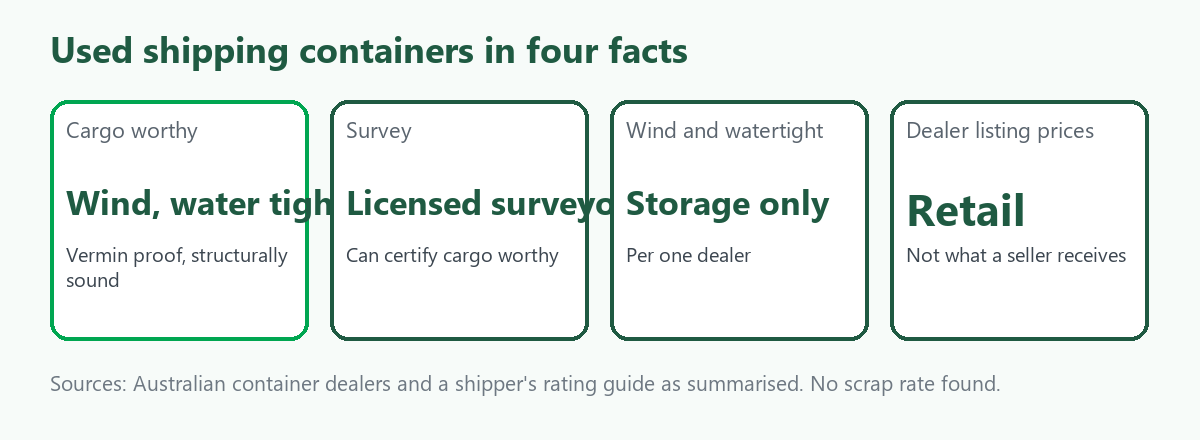
Dealers grade containers by condition. One Australian dealer defines cargo worthy as wind and water tight, vermin proof and structurally sound, and says its cargo-worthy units run up to about 15 years of age and may show surface rust, dents and patched repairs. Another source says cargo-worthy containers can be certified by a licensed surveyor and used to carry cargo again. Another dealer lists wind and watertight units as stored-use only. A grading guide from a container dealer describes grades as an indication of condition. Terms differ between dealers, so ask what each one means by its grade and whether it has a survey.
Types and sizes
Dealer listings show how buyers search: by length, 20 foot or 40 foot, and by type, such as general purpose, high cube, pallet-wide high cube, double-door and bolster. A seller who knows which type they hold, and its length, can compare quotes more accurately, because a high cube and a general purpose container of the same length are listed separately. Check the markings on the container for its size and type, and tell each buyer.
What a seller should check
- Doors, seals and locking bars. Do they work?
- Floor. Is it sound, or rotted, patched or contaminated?
- Roof and walls. Look for holes, heavy rust and dents.
- Age and markings. The container's identification and any records.
- What it carried. Contamination can matter, and we did not research it.
Dealer, direct sale or scrap
- To a container dealer. We found only dealer listings, which show what they charge buyers and not what they pay sellers. Dealers typically pay less than their retail prices, and their prices exclude delivery, which is quoted separately by distance. Get several quotes.
- Direct to a buyer who needs storage. More money in principle, and the work of listing, showing and loading falls on you.
- To a scrap yard. A container that is damaged or unsellable is steel by weight. We found no scrap rate, so ask a yard for a per-tonne rate and tell it the container's size and approximate weight.
One container marketplace says cargo-worthy containers are likely to hold or even gain value when resold, though some repairs may be needed first. That is a seller's view, and we could not check it.
Moving it
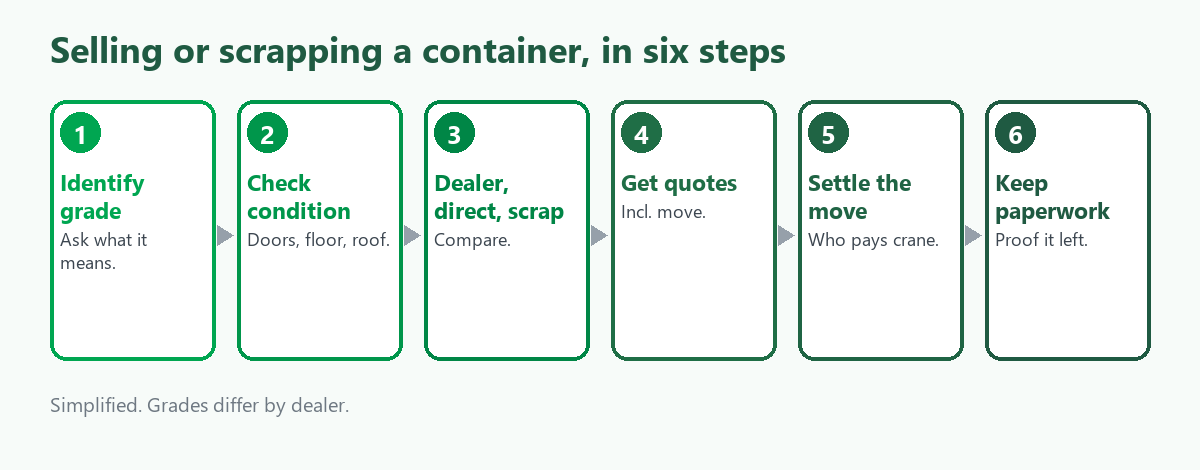
A container is heavy and needs a crane, a tilt tray or a similar vehicle, and delivery is a real cost. We found no source on the cost of collection, and the dealers we saw quote delivery separately. Ask any buyer who is paying for the move, and whether there are access limits at your site.
Questions to ask
- Dealer: What do you pay for this size and grade, and do you collect?
- Dealer: What do you mean by cargo worthy, wind and watertight or one-trip, and is it surveyed?
- Yard: What is your rate per tonne, and what weight do you assume?
- Any buyer: Who pays for the crane and the transport?
- Anyone: What paperwork do you need from me?
Where ScrapTrade fits
A container is a bulky object that suits a dealer or a yard, and ScrapTrade is not a container marketplace. A fabricator, a builder or a business with several containers, or a lot of sorted steel from a site, may find it useful: listing is free with no commission, price and terms are negotiated in chat and the buyer's 5 percent deposit is held in escrow once a bid is accepted. Businesses and individuals can sell after verification, and buyers in more than 50 countries bid. Whether whole containers are accepted, and how freight would work, is something we could not confirm, so ask cs@scraptrade.com.au first.
What we could not verify
- What any container fetches from a dealer, a buyer or a yard. We give no prices.
- An Australian scrap rate for containers.
- What dealers pay sellers. The listings we saw are retail.
- The cost of collection and crane hire.
- Whether ScrapTrade accepts whole containers.
Frequently asked questions
What does cargo worthy mean?
One Australian dealer defines it as wind and water tight, vermin proof and structurally sound, and says a licensed surveyor can certify it.
Can I scrap a shipping container?
Yes, as steel by weight. We found no rate, so ask yards.
Is the dealer's advertised price what I will get?
No. Those are retail prices, and dealers typically pay less.
Who pays for moving it?
Usually the buyer or you by agreement, and dealer prices exclude delivery. Settle it in writing.
Can I list a container on ScrapTrade?
Verified sellers can list scrap. Ask support about whole containers.
Sources
- Australian container dealer listings and grading guides, a container shipper's rating guide and a dealer blog, as summarised in search results. These are retail sources.
- ScrapTrade website, accessed November 2026.
General information only, not financial advice. Grades and terms vary by dealer.