

A business that closes, upgrades or moves ends up with equipment it no longer needs: a restaurant kitchen, a workshop lathe, a shopfit, a row of desks, a pallet of surplus stock. Selling it is a different problem from selling a phone or a car. The buyers are fewer and more specialised, the paperwork is heavier, and the safety rules can follow the goods. This guide is the hub for that family. It explains what search data does and does not tell us, how to grade equipment, the legal checks that matter, the routes compared and where ScrapTrade fits. It is written for owners, managers, liquidators and tradespeople in Australia. We publish no prices, because we found no reliable source for second-hand equipment values, and we say where our evidence stops. ScrapTrade operates a scrap marketplace and has a commercial interest in the scrap trade.
What the search data says
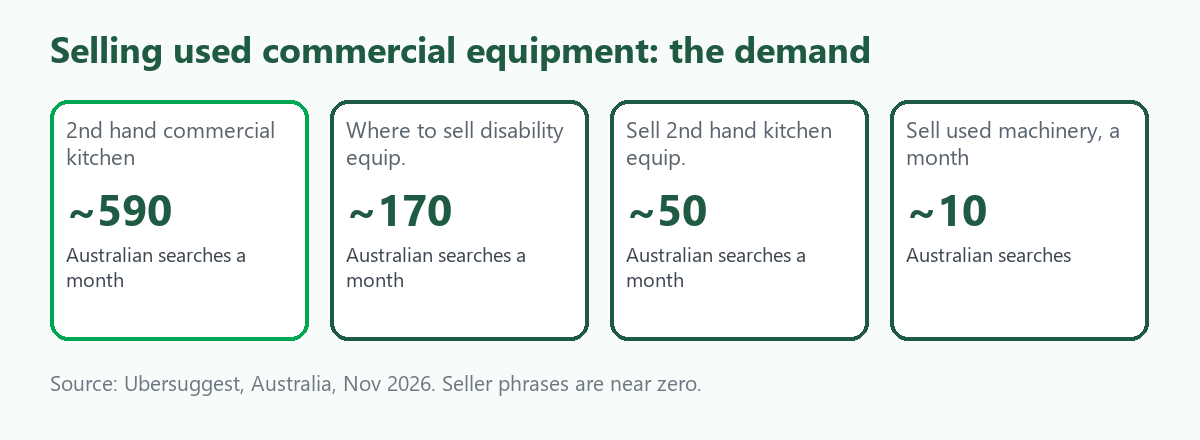
This is the thinnest keyword family we have mapped, and we think it is better to say so. Ubersuggest data for Australia, pulled in November 2026, shows almost no searches for the seller phrases: "sell used machinery", "where to sell used machinery" and "sell old machinery" are each about 10 a month, and "sell used commercial kitchen equipment" is also about 10. The volume sits on the buyer side.
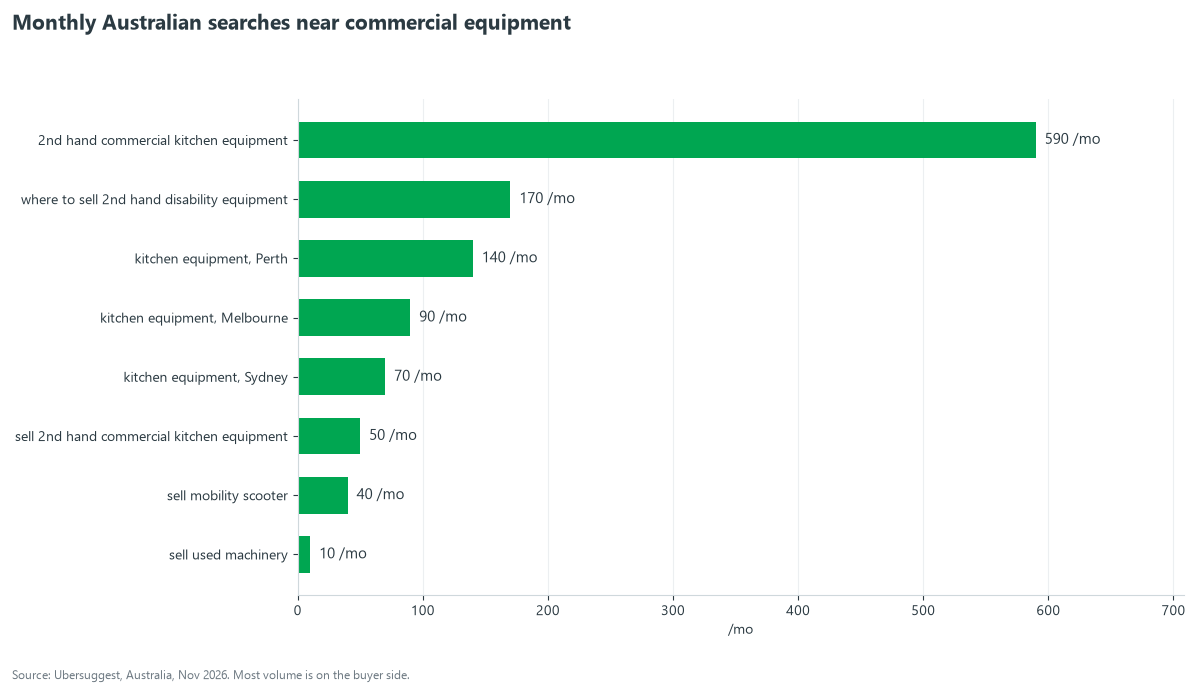
"Second hand commercial kitchen equipment" is searched about 590 times a month, with city versions of 140 in Perth, 90 in Melbourne, 70 in Sydney and 50 in Brisbane. "Sell second hand commercial kitchen equipment" is about 50 and "where to sell second hand disability equipment" about 170. Many other phrases we tried, including "sell used forklift", "sell used shop fittings" and "sell surplus stock", returned no volume at all. Two lessons follow. First, these pages will not win traffic from volume, and their value is authority and the long tail. Second, most equipment is sold by people who never search for how, so a clear process and an honest account of the rules is what they need when a deal is real.
Step 1: Grade the equipment
Four grades cover most items, and the grade decides the route:
- Serviceable. Working, safe and complete, with records. It can be sold as equipment to a user.
- Repairable. A known fault or a missing part. A repairer or a dealer with a workshop may take it.
- Spares. Not worth repairing, but components such as motors, controllers, panels or tooling are useful.
- Scrap. Beyond use, valued for the metal it contains. See Where Old Stainless Steel Goes After Selling and Where Old Copper Wire Goes After You Sell It.
Write down the make, model, serial number, age and hours or condition, and keep the manual and service history. Buyers pay for evidence.
Step 2: Run the legal checks
Four checks come up repeatedly in Australia, and each is covered in a cluster guide:
- Finance and security interests. A search of the Personal Property Securities Register by serial number and against the seller shows whether a lender holds an interest, and law-firm guides say a buyer who searches correctly will in most cases take the goods free of it. Leased gear is not yours to sell.
- Safety duties for plant. Safe Work Australia says anyone supplying second-hand plant has duties to take reasonable steps to make it safe, to disclose faults and condition, and to notify a buyer in writing when plant is sold as scrap or spares and should not be used as plant. See Sell Used Machinery and Industrial Equipment.
- Gas and refrigerant rules for kitchens. Selling a non-certified gas appliance, including a second-hand one, is an offence, according to the Gas Technical Regulators Committee, and refrigerant recovery is regulated. See Sell Second-Hand Commercial Kitchen Equipment.
- Tax. A GST-registered business generally charges GST on a sale of business equipment, and depreciated assets can trigger an income tax adjustment. See Sell Business Equipment When You Close Down.
We are not lawyers or tax advisers, we relied on regulators' pages and search summaries, and the rules vary by state, so confirm what applies to you.
Step 3: Choose a route
- A dealer or broker. Takes stock quickly for a margin. Good for common, serviceable equipment.
- An auction or liquidator. Suits a closure with many items, with fees and little control over price.
- A direct sale to a user. The best price in theory, with the most effort and the most responsibility.
- A classifieds or specialist marketplace. Suits single items such as a mobility scooter, covered in Sell Second-Hand Mobility and Disability Equipment.
- A scrap or spares buyer. The floor for anything that cannot be used, and the right route for metal, motors and wire.
- A trade marketplace. For scrap and spares lots, as the next section explains.
Why sell on ScrapTrade
ScrapTrade is a marketplace for scrap and recyclable material. That describes where it fits, and it does not fit everything in this guide. The case for it is practical:
- The buyers are traders. ScrapTrade describes its buyers as verified traders and buyers in more than 50 countries. Metal recyclers, spares traders and exporters look for the lots that a local auction prices badly.
- Listing is free and there is no commission. You create a listing in minutes, add photos, set a price and use the built-in AI to help write the description.
- You keep control of price and terms. You chat and negotiate in real time and agree collection or shipping directly, with terms such as EXW and FOB in Australian or US dollars. Heavy equipment makes collection terms important.
- Payments are protected. After a bid, the buyer's 5 percent deposit is held in escrow, and it stays on hold once the bid is accepted. Payments are handled through Stripe.
- Sellers are verified. ScrapTrade runs identity and business verification on sellers, and both businesses and individuals can sell.
How it works, step by step
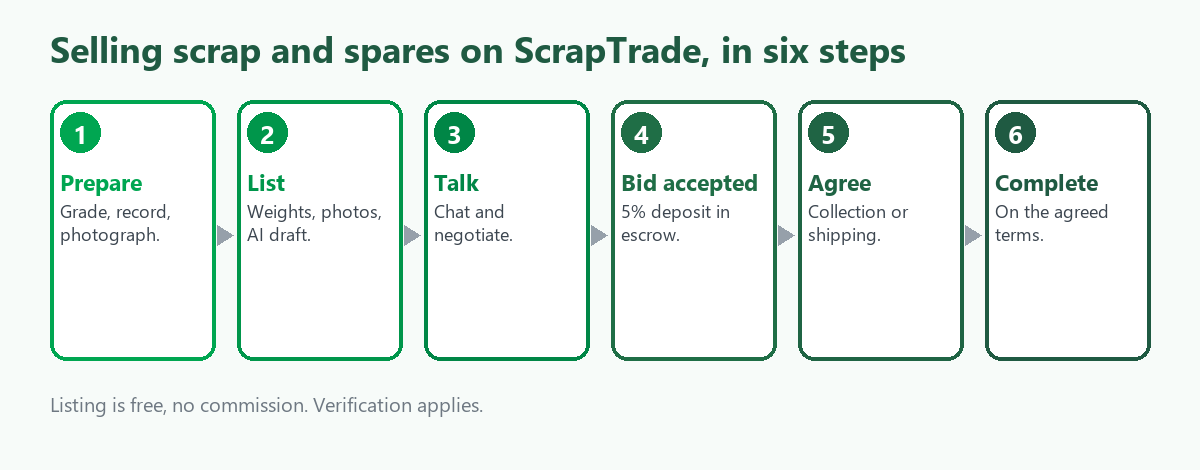
- Prepare. Grade the equipment, record the models and weights, and photograph each item.
- List. Create an account, complete verification, and create a listing with photos, quantities and price. The AI helper can draft the text, which you should check.
- Talk. Buyers send inquiries. You chat and negotiate in real time.
- Bid accepted. When you accept a bid, the buyer's 5 percent deposit is held in escrow.
- Agree logistics. You and the buyer agree collection or shipping, including who loads heavy items.
- Complete. The sale is completed on the terms agreed.
Where it does not fit
Be realistic. A working commercial oven for another restaurant, a serviceable forklift for a warehouse or a mobility scooter for a household is usually better sold to a user through a dealer, auction or specialist marketplace, where the buyer wants the item to work. We could not confirm whether working equipment can be listed on ScrapTrade as equipment, as opposed to scrap or spares, so ask the team before you plan around it. The sweet spot is scrap and spares: a closure's stainless benches, a plant's motors and cable, retired machinery sold by weight, or a pile of dead equipment that has no local buyer. For any question not answered here, including verification steps, contact cs@scraptrade.com.au.
Which guide to read next
- Sell Second-Hand Commercial Kitchen Equipment for gas certification, refrigeration and restaurant closures.
- Sell Used Machinery and Industrial Equipment for plant safety duties, PPSR and scrap.
- Sell Business Equipment When You Close Down for GST, shop fittings, office furniture and surplus stock.
- Sell Second-Hand Mobility and Disability Equipment for scooters, wheelchairs and NDIS equipment.
- Sell Broken, Faulty or Old Electronics, Sell an Old, Broken or Unwanted Car or Parts and Sell Old Gold, Silver and Jewellery for the same approach with other stock.
- Scrap business rules in Australia by state for the wider scrap rules.
Selling equipment to a buyer in another country? The international guide covers import-rule checks and inspections. Sell Used Machinery and Equipment Worldwide.
What we could not verify
- What used equipment sells for. We found no reliable price source.
- Search volume for seller phrases. It is near zero, so we cannot size the market.
- State differences in safety and gas rules. We relied on national and Victorian pages.
- Whether ScrapTrade lists working equipment as equipment. Ask support at cs@scraptrade.com.au.
- ScrapTrade's verification steps. They are not public.
Frequently asked questions
How do I sell used commercial equipment in Australia?
Grade it, record the model and serial numbers, check for finance, then choose a dealer, auction, direct sale or scrap buyer. Disclose faults and confirm safety and tax rules.
Do I have to charge GST when I sell business equipment?
A GST-registered business generally charges GST on a sale of business equipment, according to the ATO. Check your case.
Can I sell equipment for scrap or spares?
Yes, but Safe Work Australia says plant sold as scrap or spares should be marked or notified in writing as such.
Can I sell equipment on ScrapTrade?
It is a scrap and recyclable material marketplace. Businesses and individuals can sell after verification, and listing is free with no commission. Ask support whether working equipment suits it.
Do I pay anything to list?
No. Listing is free with no commission. A buyer's 5 percent deposit is held in escrow after a bid is accepted.
Sources
- Ubersuggest keyword data for Australia, queried November 2026.
- Safe Work Australia, "Plant: WHS duties" and the model code of practice on managing the risks of plant, as summarised in search results.
- Gas Technical Regulators Committee and Energy Safe Victoria guidance on second-hand gas appliances, as summarised in search results.
- Australian Taxation Office guidance on GST and the disposal of capital assets, as summarised in search results.
- Law-firm guides to PPSR searches for plant and equipment, as summarised in search results.
- ScrapTrade website, accessed November 2026.
This is general information, not legal, safety or tax advice. Rules differ by state and change, so check with the relevant authority. ScrapTrade operates a scrap marketplace and has a commercial interest in the scrap trade.