

Timber and bricks from a demolition are not scrap metal, and this guide is outside the scrap trade in the narrow sense. But anyone clearing a building ends up with both, alongside the steel and aluminium, and the question is the same: can it be sold, or does it have to be thrown away? This guide covers what we could find on reclaimed timber and bricks in Australia, the treated timber that is hard to dispose of, and what to ask a salvage yard. The sources were thin on what yards actually buy, and nothing we found covered old lead paint on timber, so we give no prices and say where we looked and found nothing. ScrapTrade runs a scrap marketplace and has a commercial interest in the scrap trade.
Who buys
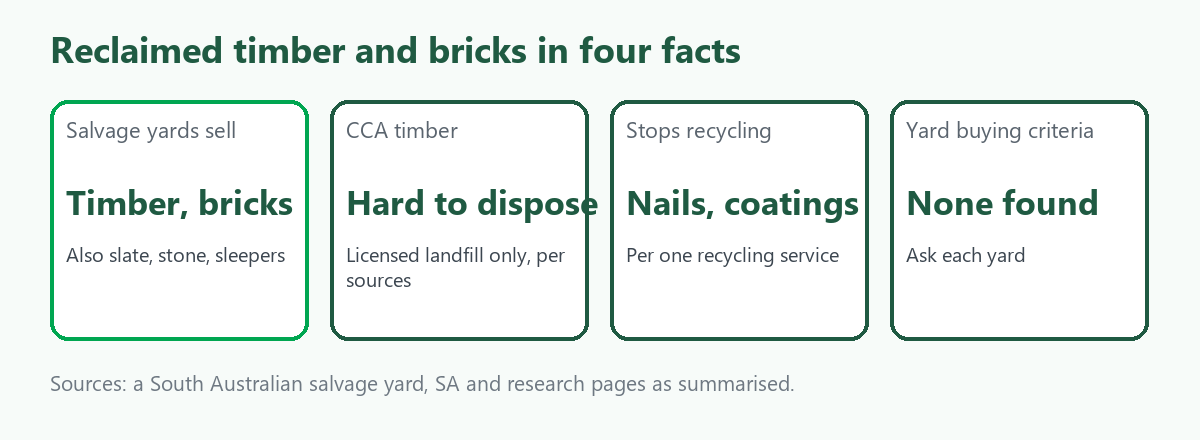
Salvage yards sell reclaimed material. One South Australian yard lists salvaged recycled timber and floorboards, sleepers, fencing, plywood and sheet board, concrete blocks, bricks, slate and stone, and offers machining on site. That shows there is a market for reclaimed timber and bricks, but it does not tell us what a yard pays or what it will accept. We found no yard's buying criteria. Ask salvage yards, demolition recyclers and timber merchants, and expect them to want photos, quantities and the original use.
Treated timber is the problem
Timber treated with copper chrome arsenic, or CCA, is hard to dispose of in Australia. CCA timber can be landfilled but cannot be burned except in specially licensed facilities, and in South Australia the only available disposal route for CCA posts is a suitably engineered and licensed landfill, according to the sources. The main research is on vineyard posts, and reuse ideas under study include chipped treated timber in particleboard and posts for agricultural and landscaping uses. Yards are unlikely to take CCA timber, and any that do would need to check state rules, which is our reading. The South Australian green industries page on treated timber is a place to start. We could not tell from the sources how to identify CCA timber on a demolition site, so ask a supplier or your state EPA before you list treated timber for sale or send it to a yard.
Nails and coatings
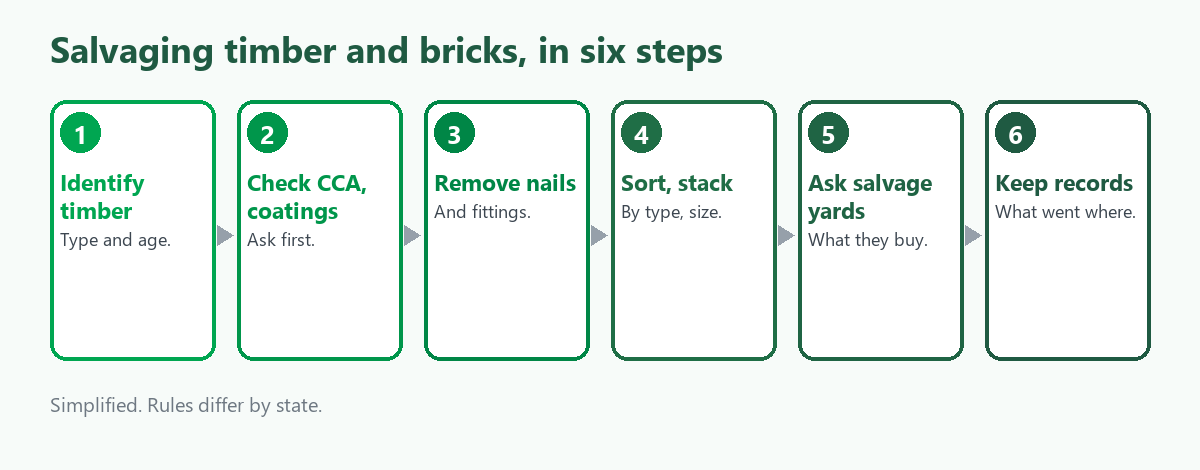
A recycling service lists the contaminants that stop timber being recycled: nails, metal connectors, plastic wrapping, dirt and sand, and paint, oil and other coatings. That is a recycler's rule and not a salvage yard's, but it suggests that denailing and cleaning matter for any buyer. A NSW EPA page says old coats of paint, dust or even soil may contain lead, and it does not cover salvage handling. So the question of old painted timber is unresolved, and we would ask your state EPA or WorkSafe before you strip or sell it.
Bricks and other masonry
The same yard sells concrete blocks, bricks, slate and stone, which tells us there is a market for masonry. We found nothing on how to clean mortar from bricks, how yards value them or what they accept. Ask a yard whether it wants them cleaned and palletised.
Metal from the same job
A demolition yields metal as well. The nails and fittings you take off timber, along with steel, aluminium and copper, are scrap and belong in separate piles. Our guides to scrap roofing iron, old aluminium windows and doors and salvaged structural steel cover the metals, and our guide to selling business equipment when you close down covers the wider clear-out.
Questions to ask a salvage yard
- What timber do you buy, and in what lengths and condition?
- Do you take treated or painted timber? Expect the answer to be no for CCA.
- Do you want nails removed and the timber stacked?
- Do you buy bricks, and do they need cleaning?
- Do you collect, and do you pay or take it for free?
Where ScrapTrade fits
ScrapTrade is a scrap marketplace, and we have no confirmation that timber or bricks are accepted. It may help with the metal from the same site: a demolition contractor with sorted steel, aluminium, copper and brass can put it in front of verified buyers, with free listing and no commission, terms agreed in chat and the buyer's 5 percent deposit held in escrow after a bid is accepted. Businesses and individuals can sell once verified, and traders in more than 50 countries bid. For timber and bricks, use a salvage yard, and ask cs@scraptrade.com.au if you want to check what the platform takes.
For pallets left over from a clear-out, see Sell Used Pallets in Australia.
What we could not verify
- What any salvage yard pays or accepts. We give no prices.
- How to identify CCA timber on site.
- Handling and disposal of lead-painted timber.
- How to value or clean salvaged bricks.
- Whether ScrapTrade accepts timber or masonry.
Frequently asked questions
Can I sell reclaimed timber?
Salvage yards sell it, and we found no yard's buying criteria, so ask them.
What is wrong with CCA timber?
It is hard to dispose of: it can be landfilled at licensed sites and cannot be burned except in specially licensed facilities.
Do I need to remove the nails?
Nails and metal connectors stop timber being recycled, according to one recycling service, so remove them or ask.
Can I sell old bricks?
Salvage yards sell bricks, but we found nothing on what they accept.
Can I list timber on ScrapTrade?
We could not confirm. It trades scrap metal, so ask support.
Sources
- A South Australian salvage yard listing, South Australian green industries and EPA pages on treated timber, University of the Sunshine Coast and Wine Australia research on treated timber, and a recycling service's contaminant list, as summarised in search results.
- NSW EPA page on lead in old paint, as summarised in search results.
- ScrapTrade website, accessed November 2026.
General information only, not safety, legal or financial advice. Rules differ by state.