

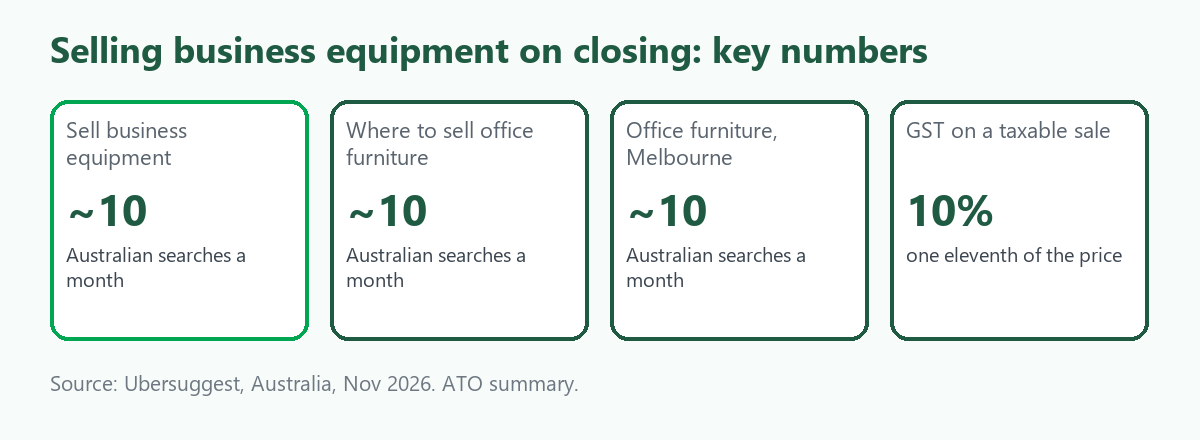
"Sell business equipment" and "where to sell used office furniture" are each searched about 10 times a month in Australia, according to Ubersuggest, and "sell used shop fittings", "sell surplus stock" and "sell excess inventory" returned nothing measurable. The people who need this guide rarely search for it. They are closing, downsizing or merging, and have a short window to clear a lease. The sale of equipment is also a tax event, and mistakes show up later in an activity statement or a tax return. This guide covers the sequence, the GST and tax points and the routes for each kind of item. It belongs to our guide to selling used commercial and industrial equipment. We give no prices, because we found no reliable source, and ScrapTrade has a commercial interest in the scrap trade.
Step 1: List every asset
Walk the premises and list what you have in groups: kitchen or workshop equipment, shop fittings and shelving, office furniture, computers and phones, vehicles, tools and surplus stock. Next to each item write whether you own it outright, owe money on it or lease it. Leased gear goes back to the lessor, and financed gear needs the lender's release before it can be sold, as our machinery guide explains.
Step 2: Check the tax before you sell
The Australian Taxation Office says that if you are registered, or required to be registered, for GST and you sell a capital asset, it is generally a taxable sale and you account for GST on it, reporting the amount at G1 on your activity statement. At 10 percent, the GST in a GST-inclusive price is one eleventh of it. Selling a depreciated asset can also produce a balancing adjustment that raises or lowers your taxable income, and capital gains tax can apply to assets acquired after 19 September 1985, with small business concessions in some cases that we did not retrieve. Selling the whole business as a going concern can be GST-free, and the ATO suggests a private ruling to confirm eligibility. When you close, the ATO also expects you to cancel your GST registration and to include adjustments for assets you keep on your final activity statement. This summary comes from search results of ATO pages, and we are not tax advisers, so speak to your accountant before the sale, not after it.
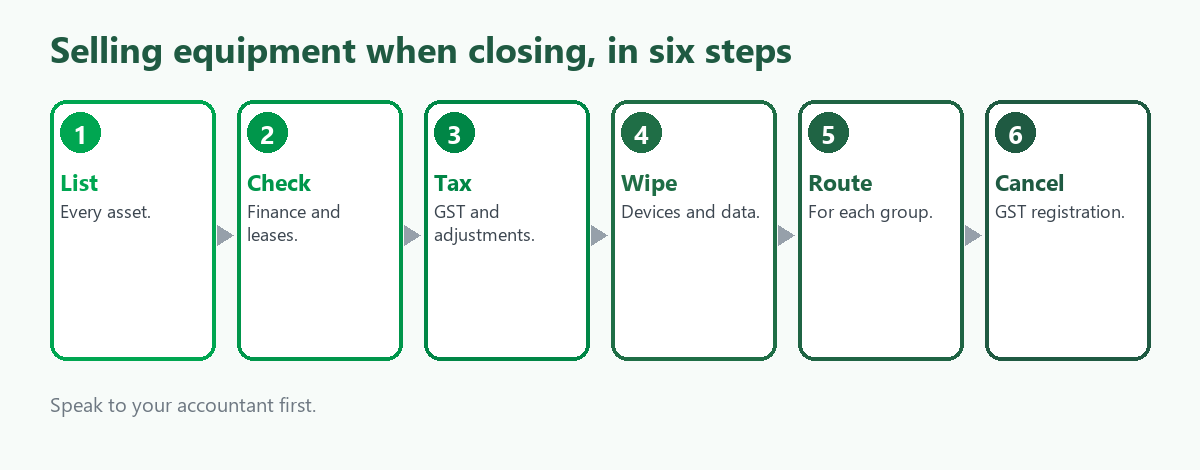
Step 3: Clear data and compliance
Computers, phones, tablets, point-of-sale terminals and cameras hold customer and business data, so wipe or destroy them before they leave. Our guides to selling an old or broken laptop and selling broken electronics cover the steps. Gas appliances and refrigerated units have their own rules, covered in Sell Second-Hand Commercial Kitchen Equipment. Check your lease for make-good obligations, because fixed fittings may need to be removed or left.
Step 4: Choose a route for each group
- Shop fittings, shelving and display units. Sell to another retailer or fit-out business, through classifieds or a specialist dealer. Offering collection, or dismantling, may help the sale.
- Office furniture. Sold to a dealer, an auction or direct buyers. Quantity helps, and desks and chairs in matching sets are easier to sell.
- Equipment and tools. To users through a dealer, auction or direct, or as scrap and spares if there is no use left.
- Computers and electronics. To a refurbisher or recycler after wiping.
- Surplus stock. Back to the supplier, to a liquidator or clearance buyer, or online. The right buyer depends on the goods.
- A liquidator or auctioneer. For the whole premises, with fees and less control over price.
- A scrap buyer. For metal fixtures, racking, stainless and wire.
Where ScrapTrade fits
A closure produces a mixed pile, and most of it has a better buyer than a scrap marketplace: furniture to a dealer, stock to a liquidator, computers to a refurbisher. What ScrapTrade is for is the metal: racking and steel shelving, stainless benches, cable, motors and equipment that is beyond use, sold by weight to traders who buy scrap. It has verified traders in more than 50 countries, listing is free and carries no commission, and you can negotiate in real time and agree collection or shipping terms directly, which matters when a landlord wants the space cleared. After you accept a bid, the buyer's 5 percent deposit stays in escrow. Both businesses and individuals can sell after verification. A business that is selling scrap to another registered business should check the GST treatment, covered in our bulk precious metals guide for gold, silver and platinum and in the ATO guidance for other scrap. We could not confirm whether ScrapTrade lists furniture or shop fittings, so ask cs@scraptrade.com.au first.
What we could not verify
- What used equipment, fittings, furniture and stock sell for. We found no reliable source.
- The small business CGT concessions. We did not retrieve the details.
- GST treatment of scrap sales between businesses, outside precious metals. Ask your accountant.
- Whether ScrapTrade lists furniture or shop fittings.
- ScrapTrade's verification steps. Ask support at cs@scraptrade.com.au.
Frequently asked questions
Do I charge GST when I sell business equipment?
If you are registered for GST, a sale of a capital asset is generally taxable, according to the ATO. Check your case.
What happens to my GST registration when I close?
The ATO says to cancel it, and to make adjustments on your final activity statement for assets you keep.
Can I sell leased equipment?
No. Leased equipment belongs to the lessor and goes back to them.
What do I do with shop fittings nobody wants?
Sell the metal as scrap, such as racking and steel shelving, and check your lease for make-good obligations.
Sources
- Ubersuggest keyword data for Australia, queried November 2026.
- Australian Taxation Office, "GST and the disposal of capital assets" and guidance on closing or selling a business, as summarised in search results.
- Law-firm guides to PPSR searches for equipment, as summarised in search results.
- ScrapTrade website, accessed November 2026.
This is general information, not tax or legal advice. Tax rules change, so confirm with the ATO or your accountant. ScrapTrade is a scrap marketplace.