

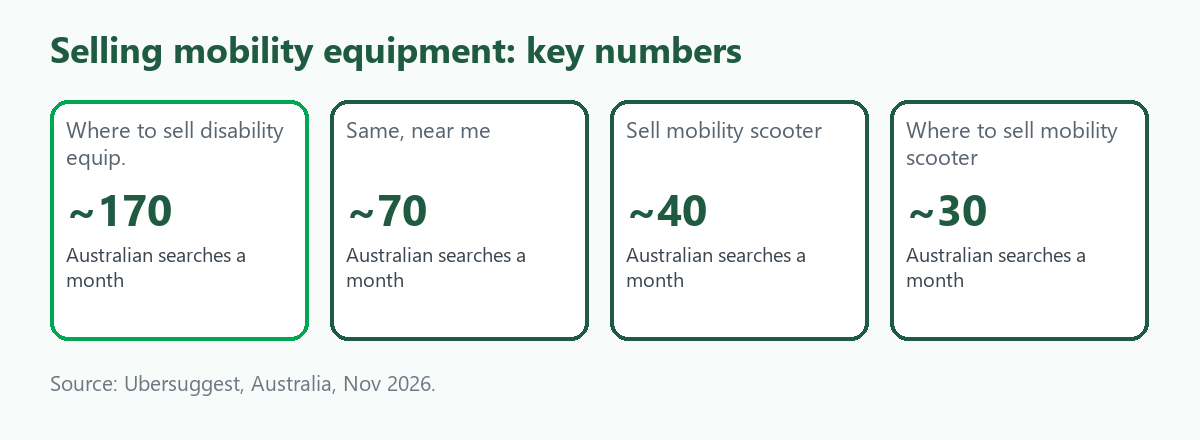
"Where to sell second hand disability equipment" is searched about 170 times a month in Australia, according to Ubersuggest, with about 70 more for the "near me" version, about 40 for "sell mobility scooter" and about 30 for "where to sell mobility scooter". Advertising on these phrases costs under A$2 a click, which suggests few businesses are buying them. The searchers are mostly households, and often families clearing equipment after a person has recovered, moved into care or died. That makes this a sensitive subject and one where ScrapTrade is rarely the right answer, so this guide says so plainly and explains the better routes. It belongs to our guide to selling used commercial and industrial equipment. We give no prices, because we found no reliable source, and ScrapTrade has a commercial interest in the scrap trade.
Who owns the equipment
Equipment bought with NDIS funding belongs to the participant, according to one disability-equipment retailer, who can keep it or pass it on when it no longer suits them. The same sources warn that getting rid of equipment you still need may mean the NDIS will not fund a replacement, and recommend checking with your planner or support coordinator before selling. If the equipment was loaned or hired, it is not yours to sell. If you are selling on behalf of an estate, confirm who has authority. We found these points in retailer and plan-manager guides and not on an NDIS page, so check the NDIS before you act.
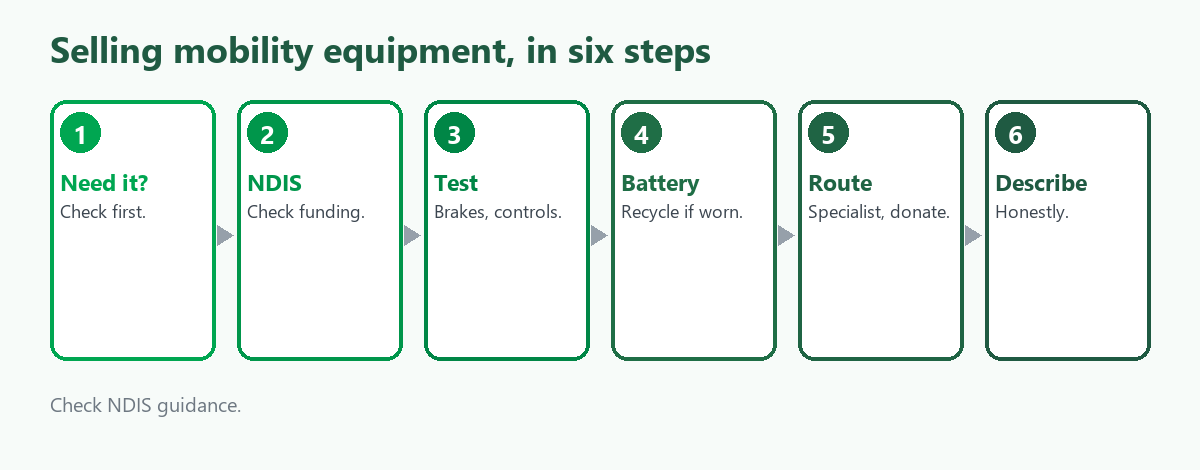
Step 1: Decide whether to sell, donate or return
A scooter or chair that still works may be needed by someone else, and several organisations take donations of usable mobility equipment. One large supplier says it has no licence to take on second-hand goods, so ask before you assume a retailer will take it back. Selling is an option when the item is in good condition and the price matters.
Step 2: Check it before you sell it
Test the equipment safely, and be honest about what does not work. Check the brakes, the controls, the seat and the frame, and the charger and battery. A buyer is trusting the equipment with a person's mobility, so a thorough description matters more than usual, and a fault you did not mention could cause harm and a dispute. We did not find a source on whether the Therapeutic Goods Administration regulates the resale of second-hand mobility devices, so ask it directly if you are a business selling them.
Step 3: Handle the battery
Mobility scooters and powered chairs commonly use rechargeable batteries. Lead-acid and lithium batteries need different handling, and a worn battery is a common reason a scooter is hard to sell. A battery that has reached the end of its life should be recycled and not put in the bin. See Sell an Old Car Battery in Australia for the lead-acid side, and ask a specialist about lithium.
Where to sell
- A specialist second-hand equipment marketplace or reseller. Built for this audience, and several list mobility scooters.
- General classifieds. Gumtree and eBay are used, according to retailer guides, with less specialist screening of buyers.
- A local organisation or charity. For donation, often with collection.
- A mobility dealer. Some will buy or take trade-ins on a newer model. Ask.
- A buyer's plan. Self-managed and plan-managed buyers may be able to use plan funds for second-hand equipment within cost limits, according to one plan-manager guide, so keep a receipt with your details.
Where ScrapTrade fits
For one scooter, one wheelchair or one hospital bed, ScrapTrade is not the right place, and we would send you to a specialist reseller, a charity or a dealer. The cases where it is relevant are narrow: a provider, hire company or supplier clearing a number of units that are beyond use and need to go as metal and batteries, or a business holding lots of end-of-life lead-acid batteries. For those, ScrapTrade has a batteries category and verified traders in more than 50 countries, listing is free with no commission and sellers agree collection terms directly. The buyer's 5 percent deposit is held in escrow once a bid is accepted, and businesses and individuals can sell after verification. We could not confirm how ScrapTrade treats used medical or disability equipment, or whether any rules apply to listing it, so ask cs@scraptrade.com.au first.
What we could not verify
- What second-hand mobility equipment sells for. We found no reliable source.
- NDIS rules on resale. We relied on retailer and plan-manager guides.
- TGA rules for reselling second-hand devices.
- How ScrapTrade treats medical or disability equipment.
- ScrapTrade's verification steps. Ask support at cs@scraptrade.com.au.
Frequently asked questions
Can I sell equipment bought with NDIS funding?
Retailer guides say it belongs to the participant, but check with the NDIS first if you still need equipment, because replacement funding may be affected.
Where can I sell a second-hand mobility scooter?
Through a specialist equipment reseller, general classifieds, a mobility dealer or by donation.
Do I have to test a scooter before selling it?
You should check the brakes, controls, battery and frame, and describe any fault honestly.
What do I do with a worn-out scooter battery?
Recycle it through a battery collection point and do not put it in the bin.
Sources
- Ubersuggest keyword data for Australia, queried November 2026.
- Disability-equipment retailer and plan-manager guides on selling second-hand equipment, as summarised in search results.
- ScrapTrade website, accessed November 2026.
This is general information, not medical, safety or legal advice. Check NDIS and regulator guidance before selling. ScrapTrade is a scrap marketplace.