

Updated 26 October 2026. If you want to understand the global scrap market, start with a country most people know for something else. Turkey is famous for textiles, tourism and Istanbul. In the scrap trade it is something simpler and bigger: the world's largest importer, by a wide margin. In 2024 it brought in about 20.1 million tonnes of recycled steel, according to the Bureau of International Recycling (BIR), more than three times the volume of the next biggest buyer [1][5]. When Turkish mills buy aggressively, scrap prices around the Atlantic rise. When they step back, prices slide, and every seller from Rotterdam to Houston to Fremantle feels it.
This profile looks at the numbers, at who supplies Turkey and how that has changed in 2026, at what sets Turkey apart from other importers, and at the policy questions that hang over it. It uses BIR statistics and Turkish customs data as reported by SteelOrbis. It is general information and not trading advice.
The scale
Two BIR figures put Turkey's position in context. Its mills used 31.3 million tonnes of recycled steel in 2024, up 7.5%, and it imported about 20.1 million tonnes, up 6.7% [1][2]. Taken at face value, that means imports made up roughly two-thirds of the scrap its mills consumed, which is why a Turkish supply problem becomes a global one so quickly. The two figures use different definitions, so treat the ratio as an indication and not a precise share.
In 2026 imports are running a little higher. In the first seven months Turkey bought 11.33 million tonnes, up 4.4%, at a cost of US$4.45 billion, an average of about US$393 a tonne. In the first quarter alone it imported 4.746 million tonnes and kept its place as the world's largest importer [3]. A headline reported that 2025 imports as a whole were down 6.7%, so 2026 is a partial rebound, though we could only confirm the headline [3].
Who supplies Turkey
Turkey's suppliers form a ring around the Atlantic and Baltic.
In 2024, BIR data reported by Recycling Today show the European Union as Turkey's largest source, shipping more than 10.9 million tonnes (up 1.7%), and Egypt next among EU customers at 1.64 million tonnes. The United States sold Turkey nearly 4.43 million tonnes, up 8.9% [4].
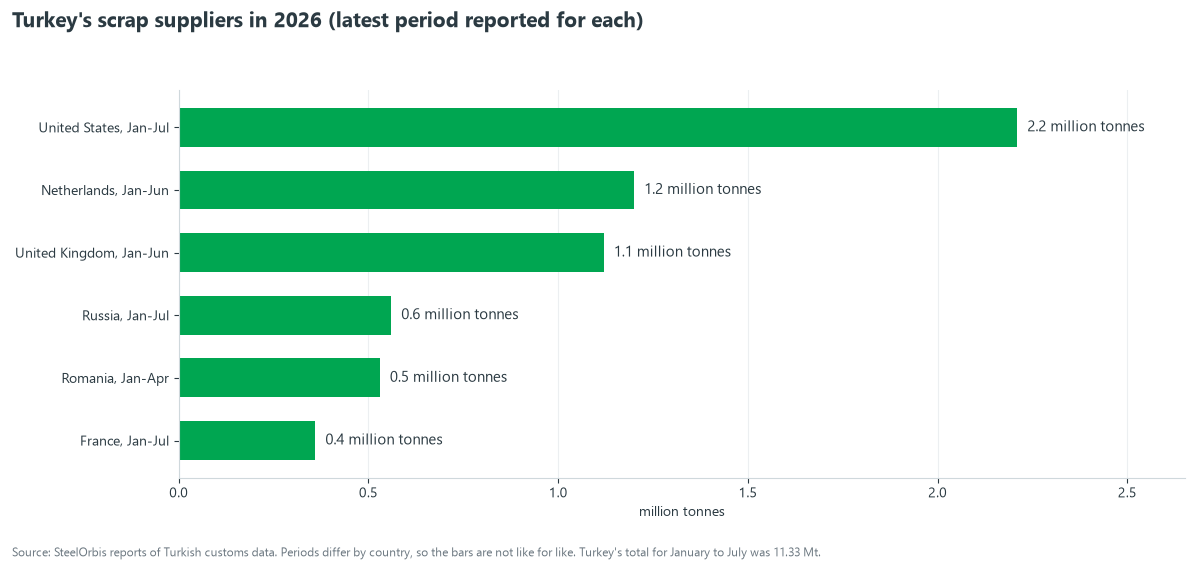
2026 has reshuffled the order. According to SteelOrbis, the United States became Turkey's top supplier in the first four months of the year and held it, supplying 2.21 million tonnes in January to July, up 10.6%. The Netherlands, which led in the same period of 2025, fell to 1.20 million tonnes in the first half, down 20%. The United Kingdom supplied 1.12 million tonnes in the first half, up 20.8%. Russia's shipments rose 23.4% to about 564,000 tonnes in January to July, France's rose 27.1% to about 360,000 tonnes, and Romania's rose 65.6% to about 528,000 tonnes in January to April [3]. The bars above use the latest period reported for each country, so they are not directly comparable.
Two things stand out. The ranking can change in a single year, as the US-Netherlands switch shows. And the growth is coming from the edges: Romania, Russia and France are all growing faster than the traditional suppliers.
Prices and the bellwether effect
Turkey's mills buy against a price they are willing to pay for heavy melting steel, and many traders treat Turkish import prices as a bellwether for scrap across the Atlantic. SteelOrbis reported that prices for HMS 80:20, the common heavy melting steel blend, fell by about 7% in June, based on feedback from Scandinavian suppliers [3]. On an earlier occasion, BIR commentary described a downward correction in scrap prices following heavy buying by Turkey [5]. Together they show how one market sets a tone: Turkey's bursts of buying and pauses ripple outwards.
Why Turkey is different
Three features separate Turkey from other big importers.
- It leans on imports. Turkish mills depend on imports for roughly two-thirds of their scrap, so its demand is a direct pull on world supply.
- It faces a different set of rules. Turkey is a member of the OECD, which puts it outside the European Union's draft list of non-OECD countries that may receive EU metal scrap from May 2027. The European Commission has said it will engage with Turkish authorities and keep monitoring plastic waste exports to Turkey, which are a large share of EU plastic exports to OECD countries. That concerns plastic, not metal, but it shows regulators are watching OECD destinations [6]. See Europe Is Keeping Its Scrap. Who Pays?.
- It buys from three continents. Turkish mills pull scrap from Europe, the Americas and Russia, which is why its purchasing power matters in several regions at once.
What it means for Australian sellers
Australia sells very little scrap to Turkey. In 2025-26 it shipped about 27,000 tonnes there, about 1.1% of its ferrous exports, because Turkey is a long way away and its mills have closer suppliers [7]. Australia's customers are in South and South-East Asia, led by Bangladesh, Indonesia, Vietnam, India and Thailand [7].
But Turkey still matters to Australian sellers in three ways. First, because its buying sets the tone for global steel scrap prices, which influences what buyers in Asia are prepared to pay. Second, because when European and American scrap is displaced by new rules or by tariffs, some of it will compete for the same Asian buyers. Third, as a case study: the shift from the Netherlands to the United States as Turkey's top supplier is a reminder that no supplier has a permanent place. See World Scrap Trade: Top Importers and Exporters for the larger map.
If you are selling steel scrap, the basics apply wherever your cargo goes. Know your grade, check the live price calculator as a reference (it is an indicative estimate and not a quote), and compare offers on the marketplace. See how to grade scrap metal for the HMS grades.
What to watch
| Signpost | Why it matters |
|---|---|
| Monthly Turkish import data | The most direct reading of Turkish demand |
| The US, Dutch and UK shares | Shows which suppliers are gaining |
| Turkish mill buying patterns and HMS 80:20 prices | The bellwether signal for the Atlantic |
| EU decisions on scrap and waste exports | May reroute European material |
| Turkish steel output and export demand | What drives the mills' appetite |
Frequently asked questions
How much scrap does Turkey import?
About 20.1 million tonnes of recycled steel in 2024, according to BIR, and 11.33 million tonnes in the first seven months of 2026 [1][3].
Who sells scrap to Turkey?
The European Union (more than 10.9 million tonnes in 2024), the United States, the United Kingdom, Russia, France and Romania, with the United States the top single supplier so far in 2026 [3][4].
Why does Turkey import so much scrap?
Its steel industry relies heavily on recycled steel, and BIR figures show imports covering roughly two-thirds of its scrap use [1][2].
Is Turkey affected by the EU's scrap export rules?
Not by the draft list for metal scrap, because Turkey is an OECD member, but EU regulators are monitoring plastic waste exports there [6].
Does Australia export scrap to Turkey?
Only a little: about 27,000 tonnes in 2025-26, or 1.1% of ferrous exports [7].
Sources
- BIR, World Steel Recycling in Figures 2020-2024 and BIR Valencia 2025: Ferrous Division statistics release.
- As above for recycled steel usage of 31.273 million tonnes in 2024; the 20.1 million tonne import figure is from BIR as cited in our earlier analysis Europe Is Keeping Its Scrap. Who Pays?.
- SteelOrbis, Turkey's scrap imports recover in January-July 2026; Turkey's scrap imports rise in June 2026 despite sharp drop in US-origin material; US becomes Turkey's top scrap supplier in January-April 2026.
- Recycling Today, Recycled steel trade patterns shift in 2024, reporting BIR statistics.
- SteelRadar, BIR: Downward correction in scrap prices following heavy buying activity in Turkiye.
- Reporting on the European Commission's draft delegated act and plastic waste assessment, as summarised in Europe Is Keeping Its Scrap. Who Pays?.
- Department of Climate Change, Energy, the Environment and Water, Waste exports data collation, September 2026 (ABS records), ScrapTrade calculations.
Figures are as reported by the sources named and use different definitions. This article is general information, not financial or trading advice. ScrapTrade operates a scrap marketplace and has a commercial interest in the scrap trade.