

Updated 26 October 2026. Every day, thousands of containers and bulk carriers leave ports in Rotterdam, Houston, Yokohama, Felixstowe, Fremantle and Melbourne carrying old steel, copper wire, aluminium offcuts and the wreckage of things people no longer want. Most of it is heading for a short list of countries whose mills and smelters have been built around it. Scrap is one of the world's largest recycled commodities, and its trade map is stranger than most people expect: a small group of exporters in Europe, North America and Japan supplies a few big buyers, mostly in Turkey and South and South-East Asia, and the pattern has been moving quickly.
This is a guide to that map. It names the countries that sell and buy the most, with the latest figures we could verify, and then looks at why the flows shift. The numbers come from the Bureau of International Recycling (BIR), customs data as reported by trade press, and Australian export records. The sources use different years and definitions, so the figures are best read as a picture and not a league table.
Who sells the most
The two giants are the European Union and the United States, and they are not close to anyone else.
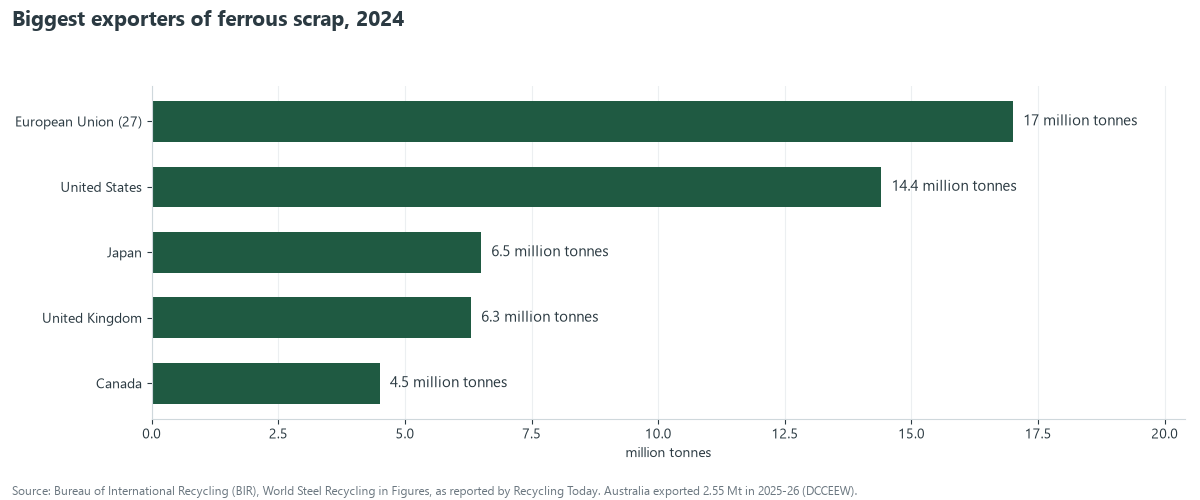
According to BIR statistics reported by Recycling Today, the EU-27 exported 17.0 million tonnes of ferrous scrap in 2024, with the Netherlands its largest single exporter, though that was 11.4% lower than the more than 19 million tonnes of 2023. The United States exported 14.4 million tonnes, down from 16.3 million. Japan (about 6.5 million tonnes), the United Kingdom (about 6.3 million) and Canada (about 4.5 million) followed, all lower than the year before [1].
2025 was harder again for the Americans. BigMint reports that US ferrous scrap exports fell to 12.1 million tonnes, down 16% and the lowest in two decades, because higher tariffs on steel imports strengthened US steelmaking and kept more scrap at home. Turkey stayed the top destination at 3.8 million tonnes, while exports to Mexico fell 45% to 1.17 million tonnes [2]. We cover that in US Scrap Exports Fall to a 20-Year Low.
Japan went the other way. Its ferrous scrap exports rose 22.8% to about 6.4 million tonnes in the first ten months of 2025, with Vietnam taking 2.8 million tonnes, Bangladesh 1.15 million tonnes (up 129%) and South Korea 1.05 million tonnes (down 21%, as a property slump cut its mills' output) [3].
Australia is a smaller but fast-growing seller. It exported 2.55 million tonnes of ferrous scrap in 2025-26, the most in any year of the available records since 2017-18, almost all of it to Bangladesh, Indonesia, Vietnam, India and Thailand [4].
Who buys the most
On the buying side, one country is in a class of its own.
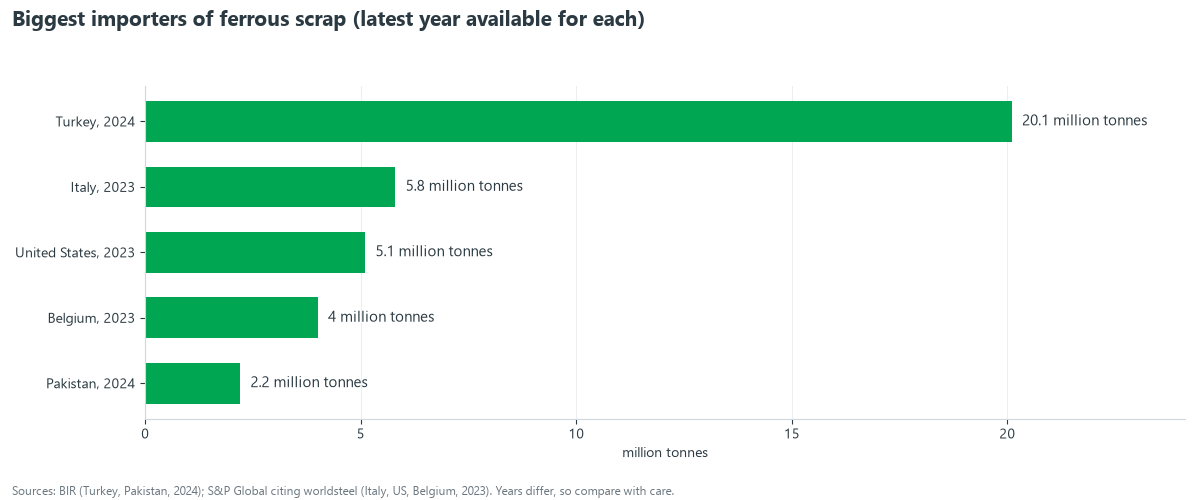
Turkey imported about 20.1 million tonnes of recycled steel in 2024, according to BIR, far ahead of anyone else. The next biggest importers of 2023, per S&P Global citing worldsteel data, were Italy (5.8 million tonnes), the United States (5.1 million) and Belgium (4.0 million) [5]. Pakistan imported 2.16 million tonnes in 2024, up 4.2% [1]. By region, Asia imported 33.3 million tonnes in 2023, up 7.1%, narrowly ahead of the European Union at 30 million tonnes, down 5.7% [5].
The picture is changing. Turkey's imports for the first seven months of 2026 were 11.33 million tonnes, up 4.4% and worth US$4.45 billion, with the United States overtaking the Netherlands as its top supplier [6]. Read the full story in Turkey: The World's Biggest Scrap Importer. India's ferrous scrap imports fell about 20% in the 2026 financial year as domestic scrap became cheaper and more plentiful, with scrap-based crude steel output up 16% to 38 million tonnes [7]. See India's Scrap Market: Imports, Duties, Rules. And Bangladesh is booming: its total scrap imports in the first four months of 2026 were about 1.66 million tonnes, up 14% [8]. Bangladesh is also Australia's biggest scrap customer, which we explain in Bangladesh: Australia's Top Scrap Customer.
Copper, aluminium and the rest
Steel is by far the biggest scrap flow by weight, but the money is elsewhere, in non-ferrous metals.
- Copper. China is the buyer that matters. It imported 2,249,952 tonnes of copper scrap in 2024, up 13.26% on 2023, according to Shanghai Metals Market's reading of customs data, and copper-bearing scrap supplied 25.2% of China's refined copper feedstock in the first half of 2026 [9][10]. See China's Copper and Aluminium Scrap Rules.
- Aluminium. The United States generated 7.6 million tonnes of aluminium scrap in 2024, of which 76% was consumed at home and 24%, about 2 million tonnes, was exported [11]. China imported about 981,000 tonnes in the first half of 2026, roughly 3% less than a year earlier [10]. Australia exported 378,000 tonnes worth A$1.43 billion in 2025-26, mostly to India, China and South Korea [4].
- E-waste. The world generated 62 million tonnes of e-waste in 2022, with 22.3% formally collected and recycled [12].
Why the flows move
Reading these numbers together shows five forces that move scrap around the world.
- Tariffs and local steel policy. US tariffs on imported steel pushed scrap into domestic mills and away from exports.
- Local supply. As India's own scrap pool grows, imports fall.
- Freight. Buyers in Bangladesh have shifted towards Australian and New Zealand cargoes partly because of lower freight and shorter transit times, according to SteelOrbis [8].
- Regional demand shocks. South Korea's property slump cut its purchases of Japanese scrap; Bangladesh's tender-based buying lifted them.
- Regulation. The EU's waste shipment rules will restrict metal scrap exports to a group of non-OECD countries from May 2027. See Europe Is Keeping Its Scrap. Who Pays?.
The practical lesson is the one traders already know: the market that is biggest today is not guaranteed to be biggest in three years. Australia's own ferrous exports, for example, have swung between Vietnam, Bangladesh and Indonesia as the top customer over the last nine years [4].
What it means for sellers
- Know your buyer's market. A rule change in India, Turkey or China can move the price your local yard can pay. Trading scrap internationally covers the basics, and the real cost of sourcing scrap abroad shows what sits between a price and a delivered cargo.
- Look at more than the headline price. Freight and transit time change who wins an order.
- Sort your material. Buyers in every market pay for grade. See how to grade scrap metal.
- Compare buyers. List on the marketplace to reach more than one.
Frequently asked questions
Which country exports the most scrap?
By ferrous scrap tonnage in 2024, the European Union (17.0 million tonnes), followed by the United States (14.4 million) [1].
Which country imports the most scrap?
Turkey, at about 20.1 million tonnes of recycled steel in 2024, well ahead of any other country [1][5].
Who buys Australian scrap?
Bangladesh, Indonesia, Vietnam, India and Thailand for ferrous scrap, and China, India, South Korea and Thailand for non-ferrous scrap [4].
Is the scrap trade growing?
Volumes move with steel demand, tariffs and local supply. US exports have fallen to a two-decade low, while Japanese and Australian exports have risen [2][3][4].
Why does the US export less scrap?
Higher tariffs on steel imports have strengthened US steel production and increased domestic scrap use [2].
Sources
- Recycling Today, Recycled steel trade patterns shift in 2024, reporting BIR statistics; BIR, World Steel Recycling in Figures 2020-2024 and its January-December 2024 update. Some half-year BIR pages repeat figures, so we use the full-year numbers.
- BigMint, US scrap exports fall to lowest level in two decades in 2025.
- Yieh Corp, Japan's ferrous scrap exports grow in January-October, citing Japanese customs data.
- Department of Climate Change, Energy, the Environment and Water (DCCEEW), Waste exports data collation, September 2026 (Australian Bureau of Statistics records), ScrapTrade calculations. See Australia's Scrap Metal Exports: 2025-26 Data.
- S&P Global, Global steel product exports rise 6.4% in 2023: worldsteel, for 2023 importers.
- SteelOrbis, Turkey's scrap imports recover in January-July 2026.
- SteelOrbis, India's ferrous scrap imports slide 20% in FY2026.
- BigMint, Bangladesh bulk ferrous scrap imports rise 11% year on year in January-April 2026; SteelOrbis, Bangladesh's import scrap prices rise further amid freight pressure.
- SMM, 2024 Brief Review of Imported Copper Scrap.
- Recycling Today, Primary copper producers turn to scrap, citing Antaike via S&P Global; Discovery Alert, China aluminium scrap imports: key overseas suppliers in 2026, a secondary source.
- SMM, America's aluminium scrap: the Aluminum Association's proposal to ban exports of UBC scrap.
- UNITAR and partners, Global E-waste Monitor 2024.
Figures are as reported by the sources named and use different years and definitions. This article is general information, not financial or trading advice. ScrapTrade operates a scrap marketplace and has a commercial interest in the scrap trade.