

A catalytic converter looks like a rusty steel box under the car, and buyers often price it by the piece, not by the kilogram. The reason is what is inside: a ceramic honeycomb coated with platinum, palladium and rhodium, three of the most valuable metals in the world. This guide follows one old converter from the exhaust to a wrecker or mechanic, through a specialist buyer and an overseas refiner, and back into a new car. It explains how the metals are recovered, why so much of the value is exported, and why converters are also a theft target. It is written for owners, mechanics and yard operators, and ScrapTrade has a commercial interest in the scrap trade.
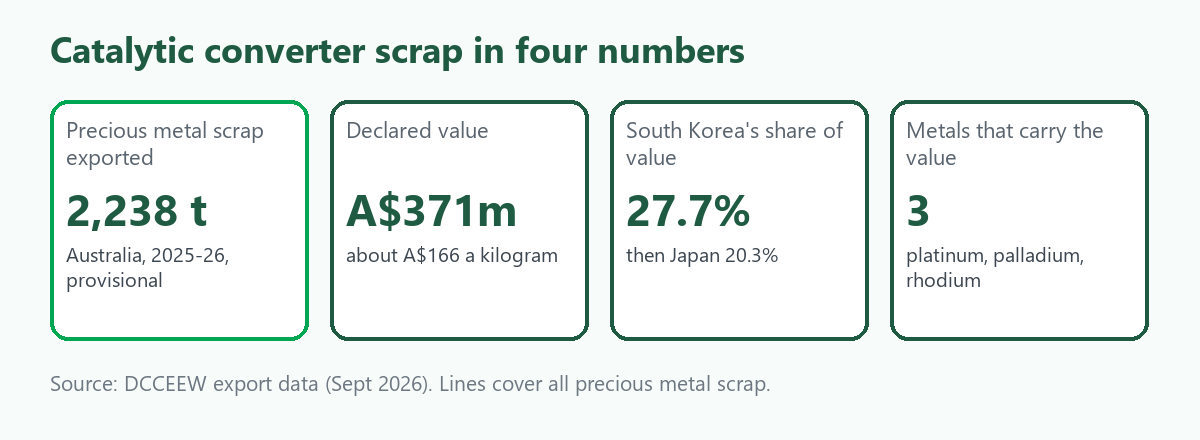
Step 1: The converter comes off the car
A catalytic converter sits in the exhaust and cleans the gases from the engine. Inside is a ceramic honeycomb coated with palladium, platinum and rhodium. It leaves the car in one of two ways. A mechanic replaces it because it has failed, been damaged or been stolen, or the whole car is scrapped and a wrecker cuts it off. For how a whole car is stripped, see End-of-Life Vehicle (ELV) Scrap: How Auto Scrap Is Recovered.
The metals are the point. Platinum, palladium and rhodium are valuable because they are rare and because they work as catalysts, so the ceramic is only a carrier. The steel shell around it is worth very little by comparison.
Step 2: A mechanic or wrecker sells it
The converter is sold by whoever removed it. A workshop may keep replaced converters in a box and sell them in batches. A wrecker takes them from cars it dismantles. Some scrap yards buy them across the counter, and some specialist buyers deal in nothing else.
A legitimate seller can show where the converter came from. That matters because converters are stolen. NSW Bureau of Crime Statistics and Research figures reported by the ABC recorded 194 thefts across New South Wales in 2022. A spokesperson for the Victorian Automotive Chamber of Commerce told CarExpert in 2023 that buyers create the market, and that thieves have nothing to sell if the sales channel is cut off.
Governments have been tightening the rules for buyers. Victoria banned cash payments for scrap metal in 2017 and requires dismantlers and yards to keep records of all transactions. Queensland has passed reforms with stricter identification and record-keeping for scrap dealers, which we cover in Scrap Metal in Queensland: Rules and Data, and South Australia introduced a Scrap Metal Dealers Bill in November 2025 that cited converter theft. We have not checked the current status of the South Australian bill.
Step 3: A buyer grades it
The buyer sorts converters by type, because they are not equal. Refiners, for example, grade each batch by how full the units are and what kind they are, such as original-equipment converters, aftermarket converters, diesel particulate filters and metallic-foil converters. Original converters often hold more precious metal than cheap aftermarket ones, which is one reason two converters that look alike can be worth very different amounts.
The yard or buyer then bags and stores them until it has enough to send. At this stage the price is an estimate. The true value is not known until the ceramic has been analysed.
Step 4: A refiner strips, mills and tests it
At a specialist refiner the process runs in stages, according to refiners' own descriptions:
- Grade and count. The units are counted and graded, and the grading report is later compared with the lab result.
- Decan. The steel shell, pipes and shields are stripped off, leaving the ceramic honeycomb. This makes dust, and one refiner says the dust often holds twice the concentration of precious metal, so it must be captured.
- Mill. The ceramic is crushed and ground into a fine, even powder, so that any sample taken is representative of the whole batch.
- Assay. A laboratory measures how much platinum, palladium and rhodium is in the powder, in parts per million, using instruments such as X-ray fluorescence or plasma analysis.
- Pay. The seller is paid on the lab result: the parts per million of each metal, the weight of the ceramic and the market price of the metals at the time of sale, less the refiner's fee. One refiner quotes fees of roughly 10 to 12 percent for ceramic converters, which is a vendor figure.
- Smelt and separate. The powder is melted in a furnace, the ceramic floats away as slag, and the metals are collected, ground and dissolved chemically into a sponge, which is then refined to pure metal.
Recovery is never complete. The same refiner says platinum and palladium recoveries are usually in the high 90s percent and rhodium is lower, in the high 80s to low 90s, because it is harder to extract. Treat those as a vendor claim.
Step 5: Most of it leaves Australia
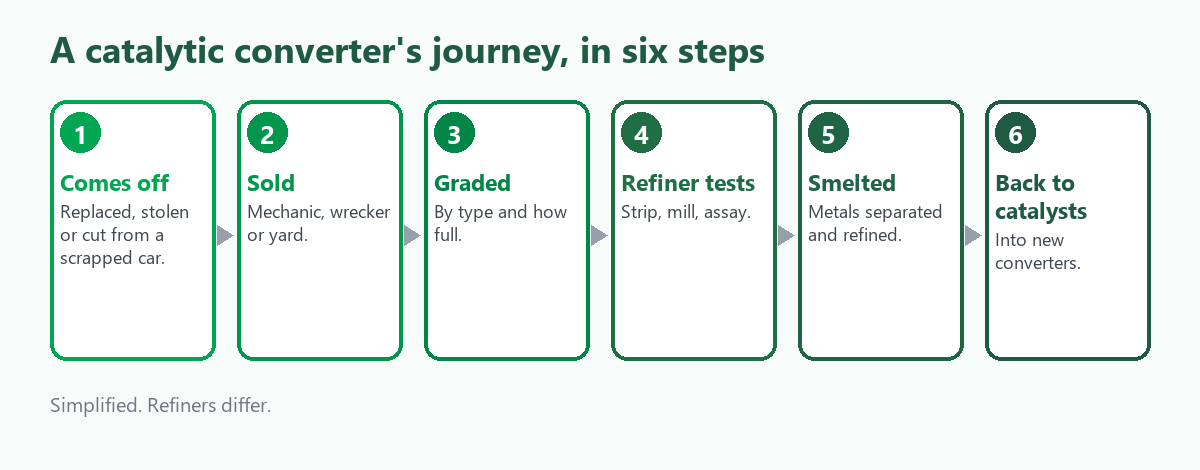
We could not find a source for an Australian refinery that handles converters. What the export data does show is large amounts of precious metal scrap leaving the country. Government export records have customs lines for waste and scrap used mainly to recover platinum and other precious metals. In 2025-26 (provisional), Australia exported 2,238 tonnes under those lines, with a declared value of A$371 million. That averages about A$166 a kilogram, against A$10.8 a kilogram for copper scrap.
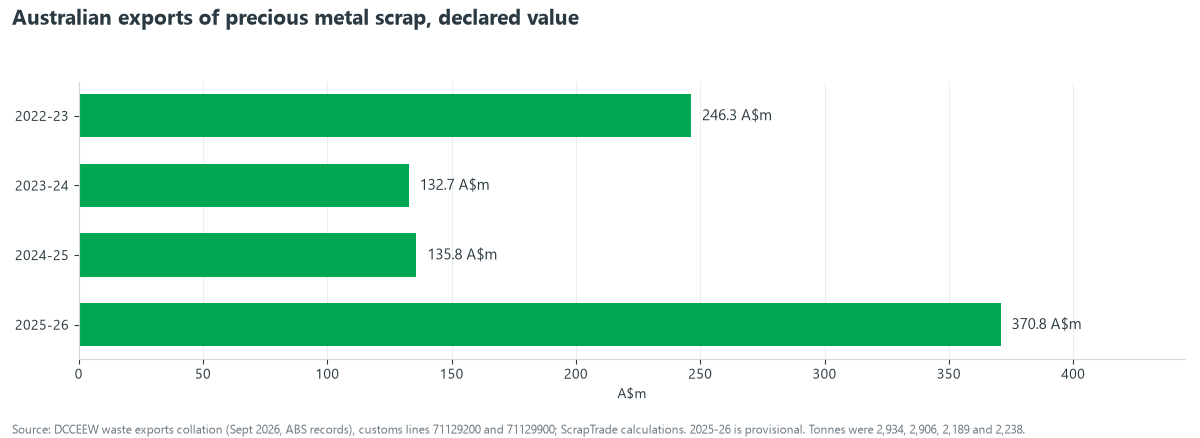
Value jumped in the latest year while tonnes hardly moved, which fits a market where the price of the metals matters more than the weight. These lines include any scrap sent to recover precious metals, such as electronics and jewellery as well as converters, so they are context and not a count of converters.
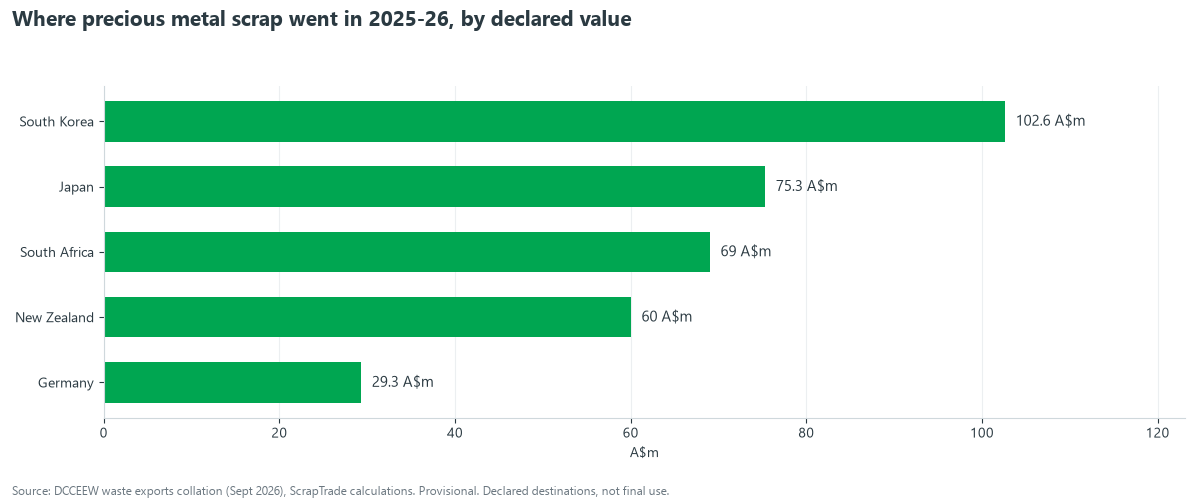
By value, South Korea took 27.7 percent in 2025-26, Japan 20.3 percent, South Africa 18.6 percent, New Zealand 16.2 percent and Germany 7.9 percent. By weight, Japan took 1,227 tonnes and Thailand 524. New South Wales and Victoria supplied most of the tonnes. These are declared destinations at export, not where the metal is finally used.
Step 6: The metals go back into catalysts
The refined platinum, palladium and rhodium are sold, and a refiner says most return to the automotive industry, where they are coated onto ceramic to make new converters. Some go into medical equipment, electronics, jewellery, fuel cells and chemical catalysts. The same refiner says around 40 percent of the precious metal supply for the car industry comes from recycled converters, but that is a vendor claim and we could not confirm it. So the platinum in a new car's converter may have been in a converter on the road a decade earlier.
How much really comes back?
It depends on the price. The World Platinum Investment Council (WPIC) says recycled supply of these metals is more price-sensitive than traditionally thought. When prices fell between 2022 and 2024, less was collected. WPIC expects platinum recycling to recover to only about 90 percent of the amount implied by how many cars are scrapped, compared with 80 percent in 2022 to 2024 and 110 percent in 2019 to 2021.
Johnson Matthey's 2026 report says high prices are speeding up collection of scrap catalysts, expects a strong recovery in automotive recycling for palladium, and says rhodium recoveries from automotive scrap are heading for a four-year high. It also says rising battery electric vehicle output will weigh on platinum use in converters. Electric cars have no converter, so in the long run there will be fewer to make and fewer to recycle.
What this means for you
- If you own a car: park securely, and do not leave the car raised on ramps or stands, since that makes the converter easier to reach. Queensland Police also suggest painting the converter in a bright colour and engraving the registration number on it.
- If you are a mechanic or wrecker: keep a record of every converter you sell, and sell only to buyers who ask where it came from. A buyer that does not ask is a risk to you.
- If you buy converters: record who sold each one, check identification, and pay by a traceable method. Our guide to how scrap yards work shows the rest of the chain. If you hold stock you can document, you can create a free account on ScrapTrade or browse the marketplace.
What we could not verify
- Where your own converter goes. Buyers sell to different refiners, so there is no single route.
- Whether any Australian refinery handles converters. We found none, but we did not search every company.
- What share of the export lines is converters. The customs lines include other precious metal scrap.
- The refiner fees, recovery rates and the 40 percent share. These come from refiners' own web pages.
- The current status of the South Australian bill.
- What buyers pay today. Prices move with the metals, and we publish none.
Frequently asked questions
Why are catalytic converters worth so much?
They contain platinum, palladium and rhodium, which are rare and valuable metals. The value is in the metal coating, not the steel.
Can you sell a catalytic converter to a scrap yard?
Often yes, but a legitimate buyer will ask who you are and where it came from, and in several states they must keep records. Do not sell a converter you cannot show you own.
How is the precious metal recovered?
A refiner strips the shell, mills the ceramic to a powder, measures the metal content in a lab, then melts and chemically refines it.
Will electric cars make converters worthless?
Electric cars have no converter, so demand for the metals in new converters will fall over time. Converters already on the road will keep coming off for years.
Sources
- Precious Metals Recycling and Catalytic Converter pages, "Converter processing stages" (pmrcc.com), a refiner's description.
- EcoTrade Group, how to choose a catalytic converter refining company (refiner fees and recovery claims).
- Johnson Matthey, 2026 PGM Market Report press release.
- World Platinum Investment Council, Platinum Essentials, August 2025 (recycling).
- CarExpert, "Crackdown on dodgy recyclers could cut catalytic converter thefts", 17 April 2023.
- South Australian Government media release on scrap metal theft, 10 November 2025 (as summarised in search results).
- Department of Climate Change, Energy, the Environment and Water, Waste exports data collation, September 2026 (ABS records), ScrapTrade calculations, customs lines 71129200 and 71129900. The 2025-26 figures are provisional.
This is general information, not financial or legal advice. Process steps are simplified, and refiners differ. Declared export values are border declarations, not prices. ScrapTrade operates a scrap marketplace and has a commercial interest in the scrap trade.