

On 15 October 2026 the Queensland Government announced that Parliament had passed new laws on metal theft, including tougher identification and record-keeping rules for scrap metal dealers. The announcement did not say when they start. If you sell scrap in Queensland, or buy it, that leaves a practical question: what is the law today, what is changing, and what should you do now? This guide sets out what we could verify from Queensland Government sources, what we could not, and then what government export data shows about scrap from the state, which sends more metal overseas by weight than any other. It does not replace advice from the regulator. We have a commercial interest in the scrap trade.
What the law is today
Scrap metal in Queensland is regulated through the Second-hand Dealers and Pawnbrokers Act 2003. Based on the Queensland Government's guidance for dealers, last updated in July 2026, before the reforms passed:
- Licence. A person carrying on a business in second-hand goods must hold a second-hand dealer licence from the Office of Fair Trading. Applicants must be at least 18, have a place of business in Queensland, and not have been convicted of a disqualifying offence in the last five years. The application is lodged in person or by post, and takes four to six weeks. The Department of Justice says that the existing licensing rules in effect restrict the sale of scrap metal to licensed persons, and that a searchable register of licensed dealers is online.
- Identity. A dealer must check the seller's identification, such as a driver licence, and record the seller's name and address. The dealer does not need to photocopy it.
- Register. Dealers keep a register of goods they receive, including items with a resale value of at least A$55 and items containing precious metals. Details include whether the seller owns the goods and how they got them.
- Holding period. "Nominated goods", which include precious metals, must be held for seven working days.
- Reporting. A dealer must tell police about goods that could be stolen.
We have not seen a cash ban in the current rules. For how cash rules work in other states, see our guide to paying cash for scrap.
What the reforms change
The changes sit in the Justice and Other Legislation Amendment Bill 2026. The Government's statement of 15 October says dealers will face stricter identification and record-keeping requirements and higher penalties for failing to report suspected stolen property or unlicensed second-hand property to police. It also lists new criminal penalties: up to 25 years for stealing or damaging where life or health is endangered, and a new offence of attempted metal theft with a maximum of seven years.
The detail below comes from the Department of Justice's response to submissions on the Bill, which describes it as introduced. The Act as passed may differ.
- Scrap metal is defined. The Act will clarify that it covers scrap metal, with a definition inserted.
- Photographic ID. Scrap sales will need photographic identification. Today the dealer must verify identity but not by photo, and records do not include date of birth or residential address. The reforms add these particulars, so expect to be asked.
- Every transaction recorded. One submission describes the Bill as requiring the recording of all scrap metal transactions regardless of value, instead of only items above a value threshold.
- Seven day hold. The Waste, Recycling Industry Association (Queensland) said it supports the Bill's removal of the seven day holding requirement for scrap metal. We could not confirm that point in the final Act.
- Penalties. Higher penalties for unlicensed dealing in scrap, and escalating penalties for dealers who repeatedly fail to report suspected stolen scrap.
- A new possession offence. Possessing a prescribed metal item that is reasonably suspected of being stolen becomes an offence, with the burden on the person to show they had no reasonable grounds to suspect. The Department says it does not apply to someone who lawfully possesses the item, and notes this will often include tradespeople and recyclers.
- No cash ban. The Department says the Bill does not ban cash for scrap, and calls whether to do so a policy matter for the Government. The City of Moreton Bay and the Local Government Association of Queensland asked for a ban.
- Regulation changes. The Department says it will consult stakeholders on changes to the Second-hand Dealers Regulation.
What we could not verify. We could not read the Act as passed, the date it starts, the penalty amounts, the fees, or the amended regulation. The statement of 15 October gives no start date, and the Fair Trading page we read, last updated 17 July 2026, still describes the reforms as before Parliament. The points above are a guide to direction, not the law.
What to do before the new rules start
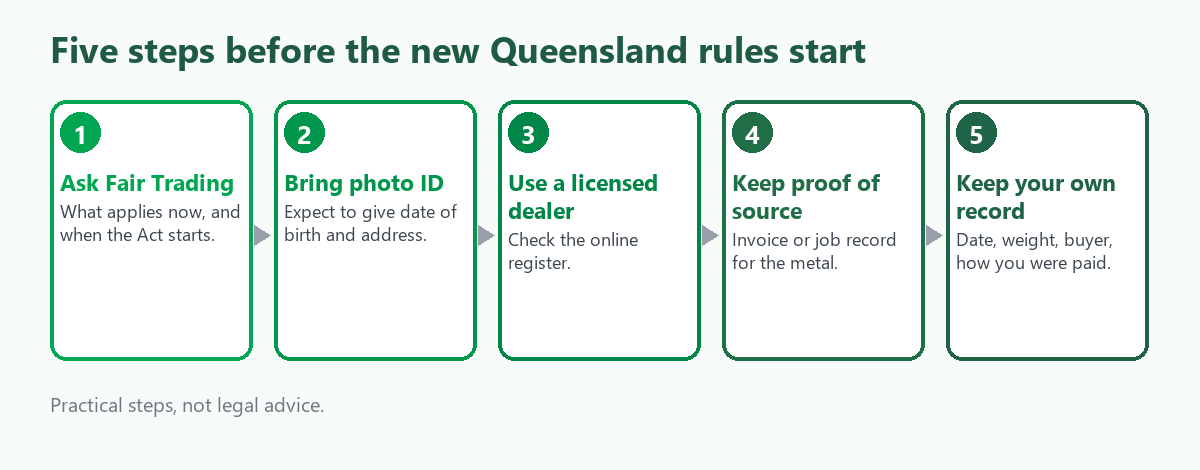
- Ask the Office of Fair Trading what applies now and when the Act starts. That is the only authoritative answer.
- Bring photo ID when you sell, and expect to give your date of birth and address. Ask the buyer what they need before you arrive.
- Sell to a licensed dealer. Check the online register of licensed dealers.
- Keep proof of where the metal came from. An invoice, job record or removal notice shows you hold it lawfully, which matters if a buyer or police ask. This is sensible practice, not a requirement we can confirm.
- Keep your own record of each sale: date, material, weight, photos, buyer's name and how you were paid. A bank transfer leaves a record. Cash is legal in Queensland as far as we can see, but it leaves none.
- If you buy scrap, plan for photographic ID capture and a complete transaction register now. See Scrap Yard Billing: What the Software Must Do.
- If you work as a broker or agent, ask the regulator whether the rules cover your role. See Become a Scrap Broker or Agent in Australia. For how Queensland compares with other states, see Scrap Business Rules in Australia by State.
How much scrap leaves Queensland
The next sections use the Australian Government's waste exports data, which records declared tonnes and value by state of origin. The 2025-26 figures are provisional, and values are declared at the border for mixed shipments. They are not prices you will be paid. We exclude one record that is almost certainly a recording error, as explained in Reading Australia's Scrap Export Data Properly.
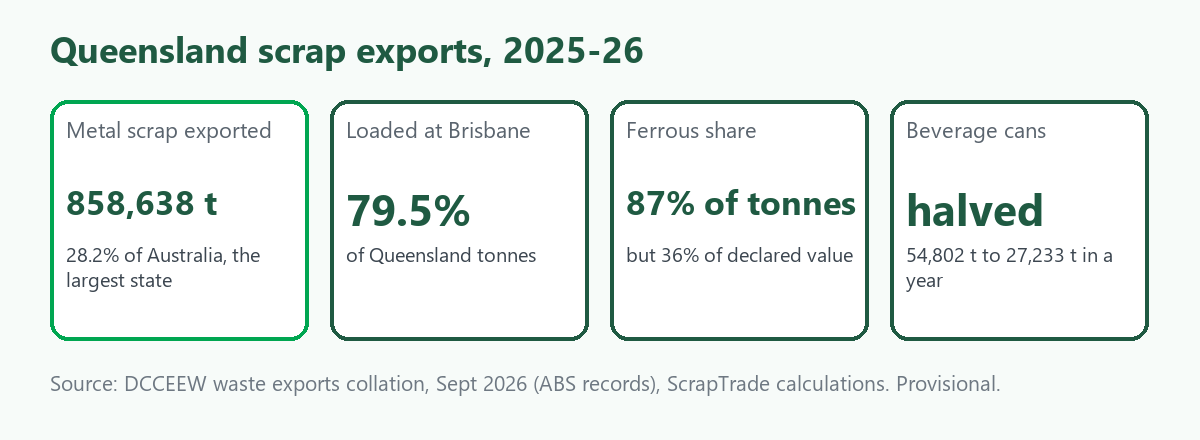
In 2025-26, Queensland exported 858,638 tonnes of metal scrap with a declared value of A$1,131.6 million. That is 28.2% of the Australian total, the largest share of any state. Western Australia was next at 26.1%, then Victoria at 22.1%.
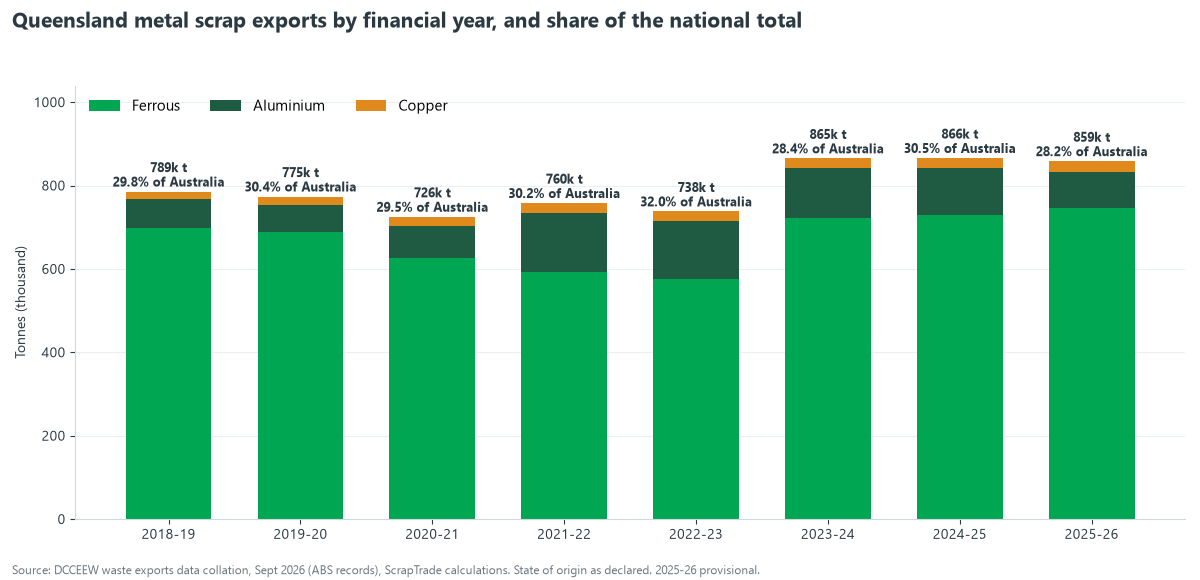
The state's output has been steady: between 726,000 and 866,000 tonnes in every year since 2018-19, and between 28% and 32% of the national total. Ferrous tonnes rose from 574,923 in 2022-23 to 745,061 in 2025-26. Aluminium went the other way, from 142,884 tonnes in 2021-22 to 88,172 in 2025-26, a fall of 38%.
What is in it
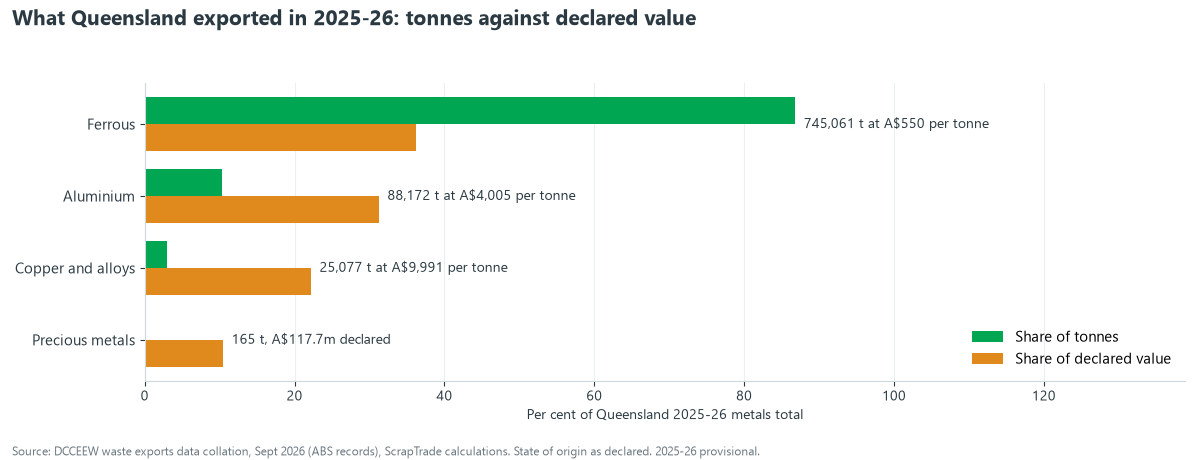
| Metal (2025-26) | Tonnes | Share of tonnes | Declared value | Share of value | Average value per tonne |
|---|---|---|---|---|---|
| Ferrous | 745,061 | 86.8% | A$409.5m | 36.2% | A$550 |
| Aluminium | 88,172 | 10.3% | A$353.1m | 31.2% | A$4,005 |
| Copper and alloys | 25,077 | 2.9% | A$250.5m | 22.1% | A$9,991 |
| Precious metals | 165 | under 0.1% | A$117.7m | 10.4% | not meaningful |
Ferrous scrap is 87% of the tonnes and 36% of the declared value. Aluminium and copper together are 13% of the tonnes and 53% of the value. The precious-metals line is tiny by weight and a tenth of the value, which is why it is left out of per-tonne comparisons. The practical point for a seller is the same as elsewhere: sorting matters, because non-ferrous metal is worth many times more per kilogram than steel. See Scrap Metal Types and Grades.
Two changes stand out in the data. Declared value per tonne for Queensland copper rose from A$5,301 in 2018-19 to A$9,991 in 2025-26, and for aluminium from A$2,472 to A$4,005. For aluminium, part of the recent rise comes from a halving of beverage-can exports, which in Queensland fell from 54,802 tonnes to 27,233 in a year. We cover it in Australia's Aluminium Can Exports Halved.
Where Queensland scrap goes
Material from Queensland reached 30 countries in 2025-26. The largest destinations by tonnes were Bangladesh (34.8%), Indonesia (21.1%), Vietnam (9.5%), Thailand (7.9%), India (6.7%), Malaysia (5.0%), China (3.9%) and Saudi Arabia (3.4%). This is a more Bangladesh and Indonesia weighted mix than the national one, because Queensland ships so much ferrous scrap. See Bangladesh vs Indonesia vs Vietnam: Australian Scrap Buyers.
Brisbane loaded 79.5% of Queensland's tonnes, followed by Mackay (9.7%), Gladstone (4.8%), Townsville (4.2%) and Cairns (0.8%). Brisbane loaded 748,772 tonnes in total, 91.2% of it from Queensland. For how ports compare, see Australian Scrap Export Ports: Who Ships What. For the older market overview, see Strategic Analysis of the Queensland Scrap Metal Market.
Getting a fair price in Queensland
Export values are context. To judge an offer, use a price you can check.
- Know the benchmark in Australian dollars. See Scrap Metal Benchmark Prices in A$ per kg.
- Use the live prices and calculators. The market prices page, the Australia scrap calculator and the scrap metal calculator give an indicative figure for your material.
- Compare buyers on four points. What price they pay and on what basis, what they deduct, when they pay, and how.
- Sell to more than one buyer. List the lot where several buyers can see it.
Where ScrapTrade fits
ScrapTrade is a marketplace where sellers list scrap and buyers compare offers and negotiate. ScrapTrade holds a 5% buyer deposit in escrow after a bid, and keeps it on hold once the bid is accepted, so the buyer stays committed to the trade. It does not tell you what Queensland law requires of you. Browse the marketplace or create a free account.
For which scrap Western Australia's dealer law covers, and WA export data, see: Scrap Metal in Western Australia: Rules, Data.
For the latest quarter of export data, see: Australia Scrap Export Tracker: June Qtr 2026.
Before you choose a system, see: Scrap Yard Software: 15 Questions for a Vendor.
What we could not verify
- The text of the Act as passed, its start date, penalty amounts, fees and whether the seven day hold for scrap is removed.
- The amended Second-hand Dealers Regulation, which the Department says it will consult on.
- Whether a licence is needed for every kind of scrap buyer. The licensing page we read does not mention scrap metal. The Department's response says the existing rules in effect restrict sales to licensed persons.
- Local yard prices. We publish none, and the export values here are not prices.
- Whether the 2025-26 figures will be revised. They are provisional.
Frequently asked questions
Do the new Queensland scrap metal laws apply yet?
The Government announced on 15 October 2026 that Parliament had passed them, but the statement gives no start date. Ask the Office of Fair Trading.
Will I need photo ID to sell scrap in Queensland?
The reforms, as described in the Department of Justice's response to submissions, add photographic identification for scrap transactions, with date of birth and address recorded. Confirm the start date before relying on it.
Is cash banned for scrap in Queensland?
We found no ban. The Department says the Bill does not include one and that it is a matter for future Government policy.
Do I need a licence to buy scrap metal in Queensland?
Dealing in second-hand goods requires a second-hand dealer licence, and the Department says this in effect restricts scrap sales to licensed persons. Check with Fair Trading for your case.
How much scrap does Queensland export?
In 2025-26, 858,638 tonnes, 28.2% of the national total, with a declared value of A$1,131.6 million. Figures are provisional.
Sources
- Queensland Government, Ministerial statement "Tougher penalties and stronger enforcement to tackle metal theft", 15 October 2026.
- Queensland Government, Department of Justice, Response to submissions, Justice and Other Legislation Amendment Bill 2026, Justice, Integrity and Community Safety Committee. Describes the Bill as introduced.
- Queensland Government, Legal requirements for second-hand dealers and pawnbrokers, and Get a second-hand dealing or pawnbroking licence, qld.gov.au (legal requirements page last updated 17 July 2026).
- Department of Climate Change, Energy, the Environment and Water, Waste exports data collation, September 2026 (ABS records), ScrapTrade calculations. State of origin and port as declared. The 2025-26 figures are provisional.
This is general information, not legal advice. State laws change, so confirm with the Office of Fair Trading and Queensland Police. Declared export values are border declarations for mixed shipments, not prices. ScrapTrade operates a scrap marketplace and has a commercial interest in the scrap trade.