

Cardboard is the material most households recycle without thinking about it. A delivery box is flattened, dropped in the bin and forgotten. This guide follows one box from the kerbside bin to a sorter, a bale and a paper mill, and shows where it goes, what happened to the trade when Australia changed its export rules for mixed paper in 2024 and how much of it really comes back as paper. It is written for households, businesses with a lot of cardboard, and collectors who bale it. The export figures are our analysis of government records, and ScrapTrade operates a scrap marketplace and has a commercial interest in the scrap trade.
Step 1: It goes in the bin
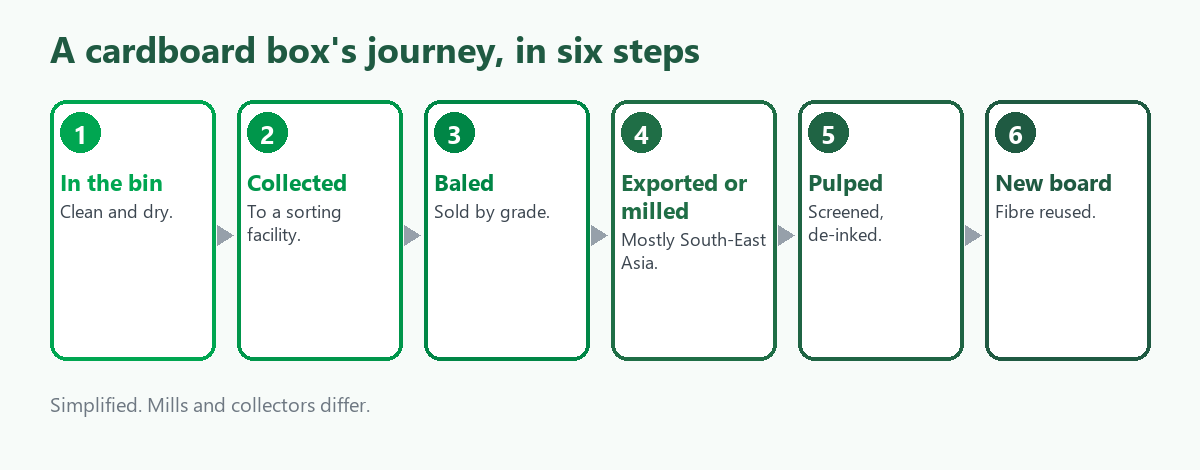
Paper and cardboard are the biggest part of most recycling bins, and the biggest problem is what rides in with them. Whether a greasy pizza box can go in is a good example, because the answer depends on where you live. According to council pages and a University of Melbourne expert, many Australian councils accept the clean lid and ask for the greasy base to go in general waste. Maroondah says a bit of grease and crumbs are fine, and the City of Sydney says a little grease is fine and chunks of cheese and crust are not. South Australia lets greasy boxes go in the green organics bin, and guidance in Western Australia is that pizza boxes go in general waste. One article reported kerbside contamination as high as 20 percent during the pandemic, with food scraps part of it. A cardboard box soaked in oil cannot be recycled, according to one source. The rule is to check your own council's list.
Step 2: A collector takes it to a sorter
A collection truck takes the bin's contents to a sorting facility, where paper is separated from the plastic, glass and metal. Visy, a large Australian packaging company, describes the model it calls closed loop: it sorts paper at its sorting facility, makes paper at its mill and remakes packaging locally. We could not find a neutral description of how the average sorting facility works, so we treat this as one operator's account.
Step 3: It is baled and sold by grade
Sorted paper is pressed into bales and sold by grade. The customs records use four, which our data labels as cardboard, office paper, newsprint and magazines, and mixed. In customs terms those are recovered unbleached kraft and corrugated board, recovered paper made mainly from bleached chemical pulp, recovered paper made mainly from mechanical pulp, and waste and scrap paper that does not fit those, including unsorted. The grade matters more than most people think. Cardboard is the best raw material, according to one source, because its fibres are long to begin with, and newsprint and corrugated board can be made from 100 percent recycled fibre.
Step 4: Most of what leaves goes to South-East Asia
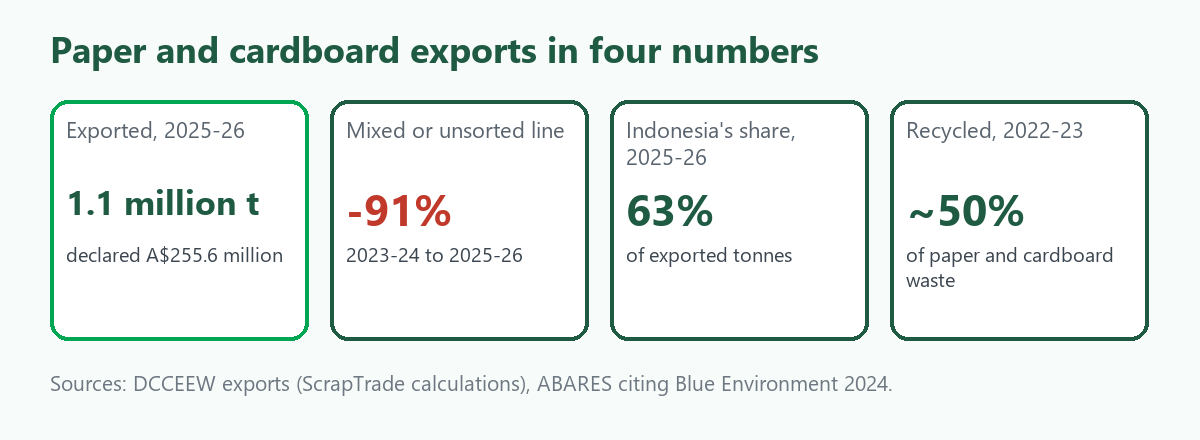
Exports of paper and cardboard have held between about 0.98 and 1.32 million tonnes a year since 2017-18. In 2025-26 (provisional) they were 1,106,395 tonnes with a declared value of A$255.6 million, about A$231 a tonne. That is a border declaration and not a price, but it shows the trade is large. Victoria shipped 29.5 percent of the tonnes, Queensland 24.1 percent, Western Australia 21.0 percent, New South Wales 14.1 percent and South Australia 9.4 percent.
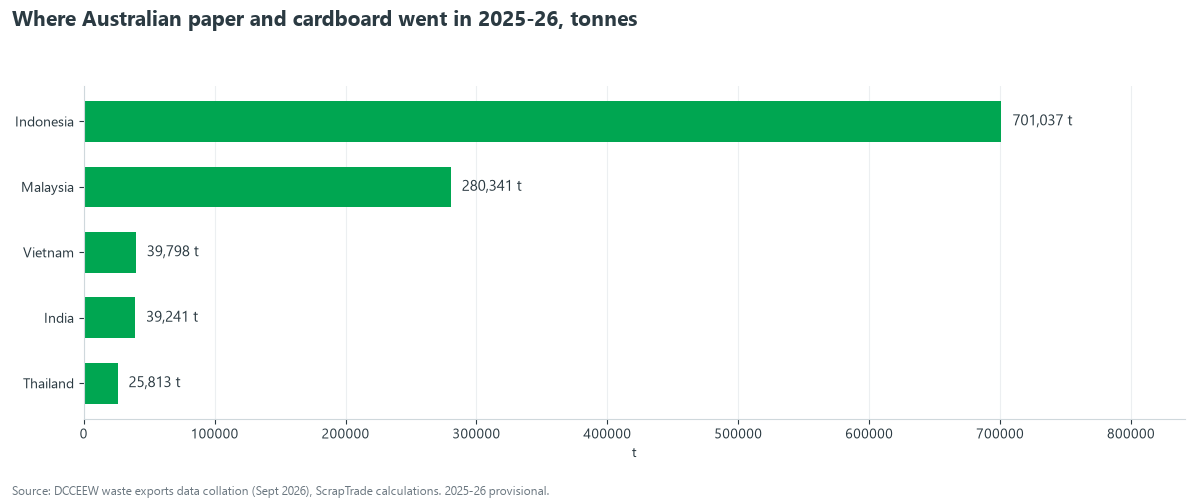
Indonesia took 701,037 tonnes, 63.4 percent, and Malaysia 280,341 tonnes, 25.3 percent. Vietnam, India and Thailand took between about 26,000 and 40,000 tonnes each. That is a very different picture from 2017-18, when China took 558,926 tonnes, 42.4 percent, Indonesia 22.5 percent and Thailand 11.6 percent. China's share collapsed after it tightened what it would accept. Sources describe China's contamination limit for recovered paper falling from roughly 5 to 10 percent to 0.5 percent from 2018, though they disagree on whether it began on 1 January or 1 March, and a peer-reviewed paper says the full policy was in place by January 2021. In our records China took 140 tonnes in 2021-22. Exporters moved to Indonesia, Malaysia and other countries that were willing buyers.
What changed in 2024
The Recycling and Waste Reduction (Export - Waste Paper and Cardboard) Rules 2024 took effect on 1 July 2024. They regulate mixed or unsorted paper and cardboard, which needs a licence, and not clean, sorted paper, which does not. According to the department, quoted by Packaging News, enforcement began on 1 October 2024, after a grace period for exporters to apply for licences.
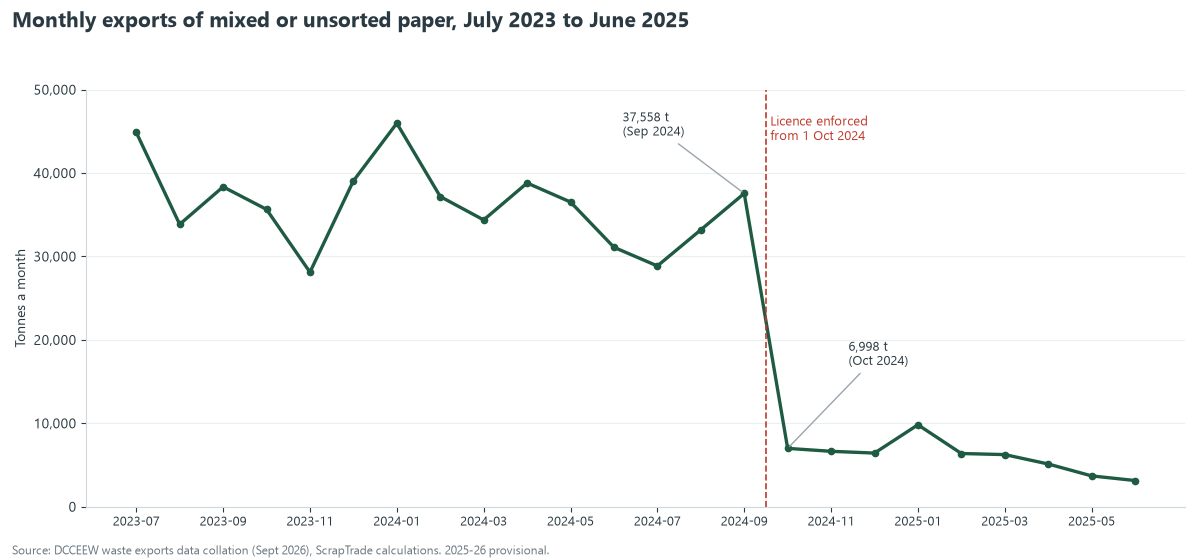
The records show a step at that date. Exports of the mixed and unsorted line were 37,558 tonnes in September 2024 and 6,998 tonnes in October 2024, and have stayed low since, falling to 3,142 tonnes in June 2025. In annual terms, the mixed line fell from 443,899 tonnes in 2023-24, 43.6 percent of exports, to 39,038 tonnes in 2025-26, 3.5 percent, a fall of 91.2 percent.
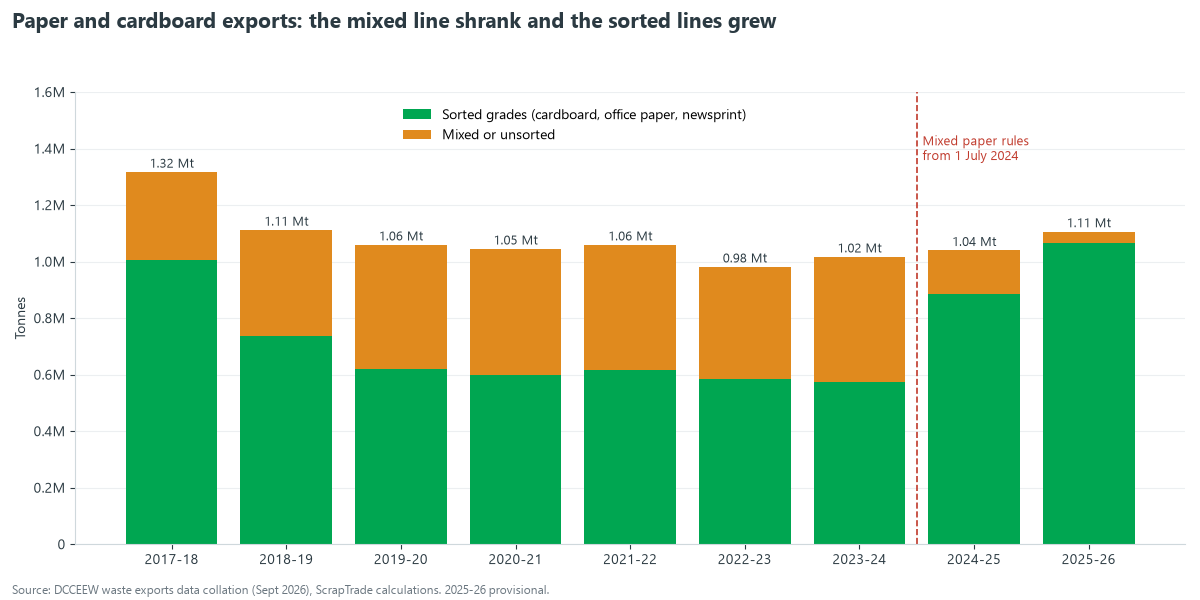
The total did not fall. The sorted lines rose from 573,359 tonnes to 1,067,357 tonnes over the same two years, 494,000 tonnes more, against a 405,000 tonne fall in the mixed line, and the cardboard line alone was 86.5 percent of 2025-26 exports. The timing is consistent with exporters sorting more material into clean grades to avoid the licence. We cannot tell from the records whether the extra tonnes were genuinely better sorted or simply declared under a sorted line, and the data do not show what quality the buyers received.
Step 5: At the mill
At a mill, the bales are broken up in water to separate the fibres into a slurry, passed through screens and filters that catch staples, tape and plastic, and de-inked where the paper carried print. Some grades are bleached afterwards. Australia's domestic picture is thinner than it was. Opal's Maryvale mill in Victoria opened a de-inking plant in 2015 with a stated capacity of 50,000 tonnes a year of recycled pulp from up to 80,000 tonnes of recovered paper. In mid-2022 Opal stopped making office and copy paper on the smaller of its two machines at the mill, and a 2023 Victorian government market report says demand for recovered white office paper at Maryvale has ended and its de-inking plant no longer makes pulp for recycled office grades. These sources are dated, and we found nothing current on capacity at Opal or Visy.
Step 6: Back into boxes and paper
The pulp is formed into new sheets, often with virgin fibre added, depending on the grade. The limit is the fibre. Each cycle shortens the fibres, and after repeated processing they become too short to make new paper, which is why virgin fibre is added. Sources put the number of times at about seven or eight, or up to seven, so we treat it as roughly seven. Cardboard fibre is long to start with, which is why it is the most valuable grade.
How much really comes back?
The measures differ, and they do not agree. The National Waste Report 2022 listed paper and cardboard at a 62 percent recycling and recovery rate, according to a summary from NESP. A later analysis reported by ABARES, from Blue Environment's 2024 report, says half of paper and cardboard waste was recycled in 2022-23, down from 60 percent in 2016-17, and notes that the figures may not be directly comparable. For packaging alone, APCO reports about 65 percent for paper and paperboard in 2022-23, down from 68 percent in 2021-22. APCO also says paper relies heavily on export markets for recovery. Our export tonnes are not a recovery rate, because they leave out what is processed here and what is never recovered. A secondary source says that before 2018 about 55 percent was recycled locally and 28 percent went to China, which we could not check against a primary source.
What this means for you
For households, keep cardboard clean and dry, flatten it and check your council's rules on pizza boxes and soiled paper. For a business or a collector with volume, the 2024 rules make grade and contamination matter more, because sorted, single-type paper is the form that can be exported without a licence, and a buyer may ask what is in the bale. Ask your buyer which grade they are paying for, what contamination they allow and who bears the cost if a load is rejected. Our guides on where an old car goes and where old electronics go follow other materials through the same loop. Whether baled paper and cardboard lots can be listed on ScrapTrade is unconfirmed, so ask cs@scraptrade.com.au before you plan around it.
What we could not verify
- Why the mixed line fell and the sorted lines rose. The timing fits the rules, and we cannot separate better sorting from reclassification.
- The text of the rules. We relied on a trade-press report attributed to the department. A summary also mentions a limit of 5 percent non-fibre content from 1 July 2026, which we could not confirm.
- What share of recovered paper stays in Australia. We found no figure.
- Current mill capacity. The Maryvale and Visy details are dated.
- The recovery figures. They come from summaries, and the measures differ.
- Provisional data. The 2025-26 export figures are provisional, and declared values are border declarations and not prices.
Frequently asked questions
Can I put a pizza box in the recycling bin?
It depends on your council. Many accept the clean lid and want the greasy base in general waste, South Australia allows greasy boxes in the green organics bin and Western Australia says general waste. Check your council.
Does Australia export its recycled paper?
Yes. About 1.1 million tonnes of paper and cardboard were exported in 2025-26, mostly to Indonesia and Malaysia.
Is mixed paper still exported?
Under rules that took effect in 2024, mixed or unsorted paper and cardboard needs a licence. Exports of that line fell by 91 percent between 2023-24 and 2025-26.
How many times can paper be recycled?
About seven times, because the fibres shorten each time, according to the sources we found.
What share of paper and cardboard is recycled in Australia?
Between about 50 and 62 percent depending on the report and the year, and the measures differ.
Sources
- Department of Climate Change, Energy, the Environment and Water, Waste exports data collation, September 2026 (ABS records), ScrapTrade calculations, customs lines 470710, 470720, 470730 and 470790. The 2025-26 figures are provisional.
- Packaging News, "New rules for waste paper and cardboard exports", 8 May 2024, reporting the department's announcement; Recycling and Waste Reduction (Export - Waste Paper and Cardboard) Rules 2024, as summarised in search results.
- NESP summary of the National Waste Report 2022; ABARES forest indicator 6.1e citing Blue Environment (2024); APCO material factsheet for paper and paperboard.
- Anthesis, BioResources (2022) and Waste Management Review on China's 2018 restrictions, as summarised in search results.
- Visy brochure on closed-loop recycling; Victorian Government market insights report on recovered paper packaging (July 2023); trade-press coverage of Australian Paper's Maryvale de-inking plant, as summarised in search results.
- University of Melbourne expert commentary and council pages on pizza boxes, as summarised in search results.
- Paper recycling process descriptions from recycling guides, as summarised in search results.
This is general information, not financial or legal advice. Process steps are simplified, and mills and collectors differ. Declared export values are border declarations, not prices. ScrapTrade operates a scrap marketplace and has a commercial interest in the scrap trade.