

Old electronics are the most complicated item in this series, because a laptop is not one material. It is steel, aluminium, copper, plastics, glass, a battery and a circuit board carrying small amounts of gold, silver and palladium, all bolted together. This guide follows one old laptop or television from the drop-off point to a recycler, a shredder and a refiner, and shows which parts stay in Australia, which parts leave, and how much of the whole is really recovered. It is written for households and businesses with a drawer of old devices, and for collectors who handle them in volume. The export figures are our analysis of government records, and ScrapTrade has a commercial interest in the scrap trade.
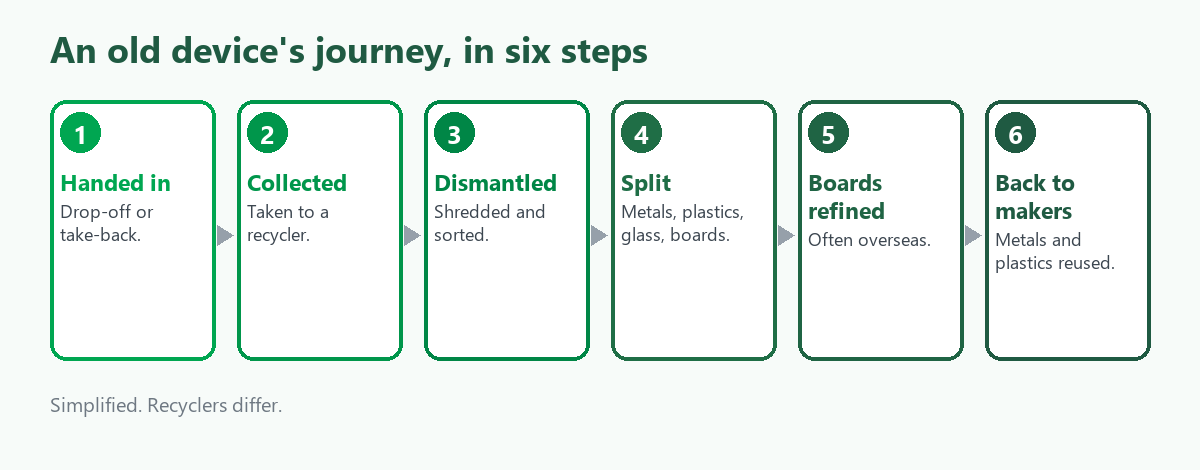
Step 1: You hand it in
A device can leave your hands in several ways: a council drop-off, a retailer take-back, a collection event, or a collector or business recycler. Televisions and computers have had their own national scheme since 2012, the National Television and Computer Recycling Scheme, funded by industry. A later evaluation cited more than 230,000 tonnes of television and computer e-waste collected and recycled under it, and recycling rates for those products were below 17 percent before it began. We could not find current scheme figures.
Several states now bar e-waste from landfill. South Australia was first, with sources giving dates between 2011 and 2013. Victoria's statewide ban started on 1 July 2019. Western Australia's started on 1 July 2024 and covers batteries, mobile phones, televisions, computers, light globes, fluorescent tubes, large white goods and professional medical devices. The WA government says it targets industry rather than households. We could not confirm the position in the other states.
Two safety notes apply. Never put a device with a lithium battery in a general or recycling bin, because damaged batteries can start fires in trucks and plants, as we explain in Where a Car Battery Goes After You Hand It In. And wipe your personal data before you hand a device over.
Step 2: A collector takes it to a recycler
Devices are gathered in bulk from drop-off points, businesses and councils and trucked to a recycler. Collectors and businesses that deal in volume can compare buyers, as we describe in the best way to sell old electronics online in Australia. Whole working devices can sometimes be refurbished and sold, which is worth more than any scrap value, but we found no Australian figure for how many are.
Step 3: It is dismantled and shredded
At the recycler, according to the process page of one Melbourne recycler, which we treat as one operator's description, crushers, shredders, density separators and X-ray sorting split the material into plastics, glass, printed circuit boards, and ferrous and non-ferrous metals. The magnet and eddy current method is the one used on cans and cars, as in Where an Old Car Goes When It Is Scrapped. The same recycler says other material is sent on to approved domestic and international partners.
Step 4: The fractions go separate ways
Each fraction has its own route:
- Steel, copper and aluminium go to scrap metal merchants, according to a 2012 description of the Canberra scheme. See Where Old Copper Wire Goes After You Sell It for what happens next.
- Plastics are separated and granulated by type and made into products such as wheelie bins, water drums and ropes, according to the Melbourne recycler.
- Old television glass, the lead-containing glass in cathode ray tubes, goes to lead smelters, the same recycler says.
- Circuit boards go to precious metal refiners. This is the step that most often leaves Australia.
Step 5: The circuit boards go to a refiner
A circuit board carries copper, gold and silver, which is why it is worth sending to a refiner. A 2012 Canberra Times report said Australia had no smelter able to break circuit boards into their metals, so they were shipped overseas and processed by approved smelters. That is an old report, and we could not confirm whether it still holds. Search summaries of a Queensland council page and Sustainability Victoria guidance name South Korea, Japan and Singapore as destinations, but we could not open the pages and treat them as unconfirmed. We did not find a current source naming the refineries Australian recyclers use.
Our own export data adds a clue. Australia exported 2,238 tonnes of precious metal scrap in 2025-26 with a declared value of A$371 million, as we show in Where an Old Catalytic Converter Goes. Those customs lines cover electronics scrap as well as converters, so circuit boards may be in that total, but the records cannot show how much. For the grades and what buyers say about boards, see PCB Scrap Prices in Australia.
What the export records show as e-waste
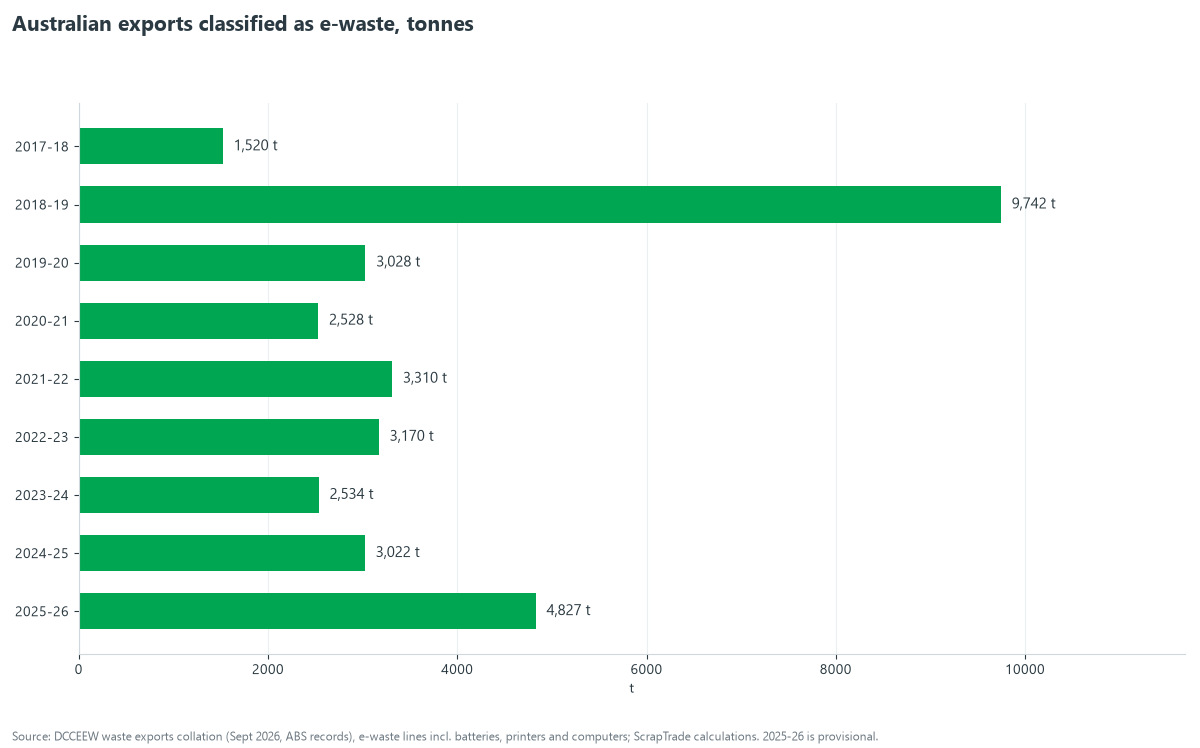
The government's export records include a classification they call e-waste, made up of specific customs lines: printers, copiers and multifunction machines, laptops and computers, and spent batteries. In 2025-26 (provisional), those lines were 4,827 tonnes, with a declared value of A$8.1 million, or about A$1,670 a tonne.
That is a small number against the roughly 500,000 tonnes of e-waste a year the national waste report is reported to show, about 1 percent by our own sum. That suggests most e-waste is processed in Australia into fractions, with whole machines a small part of the trade. The picture is also incomplete, because circuit boards, copper and precious metals would be declared under other lines that we cannot separate.
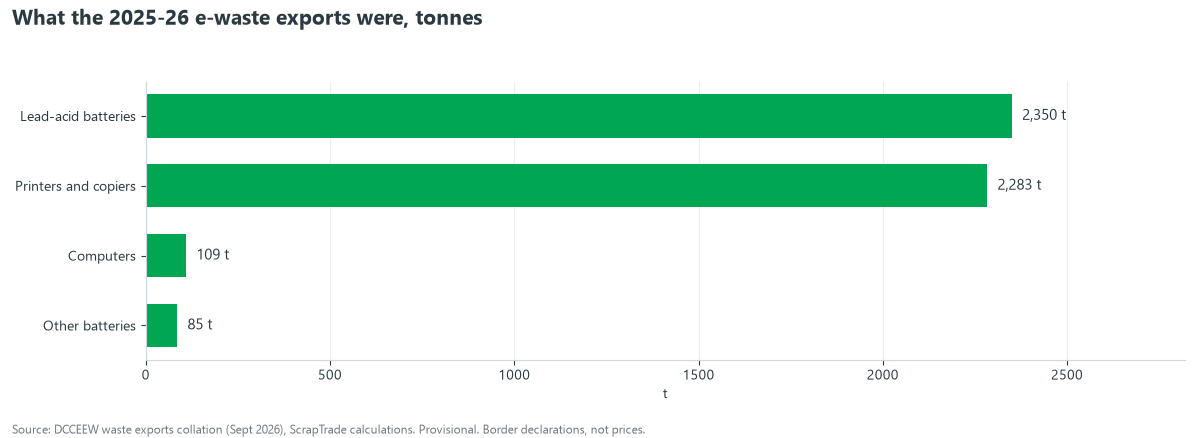
Almost half of the e-waste tonnes in 2025-26 were lead-acid batteries, 2,350 tonnes, and most of the rest were printers, copiers and multifunction machines, 2,283 tonnes. Laptops and computers were only 109 tonnes. India took 38.6 percent of the tonnes, China 27.7 percent, South Korea 11.8 percent, the United Arab Emirates 8.9 percent and Singapore 6.3 percent. New South Wales shipped 1,382 tonnes, Victoria 1,199 and South Australia 971. The total jumped to 9,742 tonnes in 2018-19, then settled between about 2,500 and 3,300 tonnes a year until the latest year. We cannot explain the spike from the records.
Step 6: The materials go back into manufacturing
Recovered metals and plastics go to manufacturers as raw material. We cannot tell you that the aluminium in your laptop becomes another laptop, or where the gold ends up, because the sources we found do not trace any single device. What they do say is that each fraction has a buyer, and that is why sorting at the recycler matters.
How much really comes back?
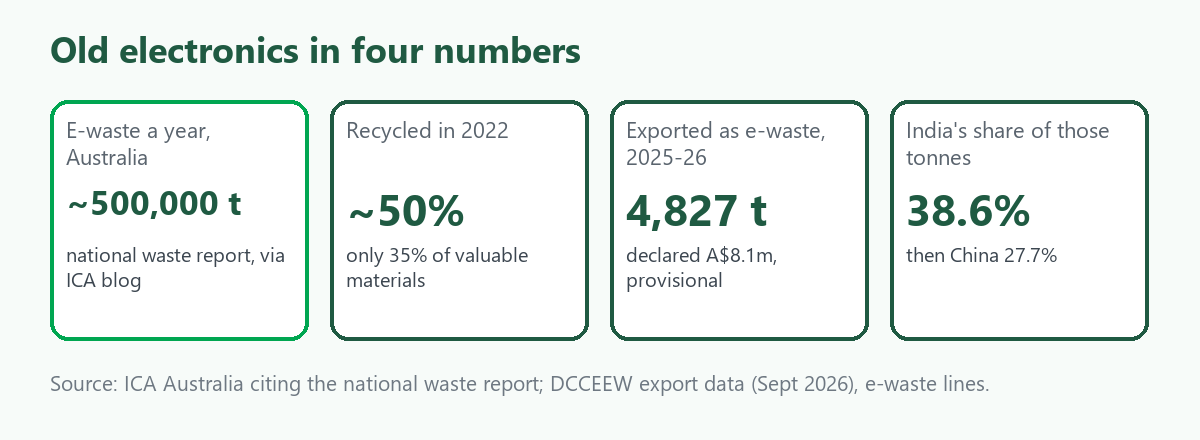
An opinion piece from the International Copper Association Australia, citing the federal national waste report, says Australia produces about 500,000 tonnes of e-waste a year, about 20 kilograms a person, with about half recycled in 2022 and only 35 percent of the valuable materials in it recovered, including copper. It projects a rise of nearly 30 percent to 657,000 tonnes by 2030. A Victorian material flow analysis puts national generation at about 650,000 tonnes in 2021. The two figures differ and we could not check either against the primary reports, so treat them as estimates.
Even so, the gap is the point. Half collected is not all recovered. A device that goes into the general bin is lost, and a device that goes to a recycler can still lose its valuable materials if they are not separated well.
What this means for you
- If you have old devices at home: take them to a council drop-off, a retailer take-back or a scheme collection point, and wipe your data first. Remove loose batteries if you can do so safely.
- If you run a business with equipment to retire: use a recycler that tells you what happens to each fraction, keep records, and ask where circuit boards and batteries go. Check your state's landfill ban.
- If you collect or trade e-waste: keep batteries separate from boards, boards separate from metal, and sort by type. You can list e-waste on the ScrapTrade marketplace or create a free account.
If your TV is broken and you want to sell it, see Can You Sell a Broken TV in Australia?.
For the complete guide to selling broken, faulty, old or used electronics, see Sell Broken, Faulty or Old Electronics.
What we could not verify
- Where your own device goes. Recyclers use different downstream partners.
- Which refiners handle Australian circuit boards today. The sources we found are old, secondary or unopened.
- The national volume and recycling rate. The 500,000 tonne and half-recycled figures come from a blog quoting the national waste report, and the Victorian estimate differs.
- The current NTCRS figures.
- Landfill bans outside South Australia, Victoria and Western Australia.
- How many circuit boards are in the precious metal export lines.
- Why e-waste exports spiked in 2018-19.
- What recyclers or buyers pay. We publish no prices.
Frequently asked questions
Is e-waste banned from landfill in Australia?
In South Australia, Victoria and Western Australia, yes, with different start dates and scope. We could not confirm the other states.
Can I recycle a laptop or television for free?
Often. Televisions and computers are covered by a national industry-funded scheme, and many councils and retailers accept devices. Check what your local drop-off accepts.
What is recovered from old electronics?
Steel, copper, aluminium, plastics, glass and the metals on circuit boards, including copper, gold and silver.
Where do the circuit boards go?
Often to overseas refiners, according to the sources we found. We could not confirm the current destinations.
Sources
- Department of Climate Change, Energy, the Environment and Water, Waste exports data collation, September 2026 (ABS records), ScrapTrade calculations, lines classified as e-waste (customs lines 84433105, 84433207, 84433908, 84713011, 84714121, 84715040, 85491100, 85491900). The 2025-26 figures are provisional.
- Western Australian Government, "E-waste disposal to landfill now banned", 1 July 2024.
- KS Environmental, e-waste recycling process (a Melbourne recycler's own description).
- Canberra Times, "Old TVs head for a new life", 5 June 2012.
- International Copper Association Australia, "Australia's e-waste tsunami" (opinion piece citing the national waste report; undated).
- National Television and Computer Recycling Scheme evaluation and outcomes reports, as surfaced in search results; Victorian e-waste material flow analysis, as surfaced in search results.
This is general information, not financial or legal advice. Process steps are simplified, and recyclers differ. Declared export values are border declarations, not prices. ScrapTrade operates a scrap marketplace and has a commercial interest in the scrap trade.