

An old car is the biggest single item most people ever send to the scrap trade, and the one whose journey is least understood. It is not simply crushed into a cube. It is drained, stripped for parts, torn into fist-sized pieces by a machine, sorted by magnets, and sold off as several different materials, with a stubborn leftover that is hard to recycle. This guide follows one old car from the driveway to a dismantler, a shredder and a steel mill, and shows how much comes back and what does not. It is written for owners with a car they no longer want, and for wreckers and yard operators who want to see the whole chain. The export figures are our analysis of government records, and ScrapTrade has a commercial interest in the scrap trade.
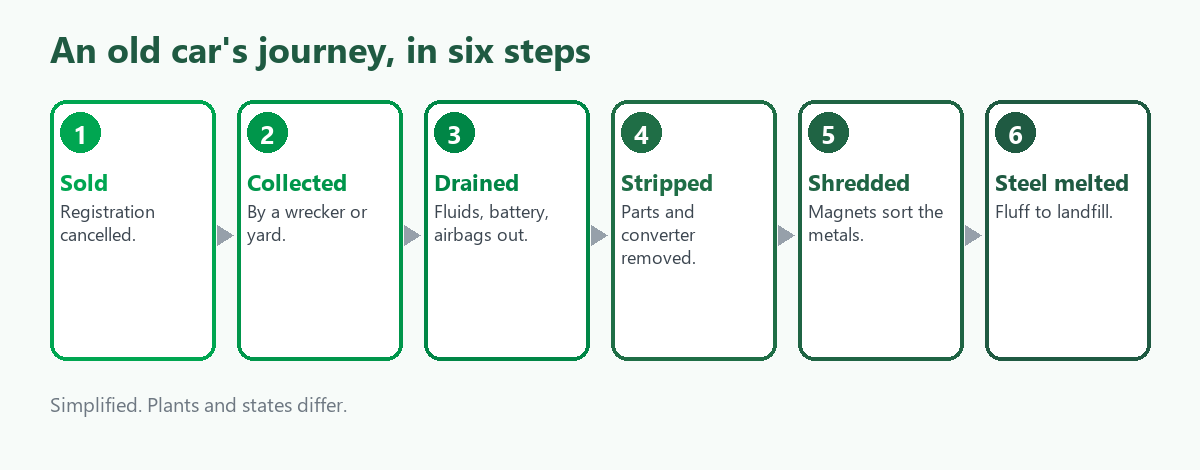
Step 1: The owner lets it go
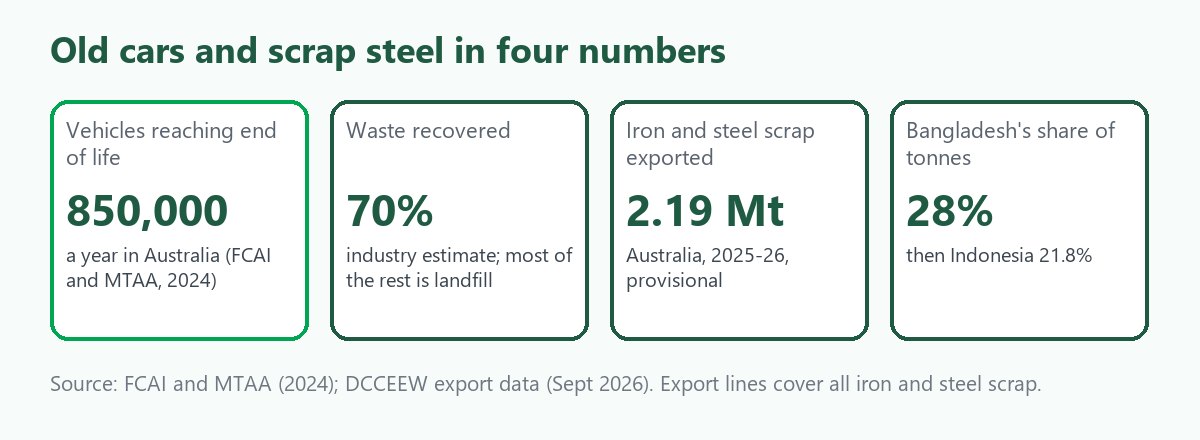
A car reaches the end of its life in one of two ways. It is worn out or too costly to repair, or an insurer writes it off after an accident. Industry figures put the number at about 850,000 vehicles a year in Australia, roughly 5 percent of all motor vehicles, generating about 1.36 million tonnes of waste. Those numbers come from a 2024 study by the Federal Chamber of Automotive Industries (FCAI) and the Motor Trades Association of Australia (MTAA). Dividing one by the other, which is our own sum, gives about 1.6 tonnes of waste for each vehicle.
The paperwork matters at this step. In New South Wales, when a light vehicle is written off it is recorded on the Written-Off Light Vehicles Register and its registration is cancelled. The state says such a vehicle can still be bought and sold, but only for parts or scrap metal. Queensland requires an owner of a total write-off to notify the Department of Transport and Main Roads before selling, unless the insurer or another notifier already has. The rules differ by state, so check yours. Our guide to how to scrap a vehicle lists what to have ready, and what your car may be worth as scrap explains what moves the offer.
Step 2: A buyer collects it
The car is sold to a wrecker, a dismantler, a yard or a cash-for-cars service, and it is towed or driven away. Many buyers collect for free and take the cost out of the offer. This is the part of the chain where most owners deal with a person, and it is also where the choice of buyer matters, because a dismantler who strips the car for parts and a buyer who sends it straight to a shredder are paying for different things. We cover the business side in how to make money from scrap cars.
Step 3: The fluids and hazardous parts come out
Before anything is cut or crushed, the car is made safe. Industry descriptions list the same sequence: drain the oil, petrol or diesel, brake fluid and coolant, and remove the battery and the airbags. These are the parts that can leak, burn or explode in a shredder, and removing them is called depollution. The details of what is required, and by whom, depend on the state and on the operator's licence, and we could not find a single national standard. The FCAI and MTAA study itself recommends authorised facilities with strict environmental and operational standards, which suggests the standard is not yet uniform.
The battery is its own story, told in Where a Car Battery Goes After You Hand It In.
Step 4: A dismantler takes the valuable parts
Next the car is stripped. A dismantler removes what can be resold or recycled separately, such as the engine, gearbox, wheels, seats, mirrors and electronics. Parts that can be sold whole are worth far more than the same weight of scrap, which is why the order matters. Some of what comes off becomes its own recycling journey:
- The catalytic converter goes to a refiner for its platinum, palladium and rhodium, as in Where an Old Catalytic Converter Goes.
- The wiring harness and motors are copper, as in Where Old Copper Wire Goes After You Sell It.
- Alloy wheels are aluminium, priced differently from steel, as we show in what your alloy rims are worth as scrap.
What is left is a stripped shell, the hulk, which is mostly steel.
Step 5: The shredder tears up the hulk
The hulk goes to a shredder. The best description we found of what happens inside is a technical document for a Sims Metal shredder in Smethwick in the United Kingdom, so treat it as an example of the method and not a picture of an Australian plant. The machine is a hammer mill: a rotor with sixteen hammers driven by a 6,000 horsepower motor, rated for up to 220 tonnes an hour at that site. Feed material falls into the chamber and is broken up almost instantly. The document says water is sprayed in to suppress dust and noise and to help against fire.
What comes out is a mix, and the plant separates it in stages:
- Light and heavy streams. A drum with air extraction pulls the light material, away from the heavy metal pieces.
- Magnets. A drum magnet lifts the ferrous pieces, the steel and iron, onto a conveyor. A worker at a picking station pulls out items such as copper wire by hand.
- Non-ferrous. What the magnet does not lift is size-sorted and sent for further processing. In the light stream, an eddy current separator, which uses a changing magnetic field to throw aluminium and other metals off the belt, takes out the non-ferrous metal.
- The leftover. The remaining dirt stream is size-sorted and is either sent for further processing or goes to landfill.
This is the same magnet-and-eddy-current method we described for cans in Where a Drink Can Goes After You Recycle It, only on a car-sized scale.
Step 6: The steel goes to a mill, or overseas
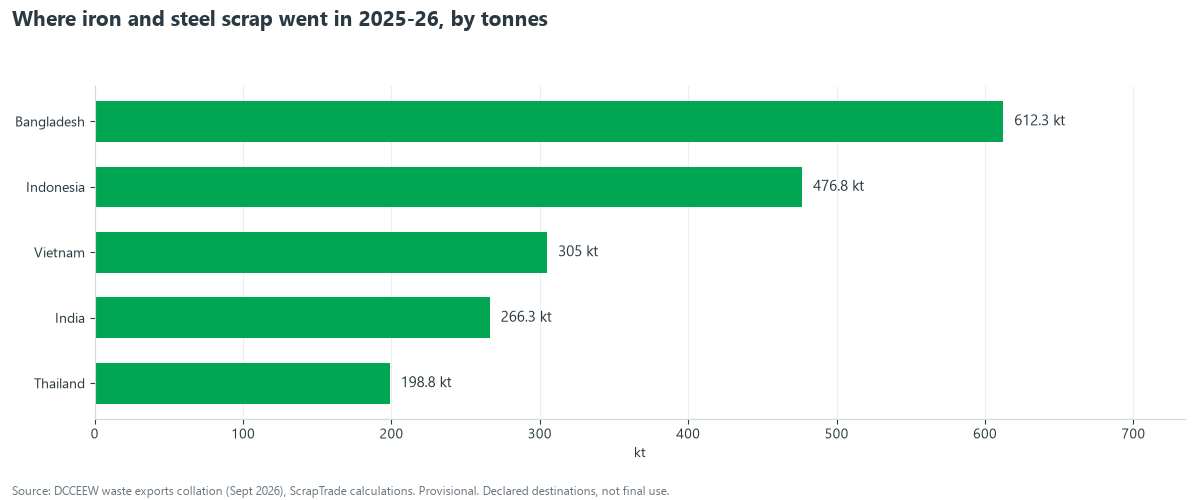
The ferrous pieces are the bulk of the weight and the main revenue. In Australia, much steel scrap is melted in electric arc furnaces such as InfraBuild's at Laverton in Victoria and Rooty Hill in New South Wales, which make products like reinforcing bar and fencing. Australia also exports a lot of it. Government export records for iron and steel scrap, which include shredded car steel but also demolition and industrial scrap, show Australia exported 2.19 million tonnes in 2025-26 (provisional), with a declared value of A$1.37 billion, or about A$625 a tonne. That is up from 1.44 million tonnes at about A$486 a tonne in 2017-18.
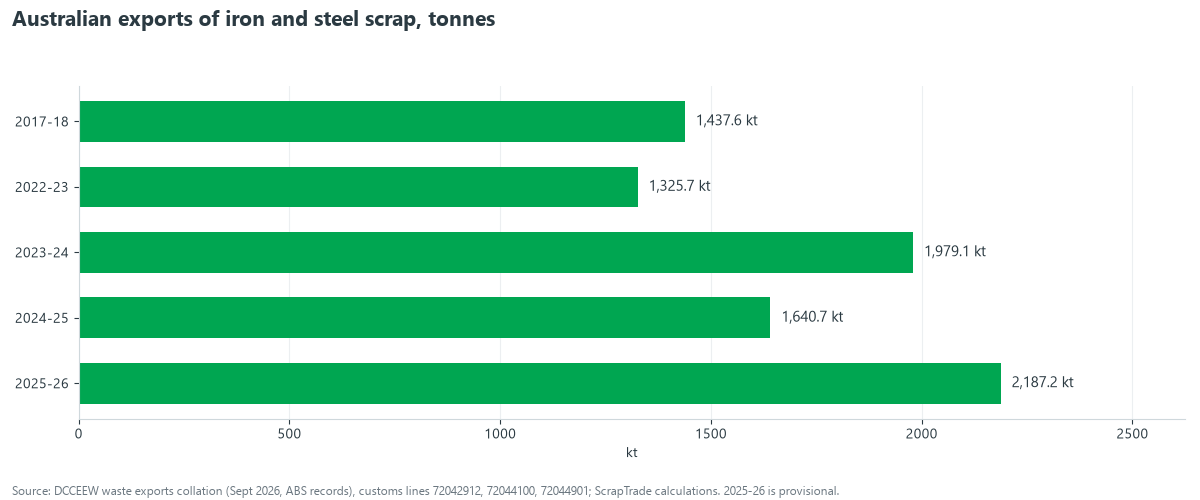
Bangladesh took 28 percent of the 2025-26 tonnes, Indonesia 21.8 percent, Vietnam 13.9 percent, India 12.2 percent and Thailand 9.1 percent. By state of origin, Queensland shipped about 702,000 tonnes, Western Australia 498,000, Victoria 475,000 and New South Wales 353,000. We cannot say from these records how much of it began as a car, so treat the figures as the setting for the car's steel and not as a count of cars. For who buys it and why, see Bangladesh vs Indonesia vs Vietnam: Australian Scrap Buyers, and for how steel scrap is graded, What is Heavy Melt Scrap?
The non-ferrous metals are sold on separately. Aluminium and copper from the shredder go to smelters and refiners, as in the other journeys in this series, and a good share of that is exported too.
Step 7: The leftover that is hard to recycle
Not everything in a car is metal. Seats, carpet, foam, glass, rubber and plastics typically make up the part of the car that a shredder cannot turn into clean metal. In the trade it is called fluff, or automotive shredder residue. The FCAI and MTAA study says there are limited recycling options for non-metal materials in Australia, and that significant amounts still go to landfill because there are not enough viable processing options. We did not find an Australian figure for how many tonnes of fluff a shredder produces or what share of a car it is. So we give no percentage.
How much of the car really comes back?
The same FCAI and MTAA study says the industry currently recovers about 70 percent, and the remainder is destined primarily for landfill. That figure is an industry estimate, and it does not tell you whether recovery is measured by weight or how reuse of whole parts is counted. The picture is lopsided: the metal, especially steel, is recovered because someone will pay for it, and the plastics and fabrics are not.
The study proposes a co-regulatory national product stewardship scheme, with authorised facilities, certificates of destruction to track vehicles and nationally consistent standards, to lift that number. We found no evidence it has been adopted, so we cannot say what the rules will be.
What this means for you
- If you have a car to scrap: cancel or transfer the registration as your state requires, keep proof of the sale, and ask the buyer whether they dismantle the car or send it straight to a shredder. Remove your belongings and any toll tags.
- If you run a wrecking business: the money is in the order of work. Pull the saleable parts and the converter before the hulk goes to the shredder, keep records of every vehicle, and compare shredder buyers before you sell your steel.
- If you sell steel or non-ferrous scrap: you can list your load on the ScrapTrade marketplace or create a free account.
For the aluminium wheel, from the tyre shop to the remelter, see Where an Old Alloy Wheel Goes After Scrapping.
For the brass and bronze journey, from the plumber to the furnace, see Where Old Brass and Bronze Go After You Sell It.
For the stainless steel journey, from the job site to the mill, see Where Old Stainless Steel Goes After Selling.
For old laptops, TVs and circuit boards, from the drop-off point to the refiner, see Where Old Electronics Go After You Hand Them In.
What we could not verify
- Where your own car goes. A buyer may dismantle it, sell it on, or send it to any of several shredders.
- How much of an Australian car is steel, non-ferrous or fluff. We found no current Australian composition figure.
- How much car steel is exported. The customs lines cover all iron and steel scrap.
- What happens at Australian shredders. The process description is from a UK plant.
- The 70 percent recovery rate and the 850,000 vehicle count. Both are industry estimates from one study.
- Whether a national scheme has been adopted.
- What buyers pay today. The A$625 a tonne is a declared export value, not a yard price.
Frequently asked questions
What actually happens to a car at the wreckers?
It is drained of fluids, stripped of the battery and airbags, and dismantled for parts that can be resold. The remaining shell is usually sent to a shredder.
Is a scrapped car just crushed?
Not usually. Some yards flatten hulks to move them, but the metal is recovered by shredding the hulk and sorting the pieces with magnets and eddy current separators.
How much of a scrapped car is recycled?
Industry estimates put the recovery rate at about 70 percent of the waste. Metals are recovered. Much of the non-metal material is not.
Can a written-off car be driven again?
In New South Wales a written-off light vehicle is recorded on a register and its registration is cancelled. It can only be sold for parts or scrap metal.
Sources
- Federal Chamber of Automotive Industries and Motor Trades Association of Australia, "The Outlook for End-of-Life Vehicles in Australia", August 2024, as summarised on the FCAI website, in an industry news item and by MTA NSW (4 September 2024).
- NSW Government, Owning or buying a written-off light vehicle. Queensland Government, Notifying of written-off vehicles.
- Sims Group UK Limited, Smethwick, Operating Techniques Appendix 4, Shredder Process Description, April 2022.
- TAGG, "The process of vehicle recycling" (a trade description of depollution and dismantling).
- InfraBuild, Steel is infinitely recyclable (media release).
- Department of Climate Change, Energy, the Environment and Water, Waste exports data collation, September 2026 (ABS records), ScrapTrade calculations, customs lines 72042912, 72044100 and 72044901. The 2025-26 figures are provisional.
This is general information, not financial or legal advice. Process steps are simplified, and plants differ. Declared export values are border declarations, not prices. ScrapTrade operates a scrap marketplace and has a commercial interest in the scrap trade.