

Selling a few hundred kilograms to a local yard takes an afternoon. Selling a container to a mill on the other side of the world takes weeks, a handful of documents, and a series of checks that most first-time exporters do not see coming. None of the steps is mysterious, but each one is a place where deals go wrong if nobody thought about it. This guide walks through a typical scrap export deal from the first conversation to the last payment, shows what different countries ask of a seller, and lists the common failure points. It describes a typical process and is not a legal checklist. Rules differ by country, by cargo and over time, so check them for your shipment.
The steps are drawn from how the trade commonly works, from the requirements of specific countries that we could verify, and from how ScrapTrade handles deals. Where a requirement comes from a trade source or a single report, we say so.
Step 1: agree the grade and the quantity
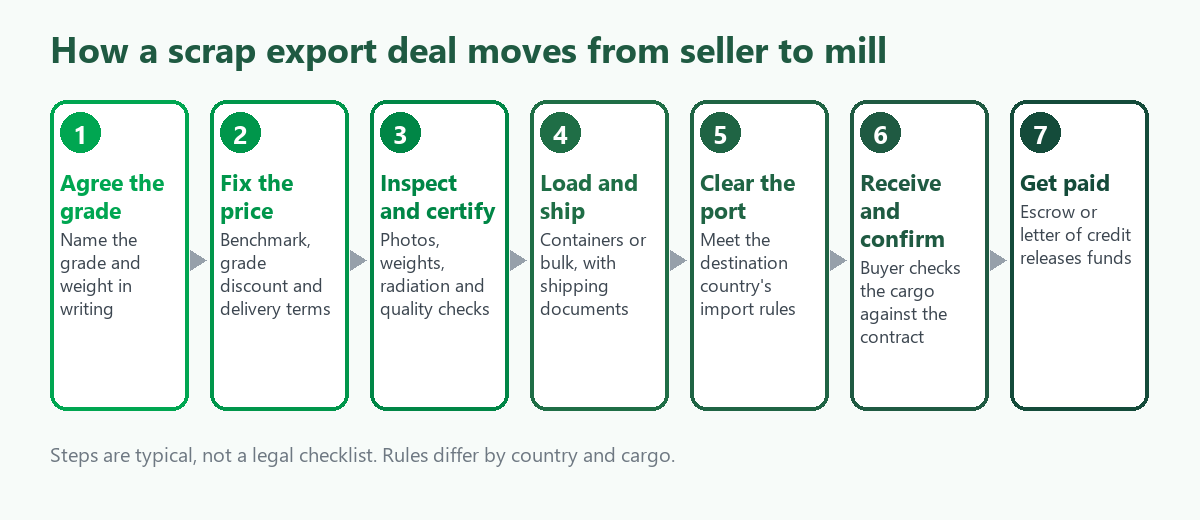
Every export deal starts with a description of what is being sold. A buyer who wants "steel" has not described anything. The deal needs a named grade, an agreed quantity with a tolerance, and a statement of what is not allowed in the load. Heavy melting steel, shredded steel, bare bright copper and aluminium extrusion are different products with different prices. Put it in writing, and attach photos of the actual material. See how to grade scrap metal.
Where it goes wrong: vague descriptions. A mixed pile described as a single grade is the origin of most disputes later.
Step 2: fix the price and the delivery terms
The price of scrap in an export deal is usually built from a reference price, an adjustment for grade and quality, and the delivery terms that decide who pays for freight and insurance. Terms such as FOB (the seller loads the ship) or CFR (the seller pays freight to the destination port) move a large part of the cost from one side to the other. The real cost of sourcing scrap abroad breaks down what sits between a headline price and a delivered cargo.
For reference prices, a calculator such as ScrapTrade's price index gives an indicative figure, but it is an estimate and not a quote. A firm price comes from the buyer. Competing offers are the best way to find the market. See why competing offers beat a single quote.
Where it goes wrong: pricing the metal and forgetting the freight, or agreeing a price with no clause for what happens if the cargo is re-graded.
Step 3: inspect and certify
Before anything is loaded, the seller records what is in the load: weights, photos, and a check that the material matches the grade. For many destinations, an independent inspection is part of the process.
India is the clearest example we could verify. It requires a pre-shipment inspection certificate from an approved agency stating that the consignment was checked for gamma and neutron radiation and does not exceed natural background. The certificate must report the background level and the maximum level found, and confirm that there are no arms, ammunition or explosives. Containers without it are not unloaded and are sent back [1]. See India's Scrap Market: Imports, Duties, Rules.
Where it goes wrong: skipping the certificate. A container that fails on paper is returned at the seller's cost.
Step 4: load and ship
Material is loaded into containers or onto a bulk vessel, and a freight forwarder or shipping line issues the transport documents. The usual paperwork for an export cargo includes a bill of lading, a commercial invoice and a packing list, and some destinations ask for a certificate of origin or other certificates. A freight forwarder will advise which apply to your cargo and route.
Some materials need extra care. Batteries and certain electronic wastes can require permits to export from Australia, and hazardous materials have specific packing and labelling rules. If your load includes anything other than plain metal, ask the regulator or a licensed forwarder before you book.
Where it goes wrong: loading mixed or contaminated material, or including something that needs a permit.
Step 5: clear the destination port
Every importing country has its own rules, and they change. Three that we could verify:
| Country | What it asks of a scrap exporter | Source |
|---|---|---|
| India | Pre-shipment inspection certificate, compliance with Bureau of Indian Standards quality control orders, and the applicable import duty, which sources report differently | [1][2] |
| China | Copper, aluminium and ferrous recycled raw materials can be imported if they meet quality standards. A trade source says non-ferrous scrap must reach 99.1% purity and faces customs inspection | [3] |
| European Union (as a source) | From 21 May 2027, metal scrap may only go to non-OECD countries on an authorised list. This applies to EU exports, not Australian ones | [4] |
See China's Copper and Aluminium Scrap Rules. Your buyer is normally responsible for import clearance, but a cargo that fails it becomes your problem under most contracts, which is why you should understand the rules of the country you are shipping to.
Where it goes wrong: assuming last year's rules still apply.
Step 6: receive and confirm
When the cargo arrives, the buyer checks it against the contract: weight, grade, and any contamination. This is the moment disputes happen, which is why the earlier records matter. A good contract says how weights are taken (loading or discharge), what tolerance applies, and how a claim is raised and resolved.
On ScrapTrade, disputes are raised against the specific order, tied to the conversation between the parties, before payment is released from escrow, which is what makes the evidence in steps 1 to 3 count. See trust and safety.
Where it goes wrong: no agreed weighing point, so each side brings a different number.
Step 7: get paid
The last step is the one every seller worries about first. Common ways to manage payment risk in an export deal are a letter of credit from the buyer's bank, a deposit paid before shipment, or an escrow arrangement. On ScrapTrade, payment is held in escrow from the moment a deal is confirmed and released only once pickup or delivery is confirmed on both sides, so neither party is exposed before the other follows through [5]. For international shipments, that matters more, because there is no in-person handover to fall back on.
Where it goes wrong: shipping before payment is secured, and discovering the buyer cannot be found.
The paperwork at a glance
| Document | What it does | Typically provided by |
|---|---|---|
| Contract or order | Fixes grade, quantity, price and terms | Seller and buyer |
| Photos and weight records | Evidence of what was loaded | Seller |
| Inspection or radiation certificate | Required by some destinations, such as India | Approved inspection agency |
| Bill of lading | Receipt and title document for the cargo | Shipping line or forwarder |
| Commercial invoice and packing list | Describe the goods and their value | Seller |
| Certificate of origin and others | Required by some destinations | Seller or authorities |
| Proof of payment | Escrow release, letter of credit or bank transfer | Buyer or platform |
This is a typical list and not a legal checklist.
Five ways deals go wrong
- A vague grade. The cargo is re-graded on arrival and the price is cut.
- A missing certificate. The container is held or sent back.
- Surprise costs. Freight, demurrage and fees are not in the price.
- Changed rules. A duty, standard or inspection requirement changes between contract and arrival.
- No protection on payment. Money is released or promised before the cargo is confirmed.
How to start
If you have never exported scrap, the sensible path is to begin with a small, well-documented deal, with a buyer you can verify, a clearly described grade and a payment method that protects both sides. Read trading scrap internationally, check the countries involved in World Scrap Trade: Top Importers and Exporters, and list your material on the marketplace or learn how ScrapTrade works.
Frequently asked questions
How do I export scrap metal from Australia?
Agree a grade and price with a buyer, document and inspect the load, ship it with the right paperwork, make sure it meets the destination's import rules, and arrange secure payment. Check with the regulator for any permit that applies to your material.
What documents do I need to export scrap?
Typically a contract, a bill of lading, a commercial invoice and a packing list, plus any certificates the destination requires, such as India's radiation inspection certificate [1].
Does scrap need to be inspected before export?
Many destinations require it. India requires a pre-shipment certificate that the cargo was checked for radiation [1].
How do I get paid safely?
Options include a letter of credit, a deposit before shipment, or escrow. On ScrapTrade, payment is held in escrow until delivery is confirmed [5].
What are the most common mistakes?
Vague grade descriptions, missing certificates, unpriced freight, outdated rules and shipping before payment is secure.
Sources
- Indian customs and DGFT rules on pre-shipment inspection of scrap imports, as summarised in TaxGuru and TaxTMI.
- National Recycling Corporation, Metal scrap import duty India: FY 2026-27 guide, a trade blog. Duty figures conflict between sources.
- Recycling International, Clarity on easing of non-ferrous scrap into China; AMCS Group, Exporting scrap metals to China, Malaysia or Indonesia?, a trade blog.
- Reporting on the European Commission's draft delegated act under Regulation (EU) 2024/1157, as summarised in Europe Is Keeping Its Scrap. Who Pays?.
- ScrapTrade, trust and safety and how it works.
This guide describes a typical process and is not legal, customs or trading advice. Rules differ by country, cargo and over time, so check them for your shipment. ScrapTrade operates a scrap marketplace and has a commercial interest in the scrap trade.