

Most people who ask how to start a scrap yard are really asking three different questions. Can I do this legally? Can I find enough material and buyers to keep it busy? And what will it cost me before the first truck comes through the gate? This checklist works through them in order. It leans on what we could verify from official sources for the state rules, and it is blunt about what we could not source, most of all the cost of building a yard. It is general information, not legal advice, and the rules change. If you only want to start with little risk, read How to Start a Scrap Business in Australia first. It is the broader guide, and a yard is one option in it.
First, is a yard the right start?
A yard means a site, equipment and approvals. There are lighter ways in, and many people use them to learn before committing to a site. A collector gathers material they may legally take and sells it. An agent works for a seller or buyer and earns a commission, as described on ScrapTrade's agent page. A broker sources scrap from an original seller and resells it, as described on the broker page. None of these needs a yard. We compare them in Who Is Who in Scrap.
Meet Alex (invented). Alex has worked for a metal recycler for six years and now wants a yard of their own. Alex can run a weighbridge and grade copper. What Alex has not done is deal with registration, permits and a landlord, and the checklist below is for that part.
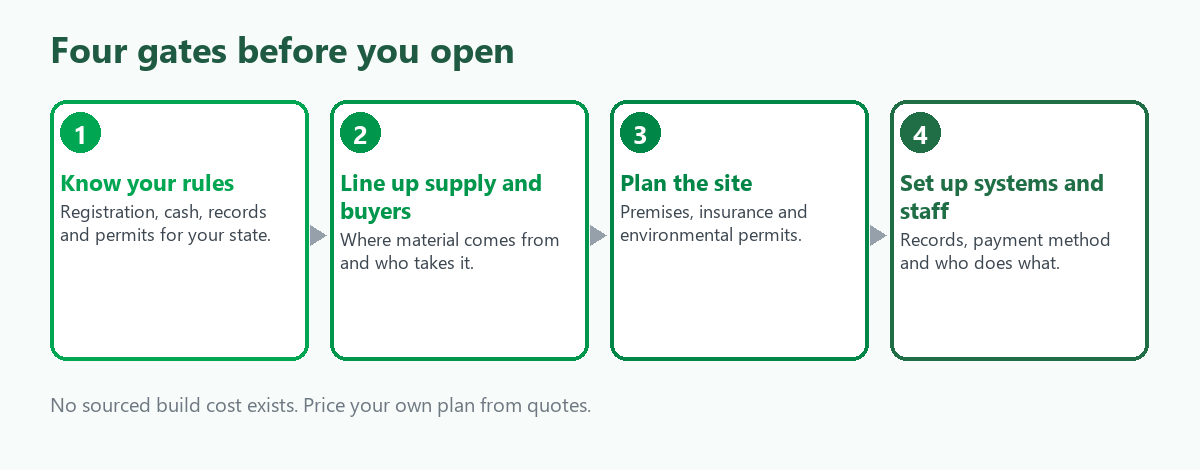
Gate 1: know the rules for your state
Australia has no national scrap metal licence. Each state and territory makes its own rules [1]. From official sources we verified the following, and we say where we could not.
| State | Registration or licence | Cash for scrap |
|---|---|---|
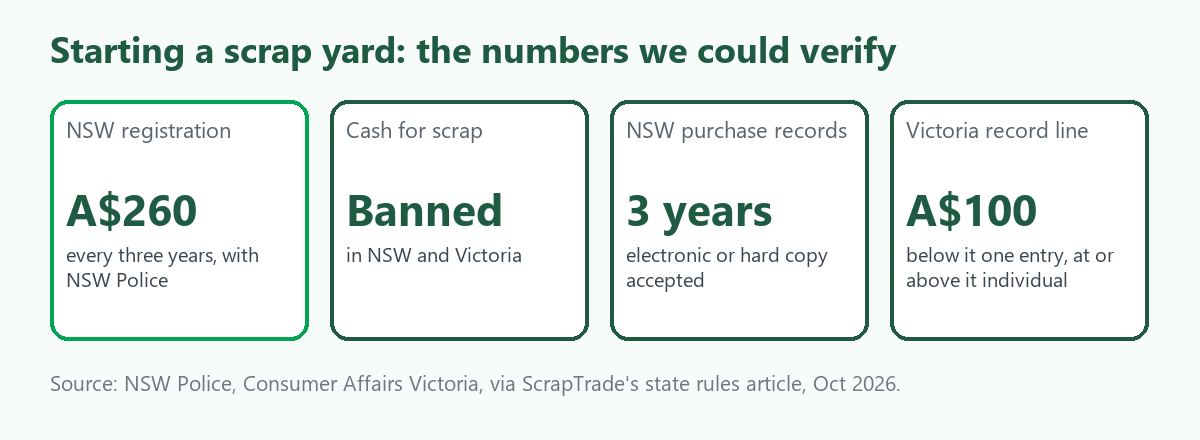
| NSW | Business registered with NSW Police, A$260 every three years | Banned |
| Victoria | Registered second-hand dealer | Banned |
| Queensland | Licensed second-hand dealer, trading from licensed premises | Not confirmed |
| Western Australia | Second-hand dealer licence from WA Police; scrap status not confirmed | Not confirmed |
| South Australia | Registration planned under the Scrap Metal Dealers Act 2025, not yet in operation | Planned ban |
Some details that change a yard's day-to-day:
- Records. In NSW a dealer keeps a record of each purchase, including the seller's details, for three years, in a form the Commissioner of Police approves. In Victoria, items worth less than A$100 can be logged as one entry, and items of A$100 or more must be recorded individually. Both are covered, with sources, in Scrap Business Rules in Australia by State.
- How you pay sellers. If you set up in NSW or Victoria, you will pay by transfer or an allowed cheque, so you need a business bank account before you open.
- Vehicles. A NSW dealer must not buy a motor vehicle as scrap if its identifying details are missing.
- Moving targets. Queensland passed reforms on 15 October 2026 with no start date stated, and South Australia's Act has not started.
We did not verify Tasmania, the ACT or the Northern Territory. Ask the regulator in your state before you sign anything.
Gate 2: find the material and the buyers
A yard is a middleman between the people who have scrap and the people who want it, so it needs both ends before it needs a lease. Alex's questions:
- Where will material come from? Trades, demolition crews, factories, walk-in sellers. We explain the sources in Australia's Scrap Metal Exports: 2025-26 Data, which shows Australia exported 3.05 million tonnes of metal scrap in 2025-26.
- Who will buy it? Mills, processors and exporters. See Who Buys Australia's Aluminium and Copper Scrap.
- What price can I count on? We found no sourced Australian yard price list. What you can check yourself is the world benchmark in Australian dollars, as in Scrap Metal Benchmark Prices in A$ per kg.
A practical test is to line up one or two buyers before you open, and to ask each what they pay for your grades, what they deduct and when they pay. That tells you more about your margin than any industry average.
Gate 3: the site, the permits and the paperwork
A site that stores, sorts or processes scrap may also need a licence or permit from the state environmental regulator, and carrying waste can have its own requirements. We did not verify the thresholds, so ask your state EPA before you commit to a site [1].
Documents to have ready, as listed in our state rules article [1]:
- photo identification, and criminal record checks where required (as in NSW)
- an ABN, if you are entitled to one; the Australian Business Register says not everyone is, and applying when you are not may lead to prosecution
- business structure details: sole trader, company or partnership
- proof of premises and insurance
- an environmental licence if you process or store material
- seller identity details and transaction records
- a bank account to pay by transfer
Tax questions, including GST, are for a registered tax agent.
What a business plan for a yard should answer
Searches for "scrap yard business plan" usually want a template. A template is only as good as the answers in it, so here are the questions the plan needs to settle. We give no figures because we found no sourced ones.
- What will you buy and from whom? Name the first ten suppliers you could approach.
- What will you sell and to whom? Name the buyers and what they accept.
- What does one tonne cost you to buy, handle and sell? The margin is the gap, and it is what pays for everything else.
- What must be in place before day one? Registration, permits, insurance, a weighbridge, and a payment method that is legal in your state.
- How long can you operate before it pays? Work out the number of months of rent and wages you can cover from savings.
- What are your records? Who you bought from, what, when, and how you paid, in a form your regulator accepts.
- What is the exit? If it does not work, what can you sell and what do you still owe?
What it costs: what we cannot tell you
The question "how much does it cost to start a scrap yard" is the one people search most, and we cannot answer it with a number. A yard's cost depends on the site, the equipment and the stock you carry, and we found no sourced Australian figure. Our related guide on how much money to start a scrap business explains how much cash a single lot of scrap can tie up, which is a useful starting point for the working-capital part.
What you can do is price your own plan: ask landlords and equipment sellers for quotes, and add your first three months of working capital.
Gate 4: systems and staff
Records are part of the compliance load, so decide early how you will keep them. Paper works for a start, but a digital system makes it easier to find a supplier's last docket, show who handled a load and bill customers. ScrapTrade's yard tools cover inventory, customers, suppliers, dockets, invoices and staff access in one account, with multiple yards possible. We describe them in Own a Digital Scrap Yard. They do not replace the weighbridge, payroll or compliance.
Selling from your yard
Once the yard is running, you can list lots on the ScrapTrade marketplace and compare bids, as How It Works describes. The Trust & Safety page says payment is held in escrow from the moment a deal is confirmed and released once pickup or delivery is confirmed. Create a free account to set up. ScrapTrade has a commercial interest in the scrap trade.
What we could not verify
- The cost to build and equip a yard. No sourced figure.
- Environmental permit thresholds in any state.
- Rules in Tasmania, the ACT and the Northern Territory.
- Western Australian treatment of scrap dealers.
- Whether Queensland's reforms restrict cash.
Frequently asked questions
Do I need a licence to open a scrap yard in Australia?
There is no national licence. NSW requires registration with NSW Police, Victoria a registered second-hand dealer, and Queensland a licensed second-hand dealer. Check your state [1].
Can I pay sellers cash?
Not in NSW or Victoria [1]. Other states vary or are changing.
How long do I keep records?
NSW says three years, in the form the Commissioner of Police approves [1]. Victoria's page does not state a period, so ask Consumer Affairs Victoria.
How much does it cost to start a scrap yard?
We could not find a sourced figure. Price your own plan from quotes.
Can I start smaller than a yard?
Yes, as a collector, agent or broker. See the guides linked above.
Sources
- ScrapTrade, Scrap Business Rules in Australia by State, which cites NSW Police, Consumer Affairs Victoria, the Queensland Government, WA Police, South Australian Legislation and the Australian Business Register, accessed October 2026.
Alex is invented. This is general information, not legal, tax or financial advice. ScrapTrade operates a scrap marketplace and has a commercial interest in the scrap trade.