

A catalytic converter is a metal canister in a car's exhaust that weighs a few kilograms. Its steel shell is worth little. What makes it a scrap category of its own is the honeycomb inside, which carries a thin coating of platinum group metals (PGMs). Those metals are why converters are bought, why they are stolen and why a seller cannot price one by looking at it. This article explains what is known about them in Australia, what is not, and what customs data says about the export side. It is general information, not trading or legal advice.
What is inside
A converter is fitted to a vehicle's exhaust to reduce emissions. Inside the outer shell is a ceramic honeycomb that carries the precious metals palladium, platinum and rhodium, which drive the chemical reaction that cleans exhaust gases as they pass through [1]. The amount differs by vehicle, so two converters that look alike can hold very different quantities. We do not quote per-converter gram figures here because the numbers we found came from recycler and equipment-vendor blogs and varied by source.
The metals can be recovered and used again. The World Platinum Investment Council (WPIC) says PGMs are for the most part infinitely recyclable, that the first autocatalysts were fitted to cars in the 1970s, and that large quantities of metal have built up in cars on the road [2]. A 2018 review by Western Sydney University researchers describes the usual recovery route as thermal treatment followed by leaching and solvent extraction, and reviews methods used for converter scrap in Australia [3].
Why the value is hard to see
Most scrap is bought by weight and grade. Converters are different: the value sits in a coating you cannot weigh. As summarised in search results from recycler and equipment-vendor sources, buyers take samples and measure the metal content using analytical instruments, and payment follows the results. The practical effect is that the seller depends on the buyer's assay, and the buyer in turn depends on a refiner's.
WPIC describes the chain as opaque. Its August 2025 analysis says refiners of scrap generate stable margins through price cycles, but scrapyards and aggregators have different exposure to PGM prices, so recycled supply responds to price. It found that the fall in the PGM basket price from 2022 to 2024 reduced recycling supply, and that high prices supported upgrades to its recycling forecasts from 2019 to 2021. It calls palladium the dominant metal in recycling economics and expects palladium markets to move into surplus from 2026, which is a forecast [2].
For a seller this has three consequences.
- Prices move with the metal markets, so a quote is only good for a short time. Our market view is in Platinum and Palladium: Price Analysis and Outlook.
- Two quotes can differ for reasons you cannot see: the buyer's assay method, deductions and how fast they pass on market moves.
- Selling to more than one buyer is the only real check. See How to Get the Best Scrap Metal Prices.
What is known about theft in Australia
Theft is the part of the story that gets the headlines, and the evidence we could verify is thin and dated.
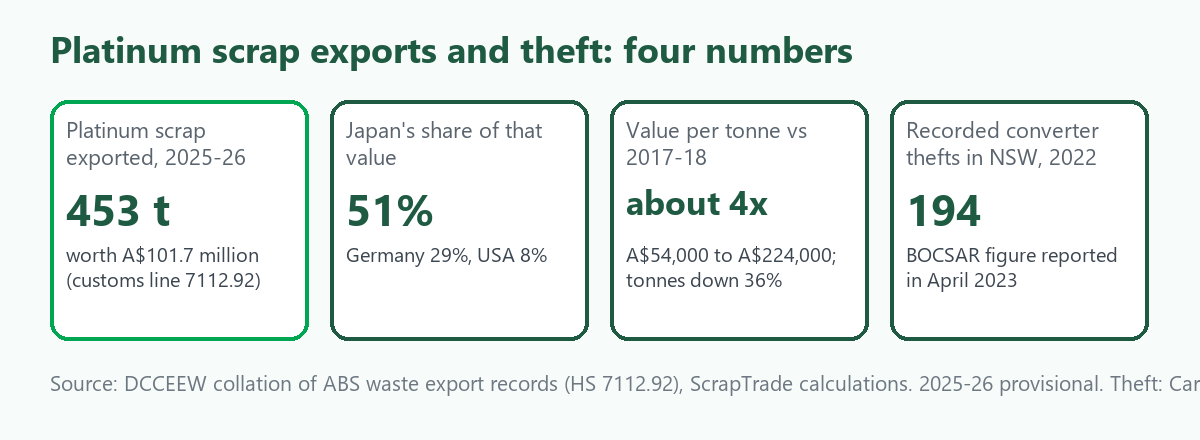
A CarExpert article from April 2023 reported that converter theft was becoming increasingly common. It cited NSW Bureau of Crime Statistics and Research figures, published by the ABC, showing 194 recorded converter thefts across the state in 2022, and it said South Australia Police had warned of thefts from driveways, car parks and main roads. It also reported that Queensland Police had charged three people after a two-month operation in the south-east of the state [1]. The article quotes the Victorian Automotive Chamber of Commerce arguing that the sales channel is the key: cut off the buyers and thieves have less opportunity and a lower price [1].
We could not find 2025 or 2026 statistics for any Australian state. Treat the numbers above as a snapshot, not a trend. Police advice cited in the same article includes parking securely, painting the converter and engraving the vehicle's registration or VIN on it, and not leaving cars up on ramps or stands [1].
What this means for anyone who buys converters
This is not legal advice and the rules differ by state. Dealer licensing, record-keeping and payment rules for scrap are covered in Scrap Business Rules in Australia, State by State. A few practical habits go with them.
- Know the seller. Check identity and keep a record of who sold what and when.
- Ask where the converter came from. A vehicle dismantler can usually point to the car. A stranger with several loose converters is a different case.
- Be cautious about cash and volume. Unusually large quantities, or sellers who want to be paid quickly in cash, are the classic warning signs.
- Keep a transaction record that would let you show a regulator or police where a part came from.
The same logic is why How to Verify Scrap Before You Buy or Sell applies to this trade more than most.
What the export data shows
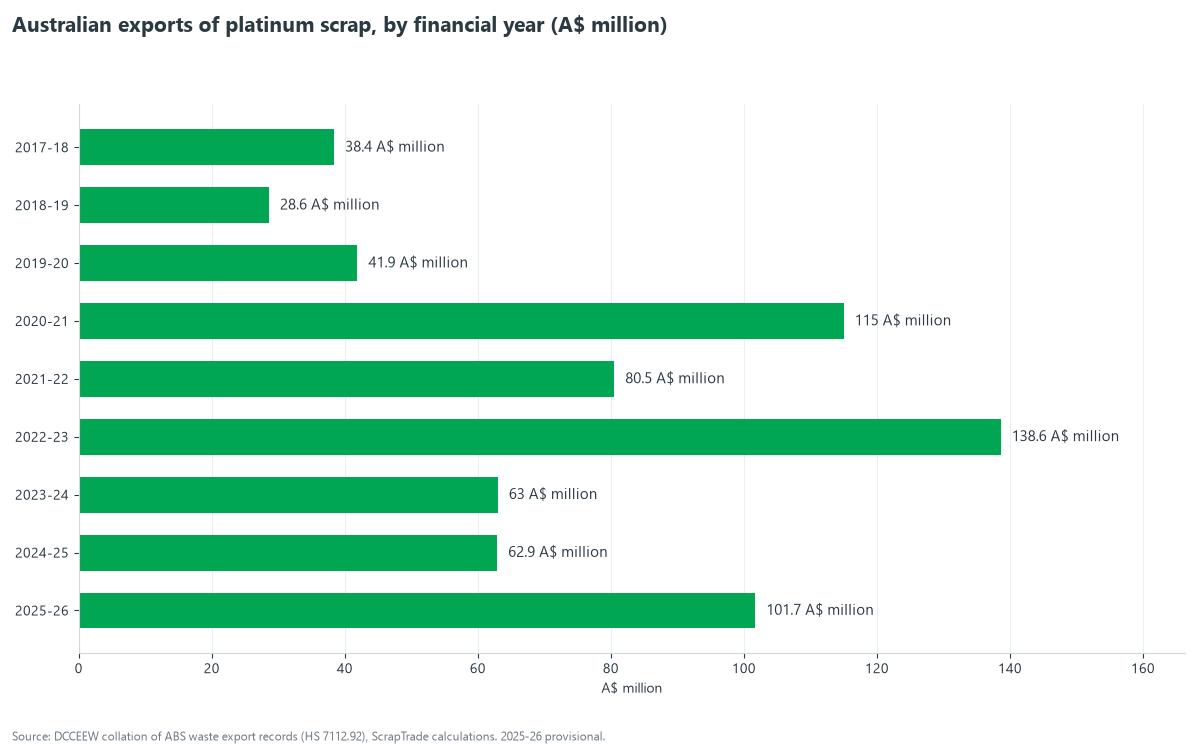
Australia's customs data has a line for waste and scrap of platinum, metal clad with platinum and other scrap used principally for the recovery of platinum (HS 7112.92). Spent converters are one source of material for that line, but the line can also include other platinum-bearing scrap, so we cannot say how much of it is converters. With that caveat, the Department of Climate Change, Energy, the Environment and Water (DCCEEW) collation of Australian Bureau of Statistics records shows [4]:
| Year | Tonnes | Value (A$ million) | A$ per tonne |
|---|---|---|---|
| 2017-18 | 705 | 38.4 | 54,500 |
| 2018-19 | 568 | 28.6 | 50,400 |
| 2019-20 | 436 | 41.9 | 96,100 |
| 2020-21 | 618 | 115.0 | 186,100 |
| 2021-22 | 352 | 80.5 | 228,700 |
| 2022-23 | 782 | 138.6 | 177,200 |
| 2023-24 | 229 | 63.0 | 275,000 |
| 2024-25 | 345 | 62.9 | 182,500 |
| 2025-26 | 453 | 101.7 | 224,500 |
Source: DCCEEW collation of ABS waste export records (HS 7112.92), ScrapTrade calculations. 2025-26 provisional. Value is customs value, not a price.
Between 2017-18 and 2025-26, tonnes fell 36% while value rose 2.6 times, so the value per tonne roughly quadrupled. That is consistent with higher PGM prices, which we cover in our price analysis, but customs values also depend on the metal content of what is shipped, so the data alone cannot prove the cause. The year-to-year swings are large because shipments are few and lumpy.
In 2025-26 the 453 tonnes went to 11 destinations. Japan took 246 tonnes worth A$52.1 million (51% of the value), Germany 134 tonnes and A$29.2 million (29%), the United States 35 tonnes and A$8.2 million, the United Kingdom A$5.7 million and South Korea A$3.9 million. By state of origin, Victoria accounted for A$62.4 million and New South Wales for A$28.5 million [4]. We have no information on who the exporters or buyers are.
A related line, other precious-metal scrap (HS 7112.99), was larger in 2025-26: 1,785 tonnes worth A$269 million. It is dominated by a few very high-value shipments, such as 41 tonnes to Korea worth A$98.7 million, 60 tonnes to South Africa worth A$69.0 million and 4 tonnes to New Zealand worth A$60.0 million [4]. Because it covers all precious metals other than gold and platinum, we do not link it to converters.
The export side connects to the rules in Australia's Waste Export Rules and Scrap Metal: that article explains that e-waste is presumed hazardous and that classification is the regulator's call. Whether a particular spent converter is treated as hazardous waste for export is not something we could confirm from the pages we read, so check with the Department before shipping.
A scenario: a dismantler with a bucket of converters
Daniel runs a small dismantling yard in Western Sydney (invented). Over a month he removes 40 converters from end-of-life cars and keeps them in a locked bin. A buyer offers a price per piece "for the lot" and says it is based on a quick look.
- He records the source of each converter against the vehicle it came from.
- He asks the buyer how the price is set. Is it assay-based, by grade, by vehicle model or by weight?
- He gets a second quote on the same bin from a different buyer.
- He keeps the paperwork, including the identity of the buyer and the date.
- He does not accept cash for the whole lot without a receipt that shows the quantity and the terms.
The most valuable step is the second quote. The assay method is the buyer's, and the only way to learn what it is worth is to compare.
What we could not confirm
- Per-converter metal content. We do not quote one because our figures were from vendor blogs.
- Current Australian theft statistics. The latest figure we verified is NSW for 2022.
- State laws specific to converters. We did not find rules for converters separate from general scrap dealer laws.
- How many exported tonnes are converters. The customs lines are broader.
- Hazardous-waste treatment of spent converters for export. Check with the regulator.
Frequently asked questions
What precious metals are in a catalytic converter?
Platinum, palladium and rhodium, in a coating on a ceramic honeycomb [1].
How is the scrap value of a converter decided?
By the metal content, which buyers measure with analytical instruments, not by weight alone. Quotes move with PGM market prices [2].
How common is converter theft in Australia?
NSW recorded 194 thefts in 2022, according to figures cited in an April 2023 article. We found no newer national figures [1].
Does Australia export platinum scrap?
Yes. The customs line for platinum scrap recorded 453 tonnes worth A$101.7 million in 2025-26, with Japan and Germany taking about four fifths of the value [4].
Can I sell a catalytic converter for scrap?
Rules on who may buy and what records must be kept depend on the state. See our state-by-state guide and check your state's regulator.
Sources
- CarExpert, Crackdown on dodgy recyclers could cut catalytic converter thefts (17 April 2023).
- World Platinum Investment Council, End of life autocatalysts are a key source of recycling supply, however, only at economically viable PGM prices (20 August 2025). WPIC does not provide investment advice.
- Ghodrat, Sharafi and Samali, Recovery of platinum group metals out of automotive catalytic converters scrap: a review on Australian trends and challenges (Western Sydney University, 2018).
- Department of Climate Change, Energy, the Environment and Water, Waste exports data collation, September 2026 (ABS records), ScrapTrade calculations. The 2025-26 figures are provisional.
Figures are as reported by the sources named. Customs values are not market prices. The scenario is invented. This article is general information, not legal or trading advice. ScrapTrade operates a scrap marketplace and has a commercial interest in the scrap trade.