

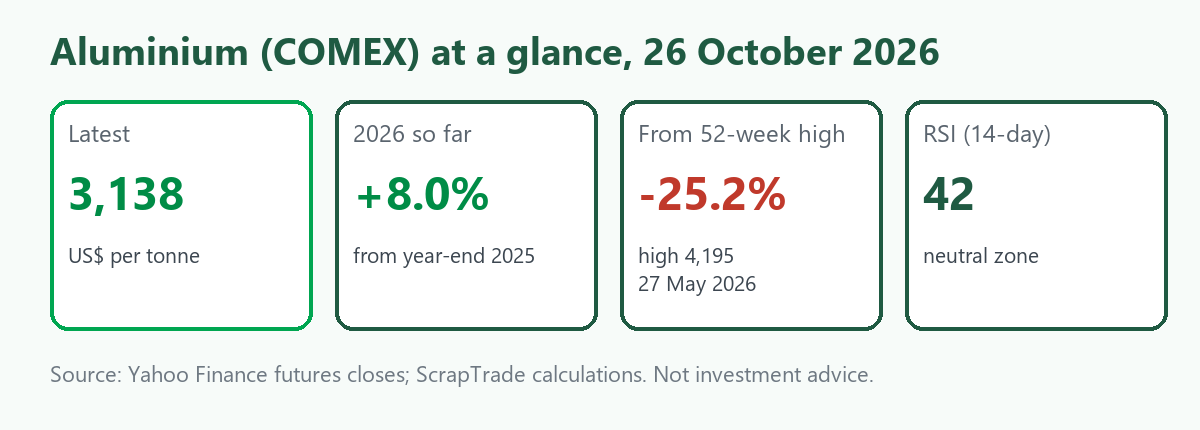
Updated 26 October 2026. Aluminium is the odd one out in 2026. While gold, silver, platinum and palladium have all fallen sharply this year, aluminium is up 8% since 31 December, and 13% over twelve months. COMEX aluminium closed on 26 October at US$3,138 a tonne, about A$4,464, after a spring spike that took it to US$4,195 on 27 May. The spike had a very specific cause: a war that knocked out a large slice of the Gulf's smelting capacity. Since then the price has fallen 25% from that peak, back to roughly where it was before the war began, even though the physical market is still unusually tight [1][2].
That contrast, calm prices and strained supply, is the core of this analysis. It looks at what happened to Gulf production, why the price has come back down, what the tariffs and China's and Indonesia's exports are doing, what the technical indicators say, and what it all means for aluminium scrap, which is where Australian sellers are most exposed. It is general information, not investment advice.
The Gulf shock
Before this year, the Gulf was a quiet source of metal. Smelters there, including Emirates Global Aluminium in the UAE and Aluminium Bahrain, supply a meaningful share of the world's aluminium. Then, in late February, US and Israeli strikes on Iran began a war that, according to Reuters reporting, led to Iranian missile attacks on Gulf smelters and the closure of the strait. Together they removed almost 3 million tonnes of annual capacity [3].
The effect on output was large and has been slow to reverse. Emirates Global Aluminium's Al Taweelah smelter shut down and Aluminium Bahrain was damaged. Gulf output fell sharply between February and May and has been creeping back since, but August's run-rate of 3.5 million tonnes a year was still about 2.6 million tonnes a year below pre-war levels. Half of the cells at Al Taweelah have been restarted [3][4].
Why the price has come back down
It is surprising that the price is back near US$3,000 on the LME, its level in early February, given that kind of loss. Reuters columnist Andy Home offers a reasonable explanation: the market expects other producers to fill the gap until the Gulf recovers [3].
- Indonesia. It exported 114,000 tonnes of primary metal in July, a monthly record.
- China. Primary metal exports face a 30% export duty, but exports of alloys doubled year on year to 349,000 tonnes in the first eight months of 2026, which is one way metal leaves the country.
- Demand. The price rise of the spring may also have cooled consumption, a classic pattern in metals markets.
The column's point, which is the useful one, is that the calm hides continuing strain. LME registered stocks, which had already fallen by a third to 339,475 tonnes by May, have been reported at 238,625 tonnes, the lowest this century. Global inventories are about 42 days of consumption, which is historically low. And one detail in the May coverage deserves emphasis: much of the metal left on LME warrant is Russian aluminium stored in South Korea, which because of sanctions is of little use to US or European buyers [3][4]. In other words, stocks look available on paper that are not in practice.
Prices for the physical metal in some regions are far from calm. The US Midwest premium, the extra US buyers pay over the LME price, was reported at US$2,312 a tonne, partly reflecting a 50% import tariff [4]. That premium alone is more than three-quarters of the LME price itself.
What the chart says
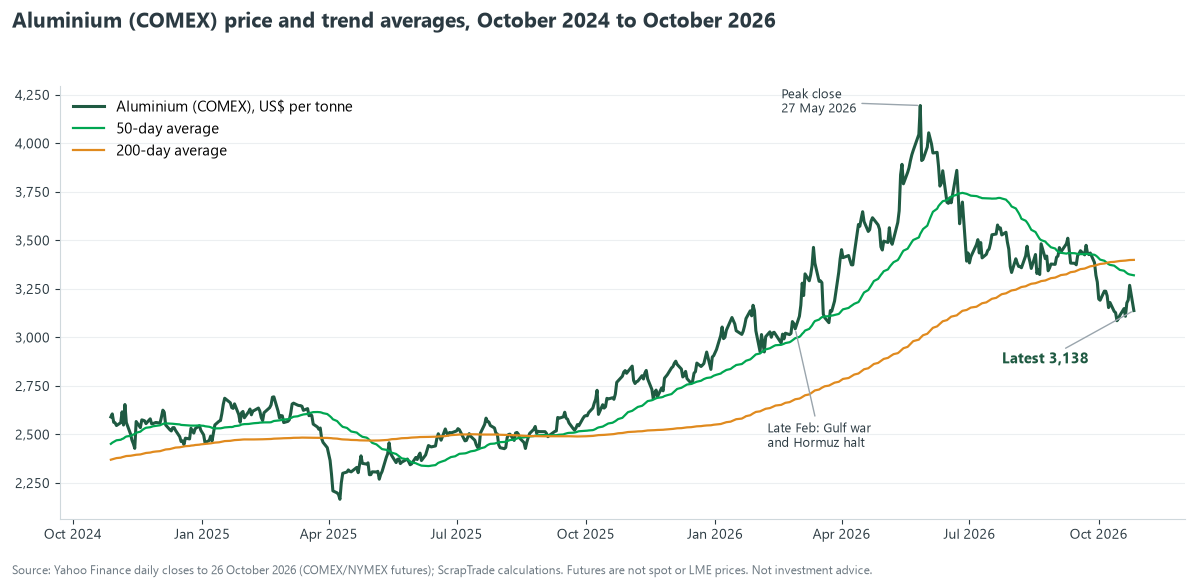
These figures are calculated from COMEX aluminium daily closes. COMEX and LME prices differ, and the COMEX peak of US$4,195 is higher than the LME peak that sources put at US$3,707 to US$3,787 in early June, so the chart should be read for direction and not as an LME quote.
Trend. The close of 3,138 is 1.3% below the 20-day average (3,181), 5.5% below the 50-day (3,320), 8.7% below the 100-day (3,437) and 7.7% below the 200-day (3,400). The price has fallen out of the uptrend that carried it from US$2,500 in the summer of 2025.
Momentum. The 14-day RSI is 42, in neutral territory, and noticeably higher than for the precious metals. The MACD is at minus 48, still negative but above its signal line at minus 61, which means the pace of selling has eased even though the trend is down. The Bollinger band runs from 3,050 to 3,311.
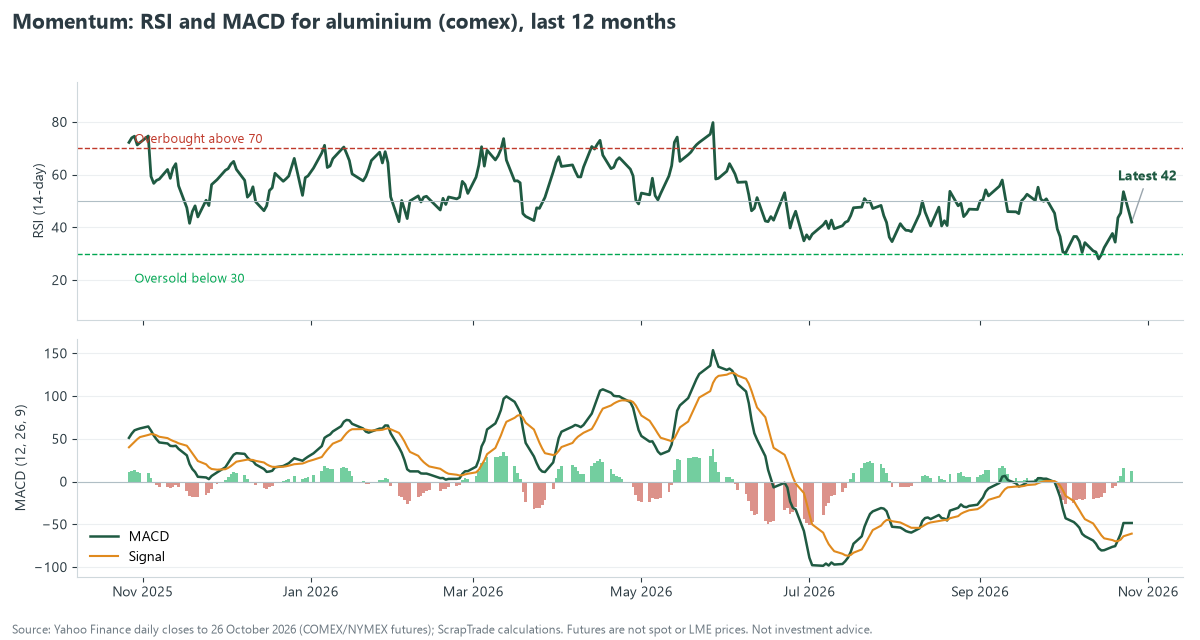
Levels. The recent low is about 3,086 (the lowest close in the past 60 trading days), and the 52-week low close is 2,684, set on 18 November 2025. Resistance is at the 20-day average (3,181), the 50-day (3,320) and the 200-day (3,400). The peak close is 4,195.
Volatility. The average daily range is US$43, or about 1.4%. The 30-day annualised volatility is 23%, close to the 28% of the past year.
Aluminium's chart is the healthiest of the metals in this series: a pullback after a spike, with momentum improving, and no oversold extreme. The risk is the 200-day average at 3,400, which price has fallen below and needs to regain.
Tariffs, China and the wider rules
- The United States. A 50% import tariff on aluminium, together with the Midwest premium, has made the US an unusually expensive place to buy metal [4].
- China. The 30% duty on primary exports pushes metal out as alloy. China's own imports of aluminium scrap were about 981,000 tonnes in the first half of 2026, down about 3% on a year earlier, which the same report attributes to pricier overseas offers and weaker demand from secondary smelters [5].
- The European Union. The bloc's waste shipment rules are moving to restrict scrap exports to non-OECD countries from 2027, and European Aluminium has said it supports export fees to keep scrap at home [6]. See our analysis, Europe Is Keeping Its Scrap. Who Pays?.
- Australia. The Australian Aluminium Council's 2026 report, written with L.E.K. Consulting, argues that scrap export bans and retention schemes have not built recycling industries elsewhere and calls for capital support for local remelting instead. See Scrap Export Bans: Three Case Studies.
What it means for aluminium scrap in Australia
Australia makes about 1.5 million tonnes of primary aluminium a year but generates only about 440,000 tonnes of scrap, and almost all of that is exported for remelting, according to the Australian Aluminium Council [6]. Our own analysis of export records shows 377,501 tonnes of aluminium scrap worth A$1.43 billion left Australia in 2025-26, with India the largest buyer by value at 29.2%, then China at 21.2% and South Korea at 19.2% [7].
Scrap prices follow the metal. The council notes that scrap in Australia typically sells above 90% of the LME benchmark, which leaves little margin for a local remelter once transport and energy are counted [6]. For sellers, the useful point is that scrap prices are more stable than they might be, but are still exposed to the benchmark and to demand in a handful of countries.
On ScrapTrade's price index on 26 October, clean aluminium extrusion was indicated at about A$2.63 a kilogram, sheet at A$2.13 and cans at A$2.21. The index is an AI-generated estimate and not a quote, so confirm prices with a buyer. Our guides explain what each grade is worth and how to grade scrap metal.
What to expect
| Scenario | What would have to happen | What it would mean |
|---|---|---|
| Gulf recovers | Smelters restart on schedule and Hormuz shipping normalises | Premiums ease, stocks rebuild, prices drift in a 2,900 to 3,300 range |
| Squeeze returns | Restarts slip, stocks stay near record lows, tariffs hold the US premium | A retest of the 200-day average near 3,400 and then 3,800 to 4,000 |
| Demand slows | Industrial demand weakens as prices stay high and the global economy cools | A move down towards the 3,000 and 2,700 areas |
We do not put odds on them. The point is what each would take.
Signposts: the pace of EGA's and Aluminium Bahrain's restarts; LME stocks and the cash-to-three-month spread; the US Midwest premium and any change in the 50% tariff; Chinese alloy exports and Indonesian output; Hormuz shipping; and the 3,086 low and 3,400 average on the chart.
Frequently asked questions
What is the aluminium price in Australian dollars?
About A$4,464 a tonne on 26 October 2026, based on COMEX aluminium at US$3,138 and an exchange rate of 70.3 US cents.
Why did aluminium spike in 2026?
Iranian missile strikes on Gulf smelters and the closure of the Strait of Hormuz removed almost 3 million tonnes of annual capacity, according to Reuters reporting [3].
Why has the price fallen back?
Traders expect Indonesia and China to fill the gap, and the spring rally cooled demand, though stocks remain at multi-decade lows and regional premiums are high [3].
What is the US Midwest premium?
The premium US buyers pay over the LME price. It was reported at US$2,312 a tonne, partly reflecting 50% import tariffs [4].
What is aluminium scrap worth in Australia?
ScrapTrade's index put clean extrusion at about A$2.63 a kilogram on 26 October, an indicative estimate. Export data show Australian aluminium scrap sold abroad for about A$1.43 billion in 2025-26 [7].
Sources
- Yahoo Finance, COMEX aluminium futures (ALI=F), daily history to 26 October 2026. Indicators and Australian dollar conversion (with AUD/USD) are ScrapTrade calculations.
- Discovery Alert, Aluminium price outlook: why record-low stocks aren't lifting LME (October 2026), a secondary source.
- Andy Home, Reuters column, Aluminium's calm belies lingering supply-chain stress (14 October 2026), and Warning lights flash as aluminium reels from Gulf shock (25 May 2026).
- Crux Investor, Aluminium prices erase war premium as LME stocks hit century low, a secondary source.
- Discovery Alert, Aluminium scrap is now a strategic asset as US imports jump 37% and China aluminium scrap imports, secondary sources.
- Australian Aluminium Council and L.E.K. Consulting, Enabling Development of Aluminium Recycling Capability in Australia (March 2026).
- Department of Climate Change, Energy, the Environment and Water, Waste exports data collation, September 2026 (ABS records), ScrapTrade calculations. See Australia's Scrap Metal Exports: 2025-26 Data.
This article is general information, not investment, financial or trading advice. Prices, forecasts and news are as reported on 26 October 2026 and change quickly. Several sources are secondary and conflict on detail, as noted. Futures prices are not LME prices. ScrapTrade operates a scrap marketplace and has a commercial interest in the scrap trade.