

Updated 26 October 2026. Ask most Australians who buys their old cars, appliances and demolition steel, and you will probably get a blank look. The answer is a country thousands of kilometres away, with a delta, a monsoon and a fast-growing construction sector. In 2025-26, Bangladesh took 805,448 tonnes of Australia's ferrous scrap, 31.6% of the total, worth about A$387 million. Nine years ago the figure was 151,000 tonnes and 7.4% [1]. Bangladesh is now Australia's biggest scrap customer by a clear margin, and understanding it helps explain what Australian scrap yards are paid.
This profile draws on Australian export records, BIR statistics and trade-press reports of Bangladeshi import data. It is general information and not trade advice.
The rise in one chart
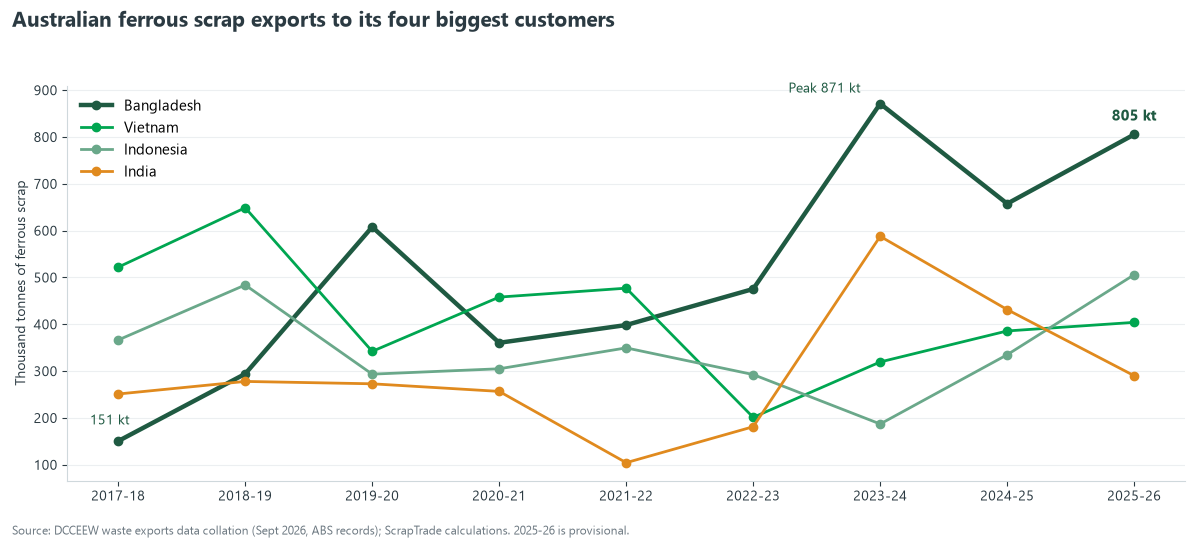
Bangladesh has not climbed in a straight line. It spiked to 608,000 tonnes in 2019-20, dropped back, and then climbed to a peak of 871,000 tonnes in 2023-24 before easing to 658,000 and then rebounding to 805,000. Along the way it has overtaken Vietnam, which took 26% of Australian ferrous scrap in 2017-18 and 16% in 2025-26, and Indonesia, now the second biggest at 20% [1].
| Australian ferrous scrap by destination | 2017-18 | 2023-24 | 2025-26 |
|---|---|---|---|
| Bangladesh | 7.4% | 35.5% | 31.6% |
| Indonesia | 18.1% | 7.6% | 19.9% |
| Vietnam | 25.8% | 13.0% | 15.9% |
| India | 12.4% | 23.9% | 11.4% |
Source: DCCEEW [1]. The five largest buyers took 86.5% of tonnage in 2025-26.
What the money looks like
Volume is only half of it. In 2025-26 Bangladesh paid about A$481 a tonne on average, down from A$739 in 2021-22 and the lowest since 2020-21 [1]. That is a declared export value for a mix of ferrous scrap, mainly shredded steel, and it is not the price a yard paid a collector. But it shows that Australia's growth in Bangladesh has come at falling prices, which is how a volume-driven market behaves.
What drives Bangladesh's buying
Trade-press reports of Bangladeshi import data point to three themes.
- Strong, if cautious, demand. Bangladesh's bulk ferrous scrap imports rose about 11% year on year in January to April 2026 to roughly 1.02 million tonnes, and total scrap imports including containerised cargo reached about 1.66 million tonnes, up 14%, according to BigMint [2]. Mills have been cautious buyers, resisting higher offers in May as freight costs and the Eid holiday slowed trade, according to SteelOrbis [3].
- A change in sources. Ship-breaking-sourced imports fell about 35% in the period, while Japan was the biggest supplier, with shipments up about 29%, and Singapore's rose about 111%. Australian-origin imports rose about 13% to roughly 170,000 tonnes in the four months, while US-origin shipments fell about 56% [2].
- Freight. Buyers have shifted towards Australian and New Zealand shredded cargoes because of lower freight and shorter transit times, according to SteelOrbis [4]. Freight is the one cost an exporter cannot ignore, and it is a real advantage for Australia on this route.
Other suppliers are also growing. Japan's exports to Bangladesh rose 129% to 1.15 million tonnes in the first ten months of 2025, driven by tender sales [5], and BIR data show Bangladesh buying 1.468 million tonnes of US scrap in the first nine months of 2024, up 32% [6]. The market is competitive.
Risks for Australian sellers
- Price pressure. The average declared price per tonne has fallen as volumes have risen, and mills are cautious buyers.
- Concentration. One country taking nearly a third of Australia's ferrous scrap is a risk if demand or rules change.
- Seasonal disruption. Monsoon and festival periods slow trade, according to trade reports [3].
- Regulation abroad. Bangladesh is among the countries the European Commission's draft list would not authorise to receive EU metal scrap from 2027. If adopted, European scrap would look for other buyers, and Bangladesh's mills might look harder at Australian material, or at the same Asian competitors. See Europe Is Keeping Its Scrap. Who Pays?.
What it means for sellers
For a collector or a small yard, the point is practical. Shredded steel that meets the buyers' spec is what moves, so sort carefully and keep loads clean. See how to grade scrap metal. Prices at the yard follow what the cargo can fetch in Dhaka and Chattogram, less freight and costs, so a move in Bangladesh's demand reaches the Australian scrap yard within weeks. Compare reference prices on the live price calculator, which is indicative only, and list material on the marketplace to reach more than one buyer.
For the wider map, see World Scrap Trade: Top Importers and Exporters, and for the full Australian data, Australia's Scrap Metal Exports: 2025-26 Data.
Frequently asked questions
How much scrap does Australia export to Bangladesh?
805,448 tonnes of ferrous scrap in 2025-26, 31.6% of the total, worth about A$387 million [1].
Who is Bangladesh's biggest scrap supplier?
In January to April 2026, Japan was the largest supplier, ahead of Australia and others [2].
Why does Bangladesh buy Australian scrap?
Lower freight and shorter transit than some alternatives, according to SteelOrbis [4].
Has the price Bangladesh pays changed?
Australia's average declared ferrous export value to Bangladesh was about A$481 a tonne in 2025-26, down from A$739 in 2021-22 [1].
Is Bangladesh's demand growing?
Imports rose in early 2026, though mills have been cautious and prices volatile [2][3].
Sources
- Department of Climate Change, Energy, the Environment and Water (DCCEEW), Waste exports data collation, September 2026 (ABS records), ScrapTrade calculations. The latest year is provisional.
- BigMint, Bangladesh bulk ferrous scrap imports rise 11% year on year in January-April 2026.
- SteelOrbis, Bangladesh's import scrap market slow ahead of Eid amid limited rebar sales, freight pressure.
- SteelOrbis, Bangladesh's import scrap prices rise further amid freight pressure, holiday slowdown limits trading.
- Yieh Corp, Japan's ferrous scrap exports grow in January-October.
- BIR, World Steel Recycling in Figures: January-September 2024 update.
Figures are as reported by the sources named. This article is general information, not financial or trading advice. ScrapTrade operates a scrap marketplace and has a commercial interest in the scrap trade.