

Updated 29 October 2026. Australia sends about three million tonnes of metal scrap overseas every year, mostly ferrous, aluminium and copper. People who sell into that trade often ask a simple question: do I need a permit to export scrap? The honest answer has three parts. Ordinary metal scrap is not one of the wastes covered by Australia's export licence rules. Several things that turn up in scrap yards, such as lead acid batteries and e-waste, are covered by a separate hazardous waste permit system. And where a load falls between the two, the classification decides, not the name on the invoice.
This article sets out what the regulator's own pages say, what they leave open and what to do about the gaps. It is general information, not legal advice. Check your specific load with the regulator before you ship.
Two laws, not one
Australian waste export control rests on two separate laws, and mixing them up is the most common mistake.
| Recycling and Waste Reduction Act 2020 | Hazardous Waste (Regulation of Exports and Imports) Act 1989 | |
|---|---|---|
| What it covers | Four named wastes: glass, plastic, tyres, paper and cardboard | Hazardous waste, defined with reference to the Basel Convention |
| What you need | A waste export licence for the waste type, plus a declaration of each consignment | A permit to export, import or transit |
| Who runs it | National EPA | National EPA (the Department's pages are being moved across) |
Sources: National EPA and DCCEEW pages [1][2][3].
The National Environmental Protection Agency was established on 1 July 2026. The Department's hazardous waste pages carry a notice that relevant content is moving to the National EPA website [2], so some links in this article may redirect over time.
The licence regime: four wastes, and metal is not one of them
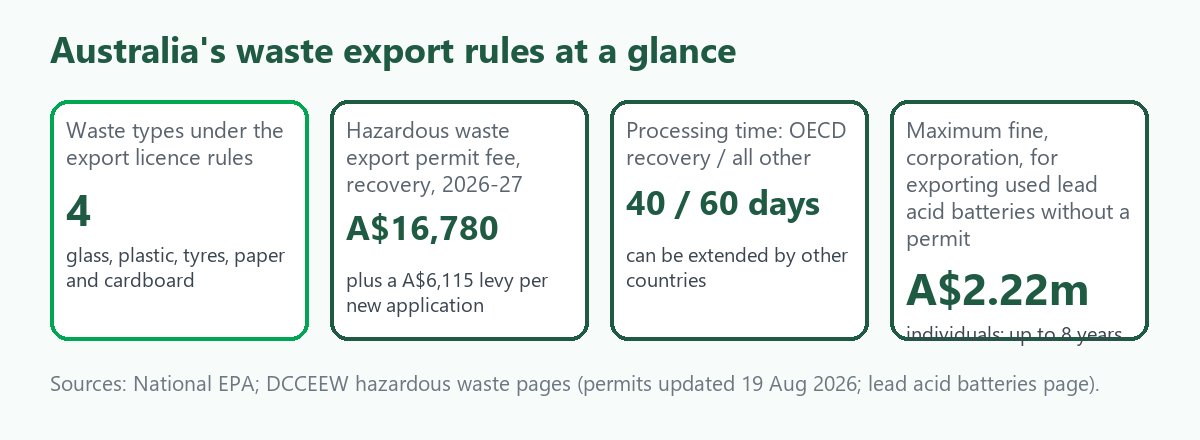
National EPA's waste exports page says that in March 2020 the Australian, state and territory governments and local government agreed that the export of waste glass, plastic, tyres and paper would be regulated by the Australian Government. Each has its own rules. To export one you must hold a waste export licence for that waste type and declare each consignment to National EPA as well as the Australian Border Force [1].
Metals are not on that list [1]. That is the basis for the statement that ordinary metal scrap does not need a waste export licence. We want to be careful about how far to push it, because the National EPA page does not say in so many words that metal is excluded. It lists what is regulated, and metal is not among the items.
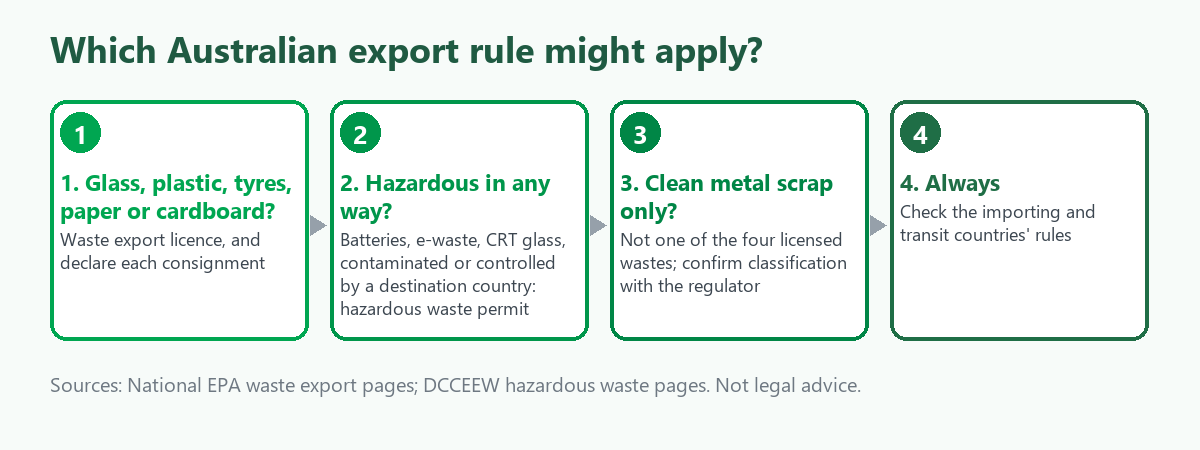
Mixed loads are where it matters. The pages for glass, plastic, and paper and cardboard each say that waste of that type needs a hazardous waste permit instead of a licence if it is mixed with other wastes, and they name metals as an example of those other wastes [3]. So a bale of paper with metal in it, or a load of glass with metal fragments, is moved out of the licence regime and into the hazardous one. In plain terms, contamination with metal changes which rules apply to a non-metal load.
The permit regime: what it controls and what it costs
The Department's hazardous waste pages say you must have a permit to export, import or transit hazardous waste. The permit page lists other requirements as well, including consent from all countries involved in the movement and authorisations from state and territory environmental regulators [4].
Three points matter in practice.
Policy stance. The page states that permits to export hazardous waste are typically only granted when there is no capacity to process the waste in Australia, and that exports for final disposal are granted only in exceptional circumstances [4].
Fees. For 1 July 2026 to 30 June 2027, an application for an export permit for operations that may lead to resource recovery or recycling costs A$16,780. For other operations the fee is A$46,409. A flat levy of A$6,115 applies to each new permit application. Variations cost less. The page says refunds are available only in limited circumstances, so it advises seeking advice before paying [4]. The fees change each financial year, so check the current schedule.
Time. The Department says it will process an application within 40 days for exports to or imports from an OECD country where the waste is going for recovery, and within 60 days for all other applications. Those timeframes can be extended, and authorities in other countries often take longer to provide their consent [4].
After a permit is granted, conditions can include how the waste is packaged, approved routes (ports) and a maximum quantity, with record-keeping and reporting such as a final disposal certificate [5].
What in a scrap yard is actually controlled
Used lead acid batteries
The Department's page is direct: used lead acid batteries (ULABs) are a hazardous waste, and you need a permit to import or export whole or broken ones or their components. Permits are granted in very limited circumstances because ULABs can be safely recycled in Australia, and an applicant has to show they cannot be collected and recycled here by a licensed or authorised facility. Exporting without a valid permit is an offence. Corporations are liable for a fine of up to A$2,220,000, and individuals may face up to 8 years' imprisonment [6].
For a yard that collects car batteries, the practical point is simple. Do not put them in an export container.
E-waste
The Department's e-waste page says to presume all e-waste is hazardous unless you can prove it has no hazardous components or characteristics. E-waste covers whole items such as computers, phones and white goods, and components such as printed circuit boards, drives and memory modules, including shredded e-waste [7].
Hazardous e-waste needs a permit, with one exception: e-waste components exported to an OECD country for metal recovery, where the importing country also does not control hazardous e-waste components. The page says to contact the competent authority in the importing country first [7].
Non-hazardous e-waste is changing. From 1 January 2025 the Basel Convention controls non-hazardous e-waste too. Until Australia implements the new rules, the Department says exports of non-hazardous e-waste need an export permit if the importing country controls them under its law [7]. Check the current position, since this page was last updated in December 2024.
Glass, solar panels and similar
Waste glass from cathode ray tubes, and waste glass that may come from medical waste, solar panels or e-waste, can need a hazardous waste permit [3]. Solar panels are also listed among the examples of whole e-waste [7].
Where does clean metal scrap sit?
This is the question the pages do not answer in one line, so we will say what we can and cannot support.
- The licence regime does not list metal [1].
- The Basel Convention distinguishes between wastes on List A, which are treated as hazardous, and List B, which are outside the Convention unless contaminated with constituents that make them hazardous. A waste on List B can still be hazardous in a particular case [8]. Metal and metal-alloy scrap in solid, non-dispersible form appears on List B in secondary reproductions of the Convention text that we saw [8]. We did not read the Convention text itself, and Australian implementing details may differ.
- We did not find an Australian government page that states, in terms, that clean ferrous or non-ferrous scrap needs no hazardous waste permit.
So our reading is that clean, uncontaminated metal scrap is not what these systems are aimed at, but we cannot present that as the regulator's statement. If you are unsure, the Department's hazardous waste team is the place to ask, and its pages say to contact it if you are unsure whether your waste is hazardous [3]. The contact on its pages is hazardous.waste@dcceew.gov.au, phone 1800 920 528 [4].
The classification risk sits in the contamination. A load of "mixed metal" that includes batteries, circuit boards, capacitors or oily components is no longer clean metal scrap. See Dangerous Items in Scrap and What to Refuse for how to keep those items out.
The other half: the importing country
Everything above is Australia's side. The Department's permit page requires consent from all countries involved, and the glass and plastic pages tell exporters to check import restrictions, such as contamination limits, with the competent authority of each importing and transit country [3][4]. Destination rules often decide whether a shipment moves at all. See our country guides for examples, such as Thailand's scrap import ban proposal, China's copper and aluminium scrap import rules and India's scrap market.
The treaty background is in Who Speaks for Scrap Recycling: Key Bodies, including the Basel Ban Amendment that restricts hazardous waste exports from developed to other countries.
A scenario: a mixed container
A yard in Sydney (invented) is filling a container of "mixed non-ferrous". The load is mostly copper and aluminium offcuts, but it also includes a pallet of old computer power supplies, a drum of capacitors from industrial equipment and four car batteries.
- The copper and aluminium offcuts. Clean metal scrap. Not in the licence list. Confirm classification if there is any doubt, then check what the buyer's country requires.
- The power supplies. E-waste components. Presumed hazardous unless the yard can prove otherwise. They would need a permit unless the OECD metal recovery exception applies, and that needs the importing country's position confirmed.
- The capacitors. The Department's e-waste page lists capacitors containing polychlorinated biphenyls as a hazardous component [7]. Treat as hazardous until tested.
- The batteries. Used lead acid batteries. Permit needed, granted only in very limited circumstances. They stay out of the container.
The yard ships the clean metal and handles the rest through licensed domestic recyclers. The other option, applying for a hazardous waste permit, costs at least A$16,780 plus the levy and takes 40 to 60 days, which is rarely worth it for a pallet of components.
What this means for you
- Know what is in your load. The legal risk is in contamination, not in the metal.
- Keep batteries and e-waste out of metal containers. Use domestic recyclers for them.
- Ask your buyer in writing what the destination country requires. See How to Verify Scrap Before You Buy or Sell.
- If in doubt, ask the regulator before shipping, not after.
- Keep records. If a shipment is questioned, a documented description of the load matters.
For where Australian metal scrap actually goes, see our 2025-26 export data analysis. You can compare buyers on the marketplace or register.
What we could not confirm
- A direct regulator statement on clean metal scrap. We found none. Our reading is an inference from what the pages list and from Basel's structure.
- Australia's own hazardous waste classification page. The Department's "what is hazardous waste" page would not load for us, so we have not relied on it.
- Customs requirements. We did not read Australian Border Force export requirements for scrap.
- State and territory rules. Environmental regulators apply their own requirements to yards, transport and storage.
- Whether Australia has now implemented the 2025 Basel changes for non-hazardous e-waste. The page we read was last updated in December 2024.
Frequently asked questions
Do I need a licence to export scrap metal from Australia?
The waste export licence regime covers glass, plastic, tyres, and paper and cardboard. Metal is not on National EPA's list of regulated wastes [1]. Hazardous items in a load are a separate matter.
Do I need a permit to export lead acid batteries?
Yes. A permit is required, permits are granted in very limited circumstances, and exporting without one carries fines of up to A$2.22 million for corporations [6].
Is e-waste covered?
Yes. The Department says to presume all e-waste is hazardous unless you can prove otherwise, and hazardous e-waste needs a permit, subject to a narrow exception for components going to OECD countries for metal recovery [7].
How much does a hazardous waste export permit cost?
For 2026-27 the application fee is A$16,780 for recovery operations, plus a A$6,115 levy on new applications [4].
How long does a permit take?
The Department says 40 days for OECD recovery exports and 60 days for others, and the time can be extended [4].
Who regulates this now?
National EPA, established on 1 July 2026. Some Department pages are still live while content moves across [1][2].
Sources
- National EPA, Waste exports.
- DCCEEW, Exporting, importing or transiting hazardous waste (updated 2 June 2026).
- National EPA, Exports of waste glass, plastic, tyres and paper and cardboard.
- DCCEEW, Hazardous waste permits (updated 19 August 2026).
- DCCEEW, How to comply with hazardous waste requirements (updated 22 March 2023).
- DCCEEW, Exporting or importing used lead acid batteries (updated 19 February 2024).
- DCCEEW, Control of e-waste for export, import and transit through Australia (updated 18 December 2024).
- Basel Convention Annexes VIII and IX, as reproduced in secondary sources found in search results. We did not read the Convention text itself.
This article summarises regulator web pages as read in October 2026 and is general information, not legal advice. Rules, fees and agency arrangements change, so confirm with the regulator before shipping. The scenario is invented. ScrapTrade operates a scrap marketplace and has a commercial interest in the scrap trade.