

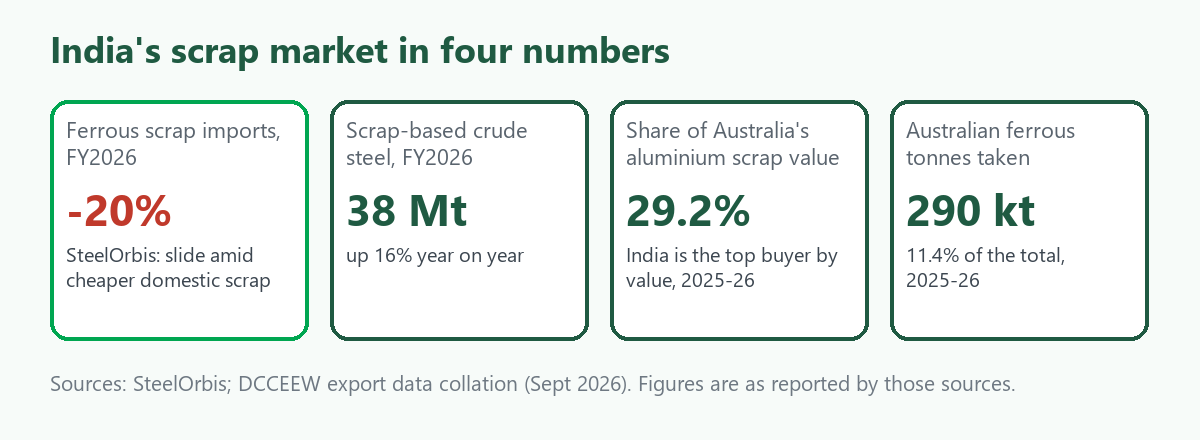
Updated 26 October 2026. For years the assumption was simple: India would keep buying more imported scrap, because its steel industry was growing and its domestic scrap pool was small. The latest numbers say it is more complicated. India's ferrous scrap imports fell about 20% in the 2026 financial year, even as its scrap-based steel output rose 16% to 38 million tonnes. The reason, according to SteelOrbis, is that cheaper domestic scrap has been taking the place of imports [1]. And yet for Australian sellers India matters more than almost any other market in one metal: aluminium. In 2025-26 India was Australia's largest buyer of aluminium scrap by value, at A$417 million or 29.2% of the total [2].
This profile looks at both stories: the shrinking steel scrap imports and the steady non-ferrous demand. It then sets out the rules a foreign seller faces, including duties, quality control and radiation checks, as far as our sources agree. Where the sources conflict, which they do on duties, we say so. It is general information, not legal or customs advice, and importers and exporters should check the current notifications from India's customs and trade authorities.
Steel scrap: importing less
SteelOrbis reports that India's ferrous scrap imports slid 20% in the 2026 financial year, with the United States remaining the biggest supplier despite a 28% decline in its shipments [1]. BIR figures show the trend building earlier: in the first half of 2024, India's imports had already fallen 26.1% to 3.881 million tonnes [3]. A blog-level estimate puts India's annual imports of iron and steel scrap at 6 to 8 million tonnes, but we could not verify that against an official source, so we do not rely on it.
The cause is at home. As more steel is made from scrap and more old vehicles, buildings and machinery reach the end of their lives, India is generating more of its own scrap. Domestic material is cheaper and avoids the freight, inspection and duty questions that come with imports. If that continues, India will remain a large market but not a growing one for foreign ferrous scrap.
For Australia the numbers are modest but real. India took 290,000 tonnes of Australian ferrous scrap in 2025-26, 11.4% of the total, a drop from 431,000 tonnes in 2024-25 and 588,000 tonnes in 2023-24 [2].
Non-ferrous scrap: India as a buyer
Non-ferrous scrap tells a different story. India is a significant buyer of aluminium and copper scrap, and Australian export records show how large:
| Australian scrap sold to India, 2025-26 | Share of value | Value |
|---|---|---|
| Aluminium scrap | 29.2% (largest buyer) | A$417 million |
| Copper scrap | 11.3% | A$139 million |
| All non-ferrous scrap | 18.4% (second after China) | A$560 million |
Source: DCCEEW [2]. India is the biggest destination for Australian aluminium scrap by value, ahead of China (21.2%) and South Korea (19.2%).
India has also moved to stimulate its own recycling industry. Its 2024 amendment to the Hazardous and Other Wastes Rules introduced mandatory recycled content requirements for aluminium, copper and zinc products, and one report says non-ferrous metal products must contain 5% recycled content from the 2027-28 financial year. The Australian Aluminium Council notes the policy is still too new to judge [4]. If it works, it will raise demand for good scrap, but a part of that demand may be met by domestic sources.
The rules a foreign seller faces
Importing scrap into India involves duties, quality control and safety checks. Our sources agree on some points and disagree on others.
Duties: where sources conflict
- Ferrous scrap. One source says India has maintained a 0% duty on iron and steel scrap. Another says it attracted a 2.5% basic customs duty through the 2025-26 financial year. A third says the statutory rate is 2.5%, but an exemption notification has kept the effective duty at nil since 2021, with some uncertainty over when that exemption expires [5].
- Non-ferrous scrap. Copper, brass and aluminium scrap carry a concessional 2.5%. One source says lead and zinc scrap were reduced to nil in the 2026-27 Budget [5].
We cannot resolve the ferrous question from published secondary sources, so please check India's current customs notifications (the Central Board of Indirect Taxes and Customs) before pricing a shipment.
Quality control
Scrap imports are subject to Bureau of Indian Standards (BIS) quality control orders. One source says these can hold consignments at the port pending conformity checks, and that the orders apply equally to domestic and foreign producers. Steel scrap is also classed as "other wastes" under India's Hazardous and Other Wastes (Management and Transboundary Movement) Rules, 2016 [5].
Radiation checks
India requires a pre-shipment inspection certificate from an approved agency for scrap imports. The certificate must state that the consignment was checked for gamma and neutron radiation and does not exceed natural background, report the background level at the location and the maximum level found on the scrap, and confirm there are no arms, ammunition or explosives. Importers must also supply a contract stating the consignment contains no radioactive contaminated material. Under a standard operating procedure in force since 15 November 2021, containers without the certificate are not unloaded and are sent back to the country of origin [6]. For an exporter, this means the inspection is not optional paperwork. It is the difference between delivery and a return shipment. See How a Scrap Export Deal Works, Step by Step.
European Union draft list
India also appears in the European Commission's draft list of non-OECD countries for waste exports. According to reporting on the draft, India is listed for other waste streams but is not among the countries proposed for metal scrap. The draft is not adopted, and it governs EU exports, not Australian ones. It could, however, redirect European scrap towards other buyers. See Europe Is Keeping Its Scrap. Who Pays?.
What it means for sellers
- Do not assume ever-growing demand for steel scrap. India is importing less, and Indian buyers are cost-sensitive.
- Aluminium is the opportunity. India pays Australia more for aluminium scrap than any other country, so clean, well-described aluminium is where Australian sellers have the strongest hand. See our guide to aluminium scrap grades, prices and demand.
- Budget for inspection. The radiation and quality checks add time and cost, and a missing certificate can send a container home.
- Check the duty on the day. Rates and exemptions change, and sources disagree.
- Know your counterparty. For cross-border deals, escrow and identity checks reduce risk. See trust and safety, the real cost of sourcing scrap abroad and trading scrap internationally.
Frequently asked questions
Does India import scrap?
Yes. Its ferrous scrap imports fell about 20% in the 2026 financial year, but it remains a major buyer of aluminium and copper scrap [1][2].
What is the import duty on scrap in India?
Sources disagree for ferrous scrap (nil effective, or 2.5% statutory). Copper, brass and aluminium scrap are reported at a concessional 2.5%. Check current customs notifications [5].
What documents does India require?
A pre-shipment inspection certificate stating the cargo was checked for radiation, among other requirements. Containers without it can be sent back [6].
Who is India's biggest scrap supplier?
For ferrous scrap, the United States, despite a 28% fall in its shipments in FY2026 [1]. For Australian aluminium scrap, India is the largest buyer by value [2].
Is Indian demand growing?
Domestic scrap-based steel output is growing, while imports of ferrous scrap are falling [1].
Sources
- SteelOrbis, India's ferrous scrap imports slide 20% in FY2026 amid cheaper domestic alternatives.
- Department of Climate Change, Energy, the Environment and Water, Waste exports data collation, September 2026 (ABS records), ScrapTrade calculations. See Australia's Scrap Metal Exports: 2025-26 Data.
- BIR, World Steel Recycling in Figures: January-June 2024 update.
- Australian Aluminium Council and L.E.K. Consulting, Enabling Development of Aluminium Recycling Capability in Australia (March 2026), citing Business Standard on India's 2024 rules.
- National Recycling Corporation, Metal scrap import duty India: FY 2026-27 guide; Steel Baba, India scrap import duty and customs calculator 2026; Steelmath, BIS certification for steel imports India 2026. These are trade blogs and their duty figures conflict. Verify against official notifications.
- Indian customs and DGFT pre-shipment inspection rules, as summarised in TaxGuru and TaxTMI (the 2021 random-checking procedure).
Figures are as reported by the sources named. Duties and rules change and sources conflict, so verify against official notifications. This article is general information, not legal, customs or trading advice. ScrapTrade operates a scrap marketplace and has a commercial interest in the scrap trade.