

Lead is the cheapest of the common non-ferrous metals and the most heavily regulated at the point where it turns up as a battery. That combination shapes what a seller can expect: a low price per kilogram, a small and shifting export market, and one rule that matters more than any price. This page gives the lead benchmark in Australian dollars, shows what Australian customs records say about where lead scrap goes, and sets out the line between scrap lead and used batteries. It is not a yard price list. We found no sourced Australian yard price for lead, so we do not print one.
The benchmark in A$ a kilogram
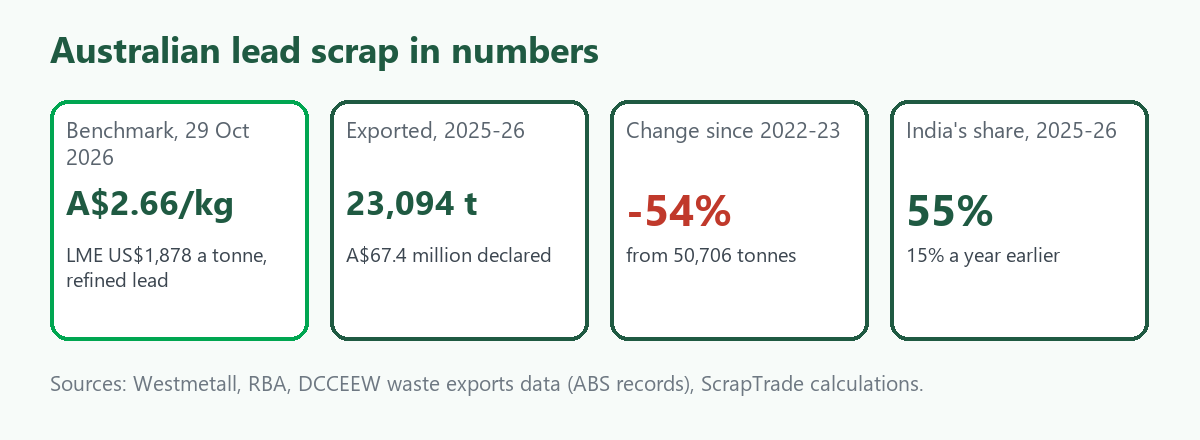
On 29 October 2026 the official London Metal Exchange (LME) cash settlement for lead was US$1,878 a tonne [1]. The Reserve Bank of Australia's rate that day was US$0.7053 per A$1 [2].
- Divide the US dollar price by the exchange rate: 1,878 / 0.7053 = about A$2,663 a tonne.
- Divide by 1,000: about A$2.66 a kilogram.
That is refined lead, not scrap, and scrap sells below it by an amount we could not source. At the benchmark, a few loads look like this:
| Weight of lead | Value at the benchmark |
|---|---|
| 10 kg | A$27 |
| 50 kg | A$133 |
| 100 kg | A$266 |
| 1 tonne | A$2,663 |
Two points follow. Lead moves in small amounts: a US$100 change in the tonne price is about A$0.14 a kilogram. And at the benchmark, about 31 kg of lead reaches the A$82.50 level above which the ATO's scrap code asks a buyer to record your details, as we explain in Is Scrap Metal Income Taxable?. Scrap sells below the benchmark, so it takes more than that.
For the other metals on the same date, see Scrap Metal Benchmark Prices in A$ per kg.
Scrap lead and used batteries are different things
This is the part of the lead market that cannot be treated like copper or aluminium.
The Department of Climate Change, Energy, the Environment and Water (DCCEEW) says used lead acid batteries are a hazardous waste, and that you need a permit to import or export whole or broken batteries or their components [3]. Permits to export them are granted in very limited circumstances only, because they can be safely recycled in Australia, and an applicant must show the batteries cannot be collected and recycled here by a licensed or authorised facility [3]. DCCEEW directs you to your state or territory environmental protection authority to find a licensed facility [3].
Australia's customs code for lead scrap, AHECC 78020000, is for lead waste and scrap excluding waste and scrap of primary cells, primary batteries and electric accumulators [4]. So the export figures below are not battery exports. For battery pricing, see Scrap Battery Prices: Car, UPS and Lithium.
For a seller, the practical lesson is to keep batteries and other lead apart, and to ask any buyer whether they are licensed to take what you have. We cannot tell you the licensing rules in your state. Your state environment authority can.
What Australian customs data shows
Australia reported 23,094 tonnes of lead scrap exported in 2025-26, worth A$67.4 million, or A$2,917 a tonne declared on average [4]. These figures are provisional.
| Year | Tonnes | Declared value a tonne |
|---|---|---|
| 2017-18 | 36,903 | A$2,360 |
| 2022-23 | 50,706 | A$2,988 |
| 2024-25 | 27,033 | A$2,759 |
| 2025-26 | 23,094 | A$2,917 |
Tonnes peaked in 2022-23 and have fallen 54% since, while the declared value a tonne rose 24% from 2017-18 to 2025-26. Declared values are yearly averages across shipments, not yard prices. They cannot be compared directly with a single day's benchmark. In particular, the 2025-26 average sits slightly above the A$2,663 benchmark above. We have not checked the benchmark's average across 2025-26 or the mix in those shipments, so we draw no conclusion from that.
Where it went
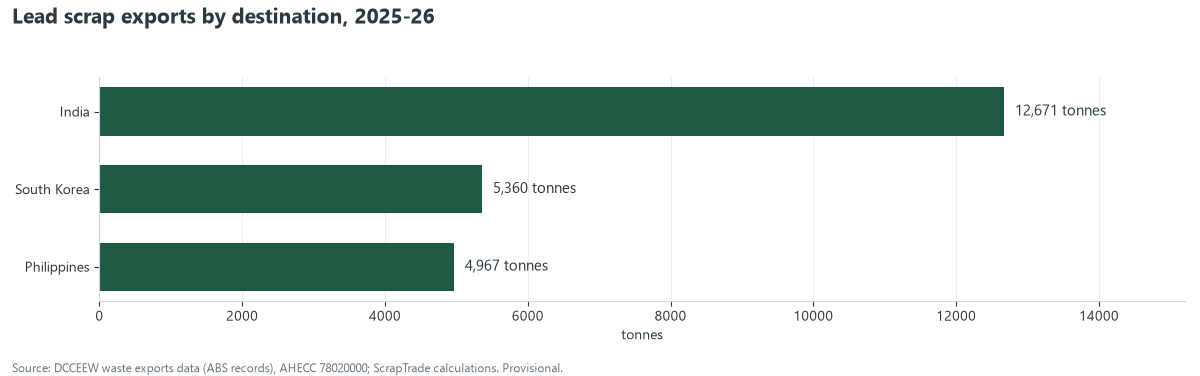
In 2025-26, India took 12,671 tonnes, or 55% of the total. South Korea took 5,360 tonnes (23%) and the Philippines 4,967 tonnes (22%) [4]. A year earlier it was different: South Korea took 53%, the Philippines 27% and India only 15%, or 4,052 tonnes [4]. India's tonnes roughly tripled in a year while South Korea's fell by 63%. The data does not say why, and we make no claim about the cause.
Where it left from
Four states each sent 4,000 tonnes or more in 2025-26: New South Wales 5,525 tonnes, Western Australia 5,476, South Australia 5,476, Victoria 4,272, with Queensland sending 2,345 [4]. By port, Fremantle loaded 7,786 tonnes, Port Adelaide 5,530 and Sydney 5,462. For how ports differ across all scrap, see Australia's Scrap Export Ports.
What this means for a seller
- Check the day's benchmark and ask for the share. The method is the same as for copper, set out in How Much Is Your Scrap Copper Worth?.
- Do not expect the swings you see in copper. A kilogram of lead is worth about an eighth of a kilogram of copper at the benchmark (A$2.66 against A$20.64), so any fixed handling or transport cost takes a bigger share of the value.
- Keep lead separate from batteries and other metals, and get weights in writing.
- Be ready to say where it came from. The ATO's scrap code treats material of an obvious commercial nature, such as industrial by-products, differently from household scrap, as we explain in the tax guide linked above.
For grades, uses and how lead is traded online, see our general guide, Lead Scrap Trading.
Selling through ScrapTrade
ScrapTrade is a marketplace where you list material with photos and pricing preferences, review buyer offers and negotiate, and buyers can post what they need, as set out on How It Works. The Trust & Safety page says payment is held in escrow from the moment a deal is confirmed and released once pickup or delivery is confirmed. We cannot say which buyers accept lead or batteries, so state exactly what you have when you list. Create a free account to list a load. ScrapTrade has a commercial interest in the scrap trade.
What we could not verify
- A sourced Australian yard price for scrap lead, or how far below the benchmark it sells.
- State licensing rules for handling and selling lead and batteries.
- Why exports fell and shifted to India.
- Prices after 29 October 2026.
Frequently asked questions
How much is scrap lead worth per kg in Australia?
The LME lead benchmark on 29 October 2026 was about A$2.66 a kilogram, and scrap sells below it by an amount we could not source [1][2].
Can I export scrap lead or lead batteries?
Whole or broken used lead acid batteries need a permit to export, granted only in very limited circumstances [3]. Lead scrap has its own customs code, and we have not reviewed what a given export needs. Ask DCCEEW or your buyer.
Why is lead worth so much less than copper?
Its world price is lower. At the benchmark, a kilogram of lead was about A$2.66 and a kilogram of copper about A$20.64.
Where does Australian lead scrap go?
Mostly India, South Korea and the Philippines in 2025-26 [4].
Sources
- Westmetall, Official LME prices, 29 October 2026.
- Reserve Bank of Australia, Exchange rates, 29 October 2026 (US$0.7053 per A$1).
- DCCEEW, Exporting or importing used lead acid batteries (last updated 19 February 2024; the page notes relevant content is moving to the National EPA website).
- DCCEEW waste exports data (ABS records), AHECC 78020000 (HS 7802), ScrapTrade calculations. 2025-26 figures are provisional.
Figures are indicative and not an offer or advice. ScrapTrade operates a scrap marketplace and has a commercial interest in the scrap trade.