

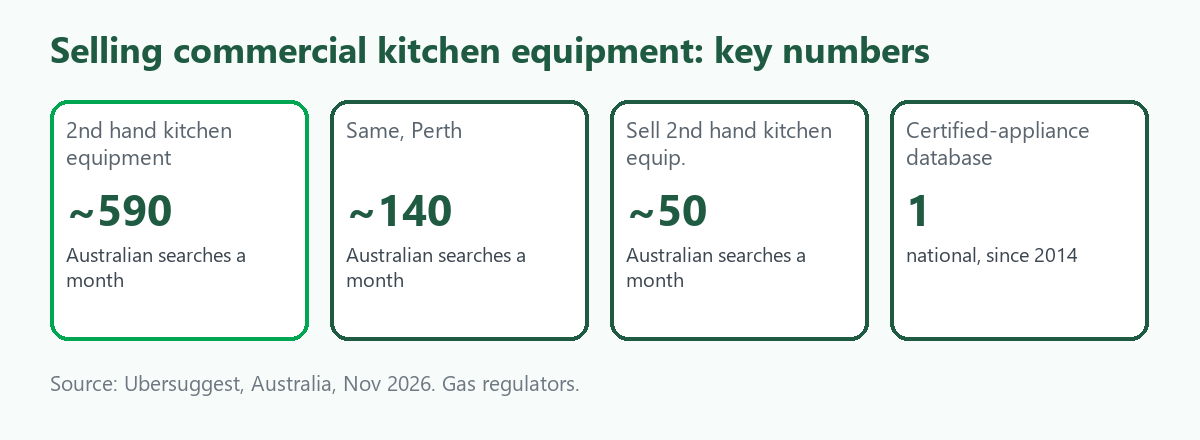
"Second hand commercial kitchen equipment" is searched about 590 times a month in Australia, according to Ubersuggest, with about 140 for Perth, 90 for Melbourne, 70 for Sydney and 50 each for Brisbane and "near me". "Sell second hand commercial kitchen equipment" is about 50, and "sell used commercial kitchen equipment" about 10. That tells you the buyer side of this market is much larger than the seller side, and the seller usually arrives when a cafe or restaurant closes, refits or changes hands. The rules for selling a kitchen are stricter than most owners expect, because gas appliances and refrigerated units are regulated. This guide covers what to check, how to prepare the equipment, where to sell it and what to do with items that cannot be sold. It belongs to our guide to selling used commercial and industrial equipment. We give no prices, because we found no reliable source, and ScrapTrade has a commercial interest in the scrap trade.
Gas appliances need certification
The Gas Technical Regulators Committee says it is an offence in Australia to supply or sell a gas appliance that is not certified, including a second-hand appliance, and in some jurisdictions even offering one for sale is an offence. Energy Safe Victoria's guidance on second-hand commercial catering equipment sets out the conditions: the appliance must have been certified when new and must be in a proper state of repair. Modifications or relocation can invalidate the original acceptance, and an appliance whose certification cannot be established, or that was imported, needs certification through an accepted body before it is installed. Certification for appliances approved since 2014 can be checked on the National Database of Certified Gas Appliances. Look for the Gas Compliance Mark or a certifier's mark on the data plate. Overseas marks such as CE and CSA are not enough on their own. Check the rules in your state, because the detail differs.
Refrigeration and refrigerant
A commercial fridge, freezer or cool room contains refrigerant, and recovering it is regulated in Australia. The Australian Refrigeration Council says anyone recovering fluorocarbon refrigerant from end-of-life equipment needs the right licence and authorisation, as we describe in Sell a Used or Broken Washing Machine or Fridge. Our search did not establish whether second-hand commercial refrigeration has different rules, so ask your state regulator. In practice, do not cut pipework or release gas, and keep proof of any degassing if a unit goes for scrap.
Step by step to a clean sale
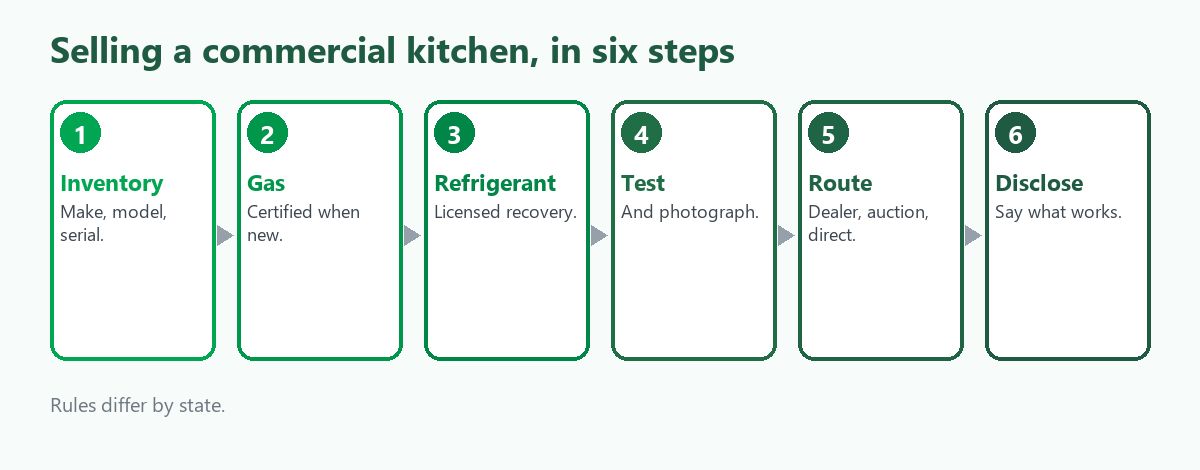
- Inventory every item. Record the make, model, serial number, age, fuel type and condition. Buyers search by model.
- Check certification and ownership. Confirm gas appliances are certified, and confirm nothing is leased or subject to finance, as the machinery guide explains.
- Handle gas and refrigerant properly. Disconnect gas appliances through a licensed person. Do not leave a fridge to be degassed informally.
- Clean, test and photograph. Show each item running if you can, and photograph data plates.
- Choose a route. See the list below.
- Disclose condition. Say what works, what does not and what has been repaired.
Where to sell
- A second-hand catering dealer. Takes common brands quickly and prices for resale. Ask what they pay for and whether they collect.
- A restaurant auction or liquidator. Suits a whole kitchen, with fees and uncertain prices.
- A direct sale to another operator. Often the best price, found through trade contacts, classifieds and local groups.
- A supplier trade-in. If you are buying new, ask the supplier whether it will take the old kitchen.
- A scrap buyer. For stainless benches, sinks and units that cannot be resold. Stainless is worth sorting, and our guide to where old stainless steel goes explains why grade matters.
Where ScrapTrade fits
A working combi oven or a good fridge is usually worth more to another operator than as scrap, and a local dealer or auction is the better home for it. ScrapTrade is a scrap marketplace, so the kitchen stock that suits it is the rest: a closure's stainless benches, sinks and shelving sold by weight, units too old to resell, or a large clear-out where a trader will take the whole lot. Verified traders in more than 50 countries can bid, listing is free with no commission, and you agree collection or shipping terms directly. When a bid is accepted, the buyer's 5 percent deposit sits in escrow. Individuals and businesses can both sell once verified. State clearly what is stainless, what is other metal and whether any refrigerant has been recovered. We could not confirm whether working catering equipment can be listed as equipment, so ask cs@scraptrade.com.au first.
What we could not verify
- What used kitchen equipment sells for. We found no reliable source.
- State-by-state gas rules. We relied on the national committee and Victorian pages.
- Rules for second-hand commercial refrigeration. We found no source.
- Whether ScrapTrade lists working catering equipment.
- ScrapTrade's verification steps. Ask support at cs@scraptrade.com.au.
Frequently asked questions
Can I sell a second-hand commercial gas oven?
Yes, if it was certified when new and is in a proper state of repair. Selling a non-certified gas appliance is an offence.
How do I know if a gas appliance is certified?
Look for the Gas Compliance Mark or a certifier's mark, and check the national database for appliances approved since 2014.
Can I sell a commercial fridge?
Yes, but refrigerant recovery is regulated, so use a licensed person for any degassing and ask your regulator about second-hand units.
What do I do with equipment nobody wants?
Sell stainless and other metal as scrap, keeping proof of any refrigerant recovery.
Sources
- Ubersuggest keyword data for Australia, queried November 2026.
- Gas Technical Regulators Committee; Energy Safe Victoria, "GIS 19: Second-hand commercial catering equipment", as summarised in search results.
- Australian Refrigeration Council fact sheets, as summarised in search results.
- ScrapTrade website, accessed November 2026.
This is general information, not legal or safety advice. Gas and refrigerant rules are regulated and differ by state. ScrapTrade is a scrap marketplace.