

Stainless steel looks like steel, but a scrap yard treats it as a different metal. It resists rust, it is not worth the same as ordinary steel, and the difference between two grades that look identical can change the price. This guide follows one stainless sink or tank from the job site to a yard, a shredder and a steel mill, and back into new stainless. It explains why grade matters, what the magnet test can and cannot tell you, why almost all Australian stainless scrap is sent overseas, and how much of the metal is recycled. It is written for tradespeople, collectors and yard operators. The export figures are our analysis of government records, and ScrapTrade has a commercial interest in the scrap trade.
Step 1: The stainless comes out
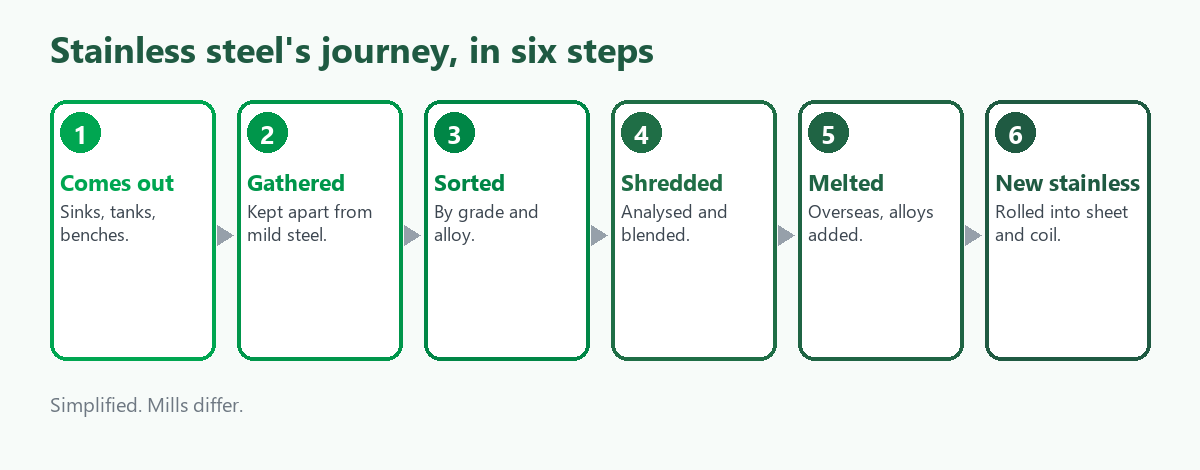
Stainless steel is steel alloyed with chromium, which is what stops it rusting, and often with nickel and molybdenum. It is in kitchen sinks, benches and appliances, in food and drink tanks, in pipes and fittings, in cutlery and in building trim. Australian industry describes two kinds of scrap. Reclaimed, or old, scrap is end-of-life material such as industrial equipment, tanks, washing machines and refrigerators. Industrial, or new, scrap is production offcuts and returns from factories and fabricators.
Stainless lasts a long time, so what comes out today was made decades ago. The Australian Stainless Steel Development Association (ASSDA) says the amount of old scrap available depends on production levels from decades earlier.
Step 2: A collector or tradesperson gathers it
A fabricator keeps an offcut bin, a kitchen fit-out crew pulls out commercial benches and sinks, and a collector picks up washing machines and fridge shells. Stainless is usually worth more than ordinary steel, so it is worth keeping apart. Do not mix it with mild steel, since that turns a better-paid load into a mixed one. We cover what yards pay in Stainless Steel Scrap Prices in Australia and how grades are priced in Stainless Steel Scrap Price Guide: Grades 304, 316 and Beyond. We publish no prices here, because they move.
Step 3: The yard sorts it by grade
This is where stainless differs from other scrap. Stainless comes in families and grades, and the alloy content decides the value. A magnet gives a first answer. According to a technical note from the Australian steel distributor Atlas Steels, the magnet test separates austenitic stainless steels, which include the common 304 and 316, from other steels, because those other steels, including ferritic grades such as 430, are attracted to a magnet. Austenitic stainless is generally not.
The test has traps, and the same note lists them. Some austenitic grades, particularly 304, are partly attracted to a magnet after they have been bent, formed or rolled. Austenitic castings and welds are usually slightly magnetic. So a magnet that sticks to a stainless sink does not prove it is the cheap kind. Two grades the note says cannot be readily sorted by simple tests are 304 from 321 and 316 from 316L.
For 316 against 304, the usual field test is a molybdenum spot test, because 316 contains molybdenum and 304 does not. The Atlas note says even a positive result only shows molybdenum is present, which could be 316L, 2205 or 904L as well as 316. The same note says there is a 200-series of austenitic stainless that is non-magnetic and otherwise indistinguishable from the 300 series, but has reduced corrosion resistance and considerably less value as scrap. Where the difference matters, the note says to use a full laboratory analysis, or portable spark or X-ray fluorescence equipment, the kind used for positive material identification.
Step 4: A processor shreds, analyses and blends it
Sorted stainless goes to a processor. ASSDA describes the next steps: the scrap is shredded, chemically analysed and stored by alloy type. It may then be blended to a customer's specification, since a mill wants a particular mix of chromium, nickel and molybdenum, and loaded into containers for export.
Step 5: Almost all of it leaves Australia
ASSDA's article, written in 2005 and last updated in 2018, says virtually all Australian stainless scrap goes overseas, with a small domestic outlet for foundries that use offcuts and plate. It estimated at least 30,000 tonnes a year going to mills in China, South Korea, Taiwan, India and Japan. That is an old estimate.
The government's export records give a fuller picture, with a caveat. They have a separate customs line for stainless steel scrap, but our copy of the collation carries it only to the first part of 2021-22, after which stainless scrap is no longer separable. So we use the last four full years that we have.
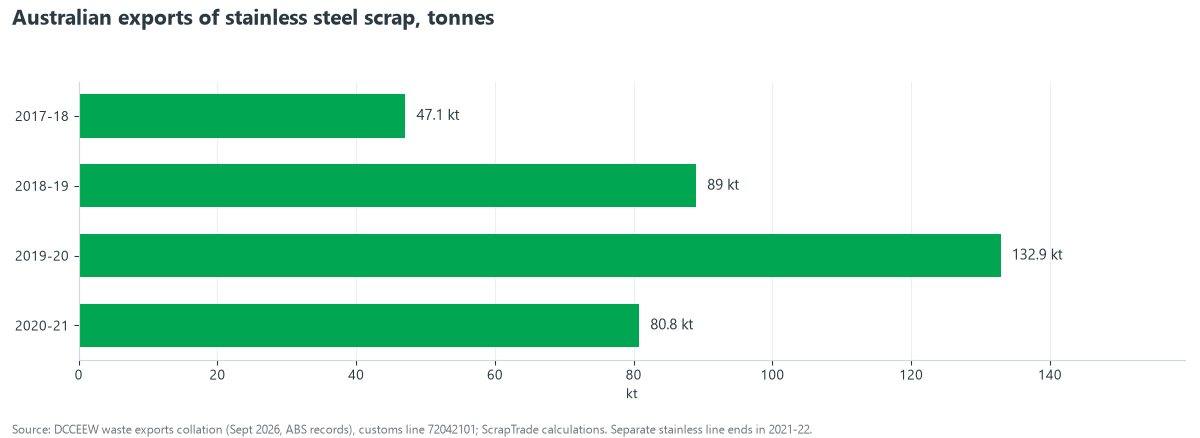
Exports of stainless scrap were 47,089 tonnes in 2017-18, 89,019 in 2018-19, a peak of 132,851 in 2019-20 and 80,773 in 2020-21, with a declared value of A$84 million, A$106 million, A$134 million and A$113 million. That is about A$1,792, A$1,193, A$1,010 and A$1,401 a tonne. Those are border declarations, not prices, and they are well above the 30,000 tonnes estimated in 2005. We cannot explain from the records why volumes swung so much.
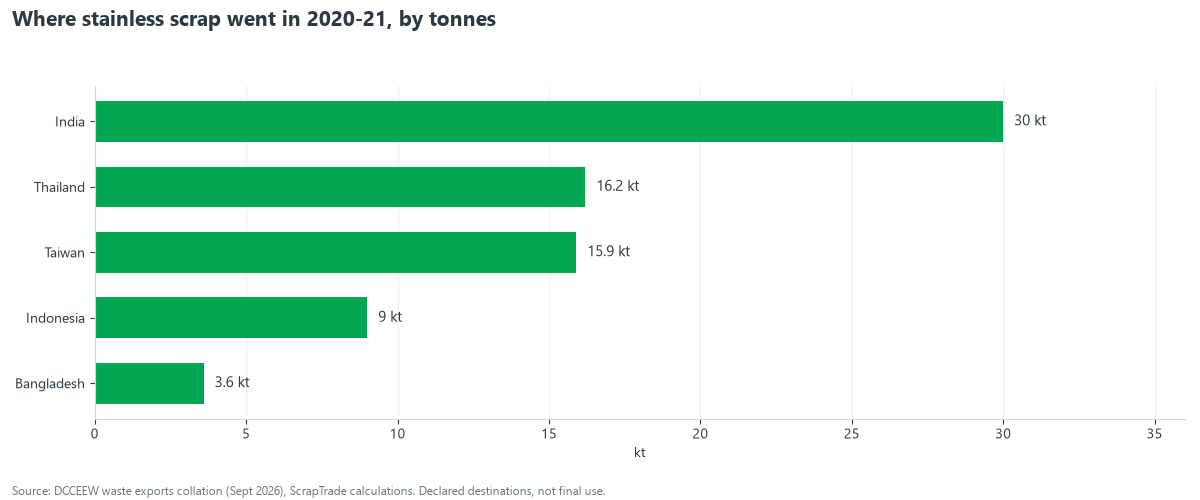
In 2020-21, India took 37.2 percent of the tonnes, Thailand 20.1 percent, Taiwan 19.7 percent, Indonesia 11.1 percent and Bangladesh 4.4 percent. That is a different mix from the 2005 list. We did not find a recent source for where Australian stainless scrap goes now.
Step 6: A mill melts it and rolls new stainless
At the mill, ASSDA says the scrap is charged into an electric furnace along with ferrochromium, ferro-molybdenum and nickel. Impurities are removed, the metal is refined, its chemistry is analysed and adjusted, and it is cast into slabs or billets and rolled into plate, sheet, coil or wire. The chromium, nickel and molybdenum in the scrap are recovered, which is the reason scrap is worth buying at all.
The result is new stainless of the same quality, according to ASSDA. So a stainless sink that goes to a mill can come back as the sheet for another sink, though we cannot trace any one sink.
How much really comes back?
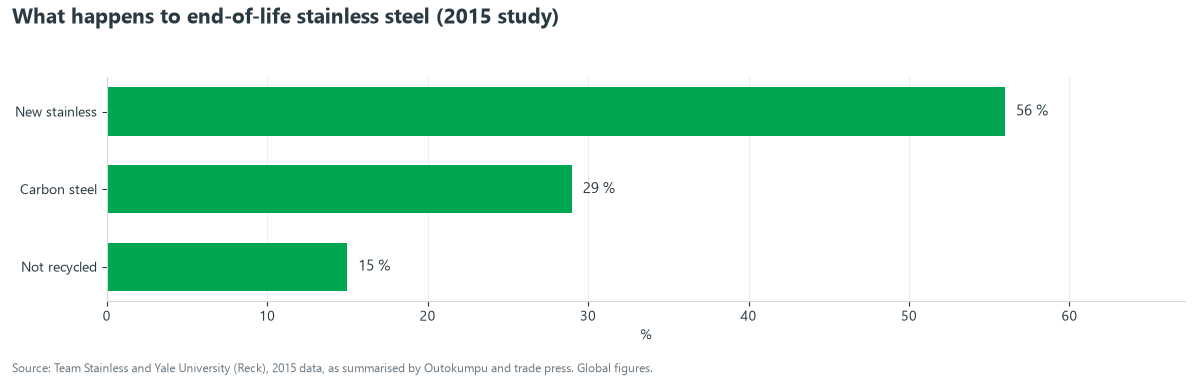
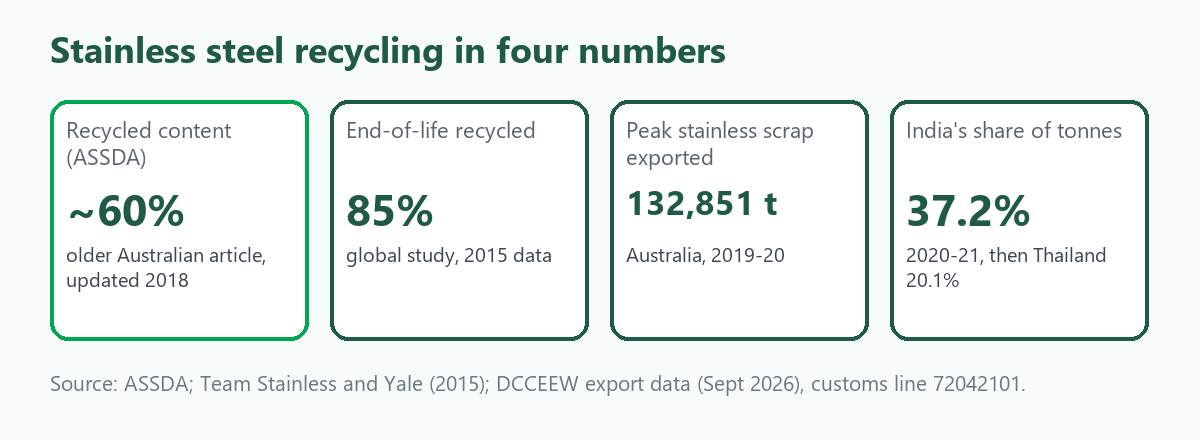
Stainless is one of the better-recycled metals, but the rates depend on what you count. A global study led by Barbara Reck of Yale University, with the industry alliance Team Stainless, estimated for 2015 that about 85 percent of stainless steel is recycled at the end of its life. Of all end-of-life stainless, about 56 percent was remelted as new stainless and about 29 percent went into carbon steel. That leaves about 15 percent not recycled. The same study put global recycled content at 44 percent, which is the share of scrap in new stainless.
A more detailed analysis of 2019 data by the Karlsruhe Institute of Technology puts global recycled content at 48 percent, according to ASSDA. ASSDA says the figures vary by region, because countries with a long history of stainless have more old scrap available and China, whose stainless is newer, has less. For Australia, ASSDA's older article gives roughly 60 percent recycled content in stainless at the time of writing, made up of 25 percent old scrap, 35 percent industrial scrap and 40 percent new raw materials. We cannot say how much of any of this is Australian metal.
What this means for you
- If you are a tradesperson or fabricator: keep stainless separate from mild steel, keep offcuts of different grades apart if you know them, and keep grade stickers and markings. The Atlas note says retaining the original identification reduces the need for sorting tests.
- If you collect scrap: use a magnet to split stainless from steel, but do not assume a non-magnetic piece is the best grade, and do not assume a magnetic one is not stainless. Ask your buyer how they test.
- If you run a yard: a handheld analyser or a lab result can change what you pay and what you get. Keep grades separate and records clean. You can list stainless on the ScrapTrade marketplace or create a free account. For the difference between the metal families, see Ferrous vs Non-Ferrous Metal Recycling Explained.
For old laptops, TVs and circuit boards, from the drop-off point to the refiner, see Where Old Electronics Go After You Hand Them In.
What we could not verify
- Where your own stainless goes. Processors sell to different mills.
- Current Australian exports of stainless scrap. Our collation has a separate line only to 2021-22.
- Why exports swung so much. The records show the change, not the cause.
- Whether any Australian company melts stainless today. ASSDA's article says a small domestic market exists in foundries, but it is from 2005.
- The recycling rates. The 85 percent rate and the 44 percent recycled content are for 2015, from a global study, and the ASSDA figures are older still. A later 2019 analysis is shown by ASSDA mainly in charts, so we do not quote its end-of-life rate.
- What yards pay today. The declared values above are not prices.
Frequently asked questions
Is stainless steel magnetic?
Some grades are and some are not. Austenitic grades such as 304 and 316 are generally not magnetic, ferritic grades such as 430 are, and 304 can become partly magnetic when it is bent or formed.
How do you tell 304 from 316?
316 contains molybdenum and 304 does not, so a molybdenum spot test or a handheld X-ray analyser can separate them. A magnet cannot.
Is stainless steel worth more than normal steel as scrap?
Generally yes, because of the chromium and nickel in it, but the price depends on the grade. Ask a buyer, and keep stainless separate from mild steel.
Can stainless steel be recycled forever?
ASSDA says stainless can return to its original quality without degrading. In practice some of it ends up in carbon steel and some is not collected, as the 2015 study showed.
Sources
- Australian Stainless Steel Development Association, "Recycling of stainless steel scrap" (Australian Stainless, issue 33, Spring 2005, updated 14 June 2018).
- Australian Stainless Steel Development Association, "The global life cycle of stainless steel" (page updated 6 February 2024), summarising Team Stainless and Karlsruhe Institute of Technology work.
- Team Stainless and Yale University (Barbara Reck), The Global Life Cycle of Stainless Steels, 2015 data, as summarised by Outokumpu and trade press.
- Atlas Steels, Tech Note No. 1, "Qualitative Sorting Tests for Stainless Steels", revised 11 August 2021.
- Department of Climate Change, Energy, the Environment and Water, Waste exports data collation, September 2026 (ABS records), ScrapTrade calculations, customs line 72042101 (waste and scrap of stainless steel), 2017-18 to 2020-21.
This is general information, not financial or legal advice. Process steps are simplified, and plants differ. Declared export values are border declarations, not prices. ScrapTrade operates a scrap marketplace and has a commercial interest in the scrap trade.