

A rack of decommissioned servers is one of the few clear-outs that still has real resale value. The people searching for "sell old servers" are usually IT managers or managed service providers who want to know whether the hardware is worth selling, what a buyer will check and what to do about the data first. This guide covers what we could find. Nearly all of it is from resellers who want to buy your equipment, so we flag what is a claim and not a fact, and we give no prices. It follows our guide to IT asset disposal in Australia. ScrapTrade runs a scrap marketplace and has a commercial interest in the scrap trade.
Data first
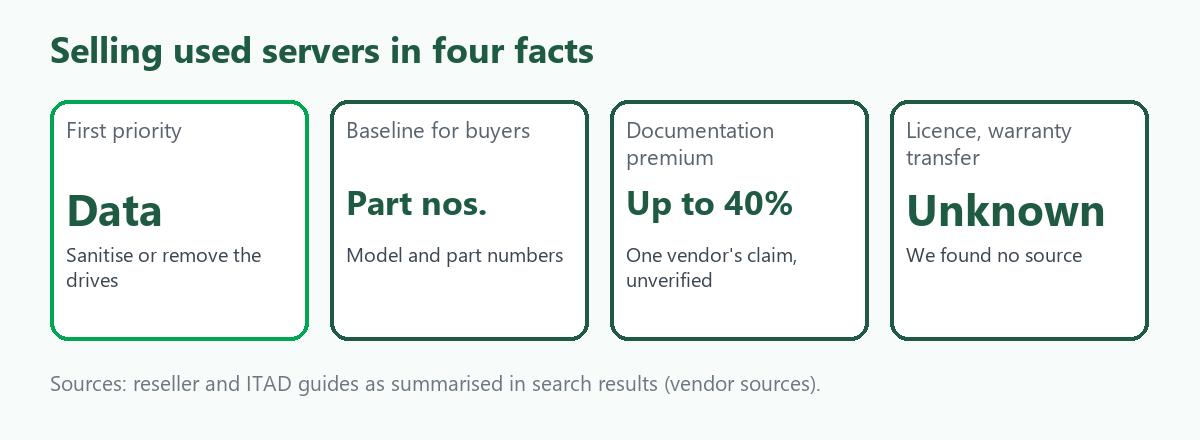
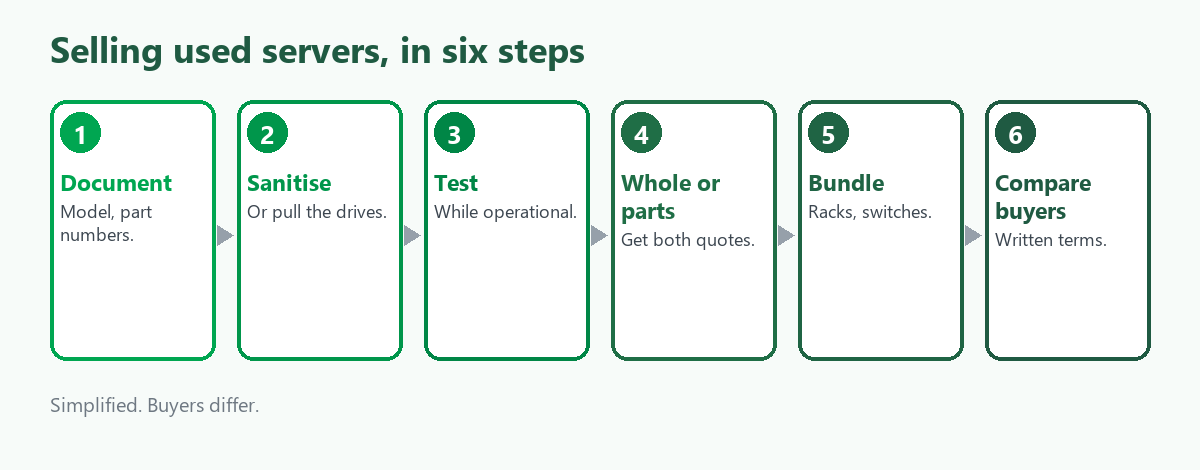
Every source we read puts data sanitisation at the start. One guide says it is the first priority unless you plan to shred the drives separately, and some resellers offer a certificate of data destruction for your records, which is worth requesting. Decide before you list whether the drives stay with the server, are wiped to a standard or are removed and destroyed. A server sold without its drives is common and avoids the question, and our guide to data destruction for old IT equipment explains the methods and the Privacy Act duty.
What buyers look at
- Model and part numbers. For most resale purposes a reseller needs the model number and the part numbers of what is inside.
- Demand for the model. One source says that if buyers are interested in your server, it has value, and value follows supply and demand.
- Condition and whether it still runs. One seller advises selling servers while they are still operational, which makes sense because a buyer can then test them.
- Documentation. A vendor claims well-documented servers can command up to 40 percent more in the secondary market. That is one vendor's unverified figure, and we do not rely on it.
Whole or in parts
Sources disagree. One says CPUs, memory and drives may fetch more when sold individually, and another says CPUs are the best candidates for quick resale while storage loses value fast because it becomes obsolete quickly. We could not settle it, so ask more than one buyer to quote the whole server and the parts. Pulling parts costs time and risks damage, and a buyer for the complete machine may pay less per part and take it all in one go.
Bundles and extras
Racks, switches, power distribution units and cabling can be sold with the servers, and one source says a bundle appeals to buyers who want a turnkey setup. Our guide to used switches, routers and firewalls covers the network gear, where licences are a bigger issue.
What we could not find
The sources said nothing on firmware and management licences, such as whether the remote-management licences on some servers move with the hardware, and nothing on warranty transfer. Check your vendor's licence terms and warranty agreement before you list, and tell buyers what applies. We found no Australian prices.
Where to sell
- Specialist resellers and buyback firms. They quote on model and condition and may collect and handle the data.
- ITAD providers. They combine sanitisation, resale and recycling, and the resale is reported against the disposal cost.
- Marketplaces and classifieds. More control, with the work of testing, listing and shipping on you.
- Scrap. A server that has no buyer is boards, metal and drives, and our guide to selling broken laptops, phones and monitors shows how that side works for smaller devices.
What to put to a buyer in writing
Before the hardware moves, settle the terms. Ask each buyer:
- What do you pay for each model, and for the parts if I split it? Compare the whole-server and parts quotes side by side.
- What condition do you assume? Ask whether the price is for tested units and what happens to units that fail testing.
- Do you take the drives, and how are they handled? If they are staying with the server, ask for a certificate of data destruction for your records.
- Who collects, and who pays? Servers are heavy, and a rack is a job for more than one person.
- When do I get paid? Before or after the buyer tests the gear.
This is how we would structure the sale and not a rule we found, and the sources gave no Australian terms. Keep the written quote with your asset records.
Where ScrapTrade fits
One server belongs with a reseller, and ScrapTrade is not a data centre buyback service. If you are a managed service provider, a contractor or a business with a pallet of wiped boards, drives or retired kit, listing it may suit you: nothing is charged to list, you agree price and terms in chat and the buyer's 5 percent deposit is held in escrow once a bid is accepted. Businesses and individuals are verified before they sell, and traders in more than 50 countries bid. Whether working servers can be listed is something we could not confirm, so email cs@scraptrade.com.au first.
What we could not verify
- What any server or part is worth. We give no prices.
- Whole versus parts. Sources conflict.
- The 40 percent documentation premium. It is one vendor's claim.
- Firmware, management licence and warranty transfer. We found nothing.
- Whether ScrapTrade lists working servers.
Frequently asked questions
Can I sell old servers?
Yes. Resellers buy them, especially models in demand, and the data must be sanitised first.
Should I sell the parts separately?
Sources disagree. Ask buyers to quote the server whole and the parts.
Do I need to wipe the drives?
Sanitise them or remove and destroy them. Every source puts data first.
Do licences and warranties transfer?
We found nothing, so check your vendor's terms.
Can I list servers on ScrapTrade?
E-waste is a category. We could not confirm working servers, so ask support.
Sources
- Ubersuggest keyword data, Australia, queried November 2026.
- Reseller and ITAD guides on selling used servers, as summarised in search results. These are vendor sources, and their figures are unverified.
- ScrapTrade website, accessed November 2026.
General information only, not legal or security advice. Resale terms vary by buyer.