

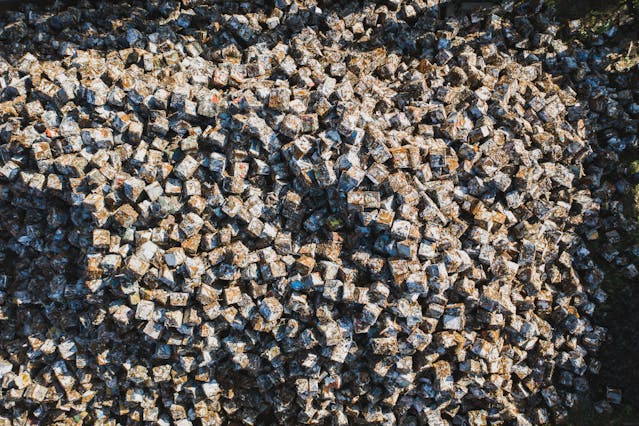
Scrap aluminium is worth a share of the world aluminium price, and the share depends on what you are selling and how clean it is. A bale of cans, a stack of window extrusions and a pile of painted sheet can all be called "aluminium" and be paid at three different rates. This guide starts from the benchmark, shows how to work out what an offer means, and says what we could and could not verify. For the payout arithmetic in more detail, see Scrap Aluminium Price Per Kg in Australia.
The benchmark in Australian dollars
On 29 October 2026 the official London Metal Exchange (LME) cash settlement for aluminium was US$3,071 a tonne [1]. The Reserve Bank of Australia's rate that day was US$0.7053 to the Australian dollar [2], which makes the benchmark about A$4,354 a tonne, or roughly A$4.35 a kilogram. That is the price of new aluminium, not scrap. Scrap sells below it, and how far below depends on the type, the buyer and the day. We found no sourced figure for the usual share.
What moves the payout
- Type. The ScrapTrade Price Index defines extrusion (6063) as clean, uncoated window and door extrusions, used beverage cans as baled cans, and sheet as clean sheet with no coating. Cast aluminium (engine parts, machinery) and mixed aluminium are different again, and yards price each separately.
- Cleanliness. The words "clean", "uncoated" and "no coating" in those definitions are the point. Paint, steel screws, rubber seals, glass and plastic reduce what a buyer pays or add a deduction.
- Weight and quantity. The payout is weight times the rate, so an accurate weight matters, and larger sorted lots are easier to price.
- The benchmark and the exchange rate, which both move every trading day.
How to check an offer
Work backwards from the benchmark.
- Divide the offer per kilogram by A$4.35. An offer of A$2.00 a kilogram, which is an invented example, is about 46% of the benchmark.
- Ask the yard what share of the benchmark it pays for your type, and what it deducts.
- Compare two or three buyers. With no sourced typical share, compare buyers with each other instead of aiming at a fixed percentage.
Getting a better payout
- Sort by type before you go: extrusion, sheet, cans and cast.
- Remove attachments such as steel fixings and rubber, where it is safe to do so.
- Ask what grade you are being paid at and what a cleaner load would earn.
- Check the date on any price you are shown. A figure without a date is not a price.
- Know your paperwork. In NSW and Victoria dealers cannot pay cash for scrap, and a business seller may be asked for an ABN or have 47% withheld, as explained in What If Every Scrap Trade Were on the Books?.
Customs data as context
Australian aluminium scrap exports averaged A$3,790 a tonne in declared value across 2025-26, up 26% on the year before, while tonnes fell 20% [3]. That is a financial-year average of mixed shipments, so it should not be compared with a single day's benchmark, and it is not a yard price. See Do Scrap Export Volumes Follow Prices? and Who Buys Australian Aluminium and Copper Scrap.
Selling it through ScrapTrade
ScrapTrade is a marketplace where you list material, receive bids and negotiate with buyers, rather than taking a single yard quote. According to ScrapTrade's own pages:
- Listings and bids. You list with photos and pricing preferences and review buyer offers, and buyers can also post what they need, as set out on How It Works.
- Escrow. The Trust & Safety page says payment is held from the moment a deal is confirmed and released once pickup or delivery is confirmed on both sides.
- Quick Sale. Quick Sale arranges free pickup on most loads across Australia, but you do not set the price: the value is assessed against current material prices after collection. If the best rate for a specific type matters more than convenience, a regular listing is the better fit.
- Calculator. The scrap calculator gives an indicative estimate. When we checked on 30 October the index said it was showing reference estimates while live pricing was unavailable, so use it as a starting point only.
- Start here: create a free account or browse the marketplace.
If you run a yard, the yard management tools cover inventory, customers, suppliers, dockets and invoices. ScrapTrade has a commercial interest in the scrap trade.
What we could not verify
- A sourced Australian yard price for aluminium. We found none.
- The typical share of the benchmark each type earns.
- City-by-city differences, for which we have no data.
- What your yard will actually pay. Ask them, and check the date on the quote.
Frequently asked questions
How much is scrap aluminium worth per kilo in Australia?
It depends on the type and the day. The LME aluminium benchmark was about A$4.35 a kilogram on 29 October 2026, and scrap sells below it [1][2].
Why do two yards quote different aluminium prices?
They use different rates, deductions and margins. Compare each offer as a share of the benchmark.
Is the export price what I will be paid?
No. Declared export value is an average of mixed shipments over a year [3].
Do I need an ABN to sell scrap aluminium?
If you sell as a business, the ATO's scrap code expects an ABN or the buyer withholds 47%, unless a valid exception applies [4].
Sources
- Westmetall, Official LME prices, 29 October 2026.
- Reserve Bank of Australia, Exchange rates, 29 October 2026 (US$0.7053 per A$1).
- Department of Climate Change, Energy, the Environment and Water, waste exports data (ABS records), ScrapTrade calculations, via Do Scrap Export Volumes Follow Prices?. 2025-26 figures are provisional.
- Australian Taxation Office, GST and scrap metal: code of compliance (3 July 2023).
Figures are indicative and not an offer or advice. The A$2.00 offer is invented. ScrapTrade operates a scrap marketplace and has a commercial interest in the scrap trade.