

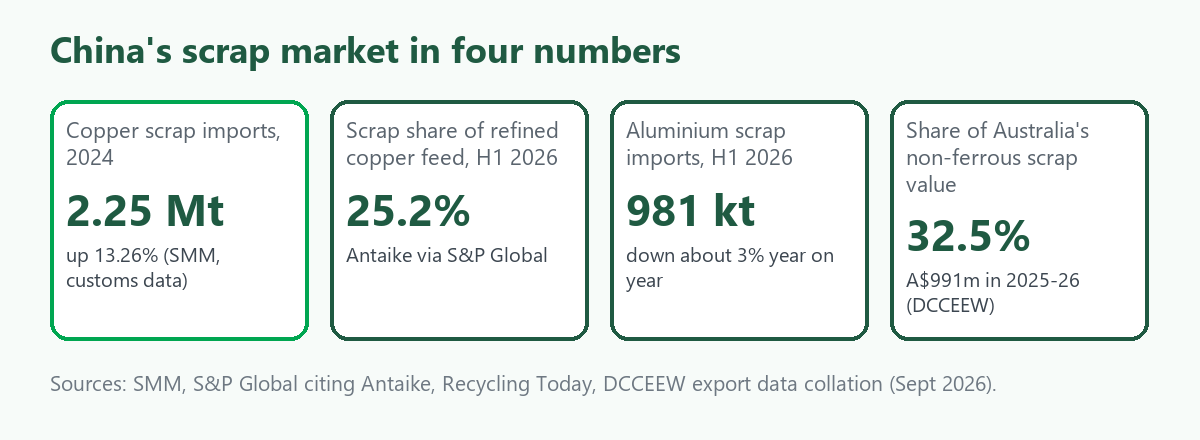
Updated 26 October 2026. For about a decade the question hanging over the scrap trade was whether China was open or closed. A sweeping ban on many types of waste imports in 2018 and 2019 shook every scrap yard in the world. The answer today is neither: China is open to recycled copper and aluminium, but only on its terms. It is also the single most important buyer of Australian non-ferrous scrap, taking 32.5% of its value in 2025-26, or about A$991 million [1]. This profile sets out what China buys, what it asks of sellers, how policy is changing and what that means for exporters.
The numbers are from Chinese customs data as reported by Shanghai Metals Market (SMM), S&P Global and Recycling Today, and from Australian export records. Several rules come from trade sources, and where a source is a trade blog we say so. China's requirements change, so check the current customs notices before you ship. This is general information and not trade or legal advice.
Copper: a hungry smelter sector
China imported 2,249,952 tonnes of copper scrap in 2024, up 13.26% from 1,986,559 tonnes in 2023, according to SMM's reading of customs data, part of the increase reflecting customs classification issues early in the year and buying to compensate. The United States was the biggest single supplier, shipping 361,099 tonnes in the first ten months of 2024, about 19.5% of the total, according to S&P Global [2][3].
The reason is the market for copper concentrate. Chinese smelters have been squeezed by tight supply of ore, so they have leaned harder on scrap. Antaike data cited by S&P Global show copper-bearing scrap at 25.2% of the feedstock for China's refined copper in the first half of 2026, up from the year before, as spot treatment charges fell further into negative territory [4]. We explain those charges in Copper Prices: Analysis, Risks and Outlook.
There is a counter-current. Stricter enforcement of China's reverse invoicing rules for recycled materials has raised costs and cut the supply of compliant domestic scrap, and tight domestic supply has cut scrap-derived anode output [4]. In other words, China's smelters want more scrap at the same time as domestic rules make it harder to supply, which pulls demand towards imports.
Aluminium: a different mood
Aluminium is a more mixed picture. China's aluminium scrap imports were about 981,000 tonnes in the first half of 2026, down roughly 3% year on year, which one report attributes to pricier overseas offers that were harder to source and weaker buying by domestic secondary smelters [5]. China's own aluminium industry faces a 30% export duty on primary metal, which pushes output out as alloy. See Aluminium Prices: Analysis, Risks and Outlook for the supply picture.
The rules in plain terms
The framework changed in November 2020. China began treating recycled copper and copper alloy, and recycled aluminium and aluminium alloy raw materials, as no longer solid waste. They can be imported freely if they meet quality standards, which BIR has summarised. Rules for ferrous recycled raw materials followed on 1 January 2021, with requirements tied to five customs codes for different ferrous grades [3][6].
Two details matter most for a seller.
- Purity. A trade source says exporters of copper, brass and aluminium scrap must meet a 99.1% purity level [7]. That is a standard about material, not paperwork: loads with too much dirt, plastic, steel or oil fail it.
- Inspection. The same source says these materials are subject to inspection by Chinese customs officials [7]. Another trade report describes the market as sceptical about China's easing of restrictions on recycled copper and aluminium imports [3]. Rules can loosen and tighten, and what is announced does not always reach the port in the same form.
The 99.1% and inspection details come from a trade blog, so confirm them against current customs notices.
Australia's China business
China is a large and, for copper, dominant destination for Australian scrap.
| Australian scrap sold to China, 2025-26 | Share of value | Value |
|---|---|---|
| All non-ferrous scrap | 32.5% (largest buyer) | A$991 million |
| Copper scrap | 56.0% (largest by far) | A$686 million |
| Aluminium scrap | 21.2% (second after India) | A$304 million |
Source: DCCEEW export data collation [1]. China takes just over half of Australian copper scrap by value but only 34% by weight, which suggests it receives the higher-value material.
Australia's ferrous scrap does not go to China in volume. The country's steel scrap goes to South and South-East Asia, a pattern described in Bangladesh: Australia's Top Scrap Customer.
What it means for sellers
- Quality is the ticket. For copper and aluminium, buyers who ship to China must pass purity and inspection, so they pay for clean, well-sorted, honestly described material. See how to grade scrap metal and our copper and aluminium guides.
- A rejected load costs far more than a downgrade. A load that fails inspection at the destination port can be returned or re-graded at the seller's expense, depending on the contract.
- Do not rely on one market. China's rules and demand can shift quickly, and Australian sellers have found other buyers in India, South Korea and Thailand, which together with China take about 79% of non-ferrous value [1].
- Watch the signals. Chinese customs notices, copper treatment charges, scrap discount rates and the US-China trade relationship all feed through to what Australian yards can pay.
Check the live price calculator as a reference (indicative, not a quote), and use the marketplace to compare buyers. For the shipping side see How a Scrap Export Deal Works, Step by Step.
Frequently asked questions
Does China import scrap?
Yes, copper and aluminium scrap that meets quality standards can be imported freely, while many other wastes remain banned. China imported about 2.25 million tonnes of copper scrap in 2024 [2].
How much copper scrap does China import?
2,249,952 tonnes in 2024, up 13.26% on 2023, according to SMM [2].
What are China's purity requirements for scrap?
A trade source says 99.1% for copper, brass and aluminium scrap, with customs inspection. Verify against current official notices [7].
Who is China's biggest scrap supplier?
For copper in 2024, the United States was the largest single source at about 19.5% of imports in the first ten months [3].
How much Australian scrap goes to China?
About A$991 million of non-ferrous scrap in 2025-26, including 56% of Australia's copper scrap by value [1].
Sources
- Department of Climate Change, Energy, the Environment and Water (DCCEEW), Waste exports data collation, September 2026 (ABS records), ScrapTrade calculations. See Australia's Scrap Metal Exports: 2025-26 Data.
- SMM, 2024 Brief Review of Imported Copper Scrap.
- S&P Global, Chinese importers hit pause on copper scrap from US (November 2024); Fastmarkets, Market remains skeptical about China's easing restrictions on recycled copper and aluminium imports.
- Recycling Today, Primary copper producers turn to scrap, citing Antaike via S&P Global.
- Discovery Alert, China aluminium scrap imports: key overseas suppliers in 2026, a secondary source.
- Recycling International, Clarity on easing of non-ferrous scrap into China.
- AMCS Group, Exporting scrap metals to China, Malaysia or Indonesia?, a trade blog.
Figures are as reported by the sources named. Rules change and some come from trade blogs, so verify against official notices. This article is general information, not trade or legal advice. ScrapTrade operates a scrap marketplace and has a commercial interest in the scrap trade.