

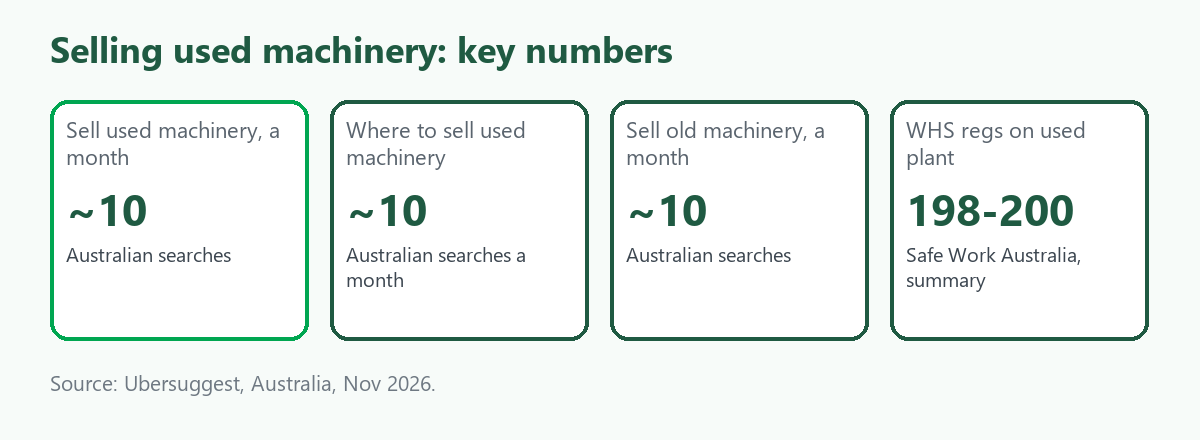
"Sell used machinery", "where to sell used machinery" and "sell old machinery" are each searched about 10 times a month in Australia, according to Ubersuggest, and the phrases "sell used forklift", "sell used tools" and "sell used compressor" returned nothing measurable. The market is real, but it is conducted through brokers, auctions and trade contacts, not search. People who have machinery to sell usually need three things answered: what a seller is responsible for, how to be sure the equipment is theirs to sell and where the buyers are. This guide answers them for plant and workshop equipment. It belongs to our guide to selling used commercial and industrial equipment. We give no prices, because we found no reliable source, and ScrapTrade has a commercial interest in the scrap trade.
What a seller owes the buyer
Safe Work Australia's guidance says anyone who supplies second-hand plant has duties under work health and safety law, which sit alongside the general supplier duties. They apply to a person selling their own used plant directly, a retailer of used plant, an importer and an auctioneer acting for a seller, with some exceptions for clearing sales. The provisions are cited as WHS Act section 25 and Regulations 198 to 200, and state versions can differ. In summary, the supplier must:
- take reasonable steps to make sure the plant is safe, which is harder with second-hand plant because it is more likely to have out-dated or missing safety features;
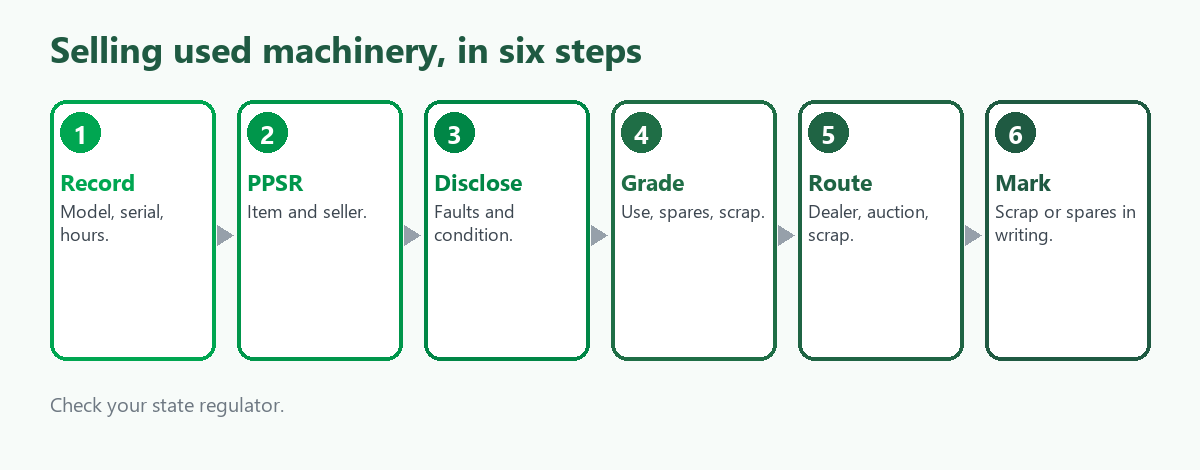
- identify faults and tell the buyer about the plant's condition;
- give the buyer information about what the plant was designed to do and how to use it safely, and take reasonable steps to get that information from the manufacturer or original supplier;
- notify the buyer in writing when the plant is sold as scrap or spare parts and should not be used as plant in its current form.
We are not lawyers, and we relied on search summaries of Safe Work Australia's pages and the 2024 model code, so check your state regulator's version for a specific sale.
Check that it is yours to sell
Equipment is often financed, leased or subject to a lender's blanket security over a business. Law-firm guides advise searching the Personal Property Securities Register both by the item's serial number and against the seller, because lenders register broad interests over a company's current and future assets. The searches give a certificate you can keep, and if an interest appears, the purchase terms should require it to be released at settlement. The guides say a buyer who searches correctly will in most cases take the goods free of any security interest, though that is not a guarantee. Equipment that is leased or hired is not the seller's to sell.
Grade it and describe it
- Serviceable. Runs, is complete and has records. Provide hours, service history, manuals and any compliance paperwork.
- Repairable. A known fault. Say exactly what it is.
- Spares. Valuable components are worth selling separately: motors, controllers, drives, gearboxes and tooling.
- Scrap. Beyond use and priced by metal. Copper windings, aluminium housings and steel frames each have a value, as our guides to copper wire and stainless steel explain.
Photograph the data plate, the controls and any damage, and note if the machine has been modified. For anything with electrical, hydraulic or pneumatic systems, have a qualified person isolate and drain it before collection.
Routes compared
- A dealer or broker. Quick, with a margin. Best for common machines.
- An industrial auction. Reaches many buyers for a fee, with the supplier duties still applying to the seller.
- A direct sale. Best price, most responsibility, and a buyer has to arrange the move.
- A scrap or recycling buyer. For equipment with no use left, sold by weight and metal type.
- A trade marketplace. For scrap or spares lots, as below.
Working through a state-by-state checklist is covered in our guide to scrap business rules in Australia, and the closure side is in Sell Business Equipment When You Close Down.
Where ScrapTrade fits
The machinery that suits ScrapTrade is the machinery that has stopped being machinery: a plant clear-out with tonnes of steel, motors and cable, a workshop's pile of obsolete equipment or a decommissioned line sold by weight and metal type. Those lots are priced by traders who buy metal, and the seller's job is to describe them well. ScrapTrade is a scrap marketplace with verified traders in more than 50 countries, listing is free with no commission, and sellers negotiate in real time and agree collection or shipping directly. Once a bid is accepted, a 5 percent buyer deposit is held in escrow. Businesses and individuals can both sell after verification. Mark anything sold as scrap or spares as such in the listing and in writing, as the safety guidance expects. A working machine for another factory is a different sale, and we could not confirm whether ScrapTrade lists working equipment as equipment, so ask cs@scraptrade.com.au before you plan on it.
What we could not verify
- What used machinery sells for. We found no reliable source.
- The detail of your state's plant supply rules. We relied on national summaries.
- PPSR outcomes for any particular sale. The guides are general and not legal advice.
- Whether ScrapTrade lists working equipment.
- ScrapTrade's verification steps. Ask support at cs@scraptrade.com.au.
Frequently asked questions
Do I have to tell a buyer about faults in used machinery?
Yes. Safe Work Australia says suppliers of second-hand plant must identify faults and tell the buyer about its condition.
Can I sell machinery as scrap or spares?
Yes, but the buyer must be told in writing that it is scrap or spares and should not be used as plant.
How do I check that equipment is free of finance?
Search the PPSR by serial number and against the seller, and keep the certificate.
Where do I sell used industrial machinery?
Through a dealer, an industrial auction, a direct sale or a scrap buyer, depending on condition.
Sources
- Ubersuggest keyword data for Australia, queried November 2026.
- Safe Work Australia, "Plant: WHS duties" and the model code of practice on managing the risks of plant in the workplace, as summarised in search results.
- Law-firm guides to PPSR searches for machinery and equipment, as summarised in search results.
- ScrapTrade website, accessed November 2026.
This is general information, not legal or safety advice. Work health and safety rules differ by state. ScrapTrade is a scrap marketplace.