

Copper wire is the scrap that people most want to understand, because it is worth real money and the difference between a good price and a bad one comes down to what is inside the plastic. This guide follows one length of old copper wire from the moment it leaves a wall, a car or a building site to the moment it turns up as new cable. It explains who picks it up, how a yard grades it, how a machine separates the copper from the insulation, why a lot of Australian copper scrap goes overseas, and what it becomes. It is written for householders, electricians and collectors who want to see where their wire ends up. The export figures are our analysis of government records, and ScrapTrade has a commercial interest in the scrap trade.
Step 1: The wire comes out
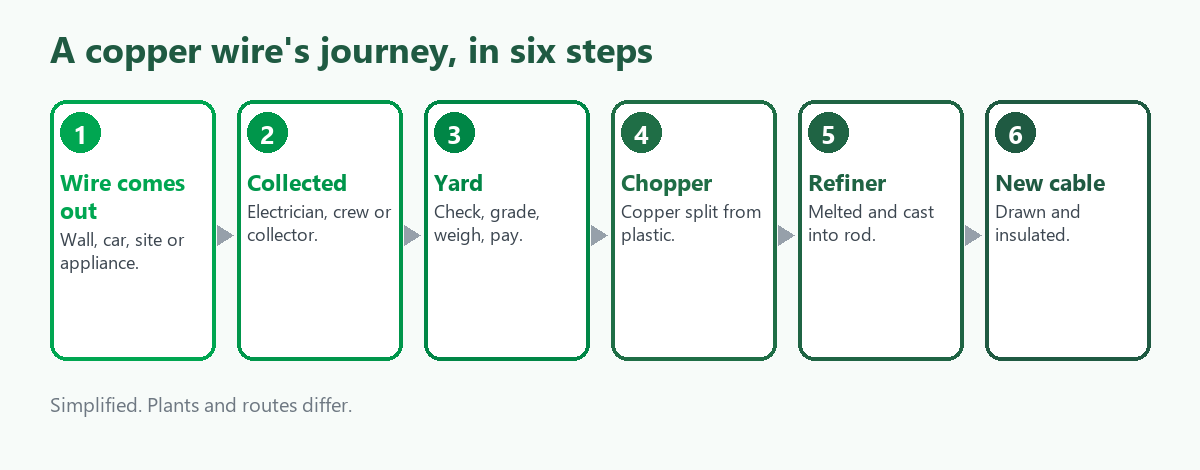
Wire reaches the end of its life in a handful of ways. A house is rewired, a building is stripped or demolished, an appliance or a car is taken apart, an extension lead is replaced, or an electrician pulls out cable at the end of a job. Often the copper has been in place for decades.
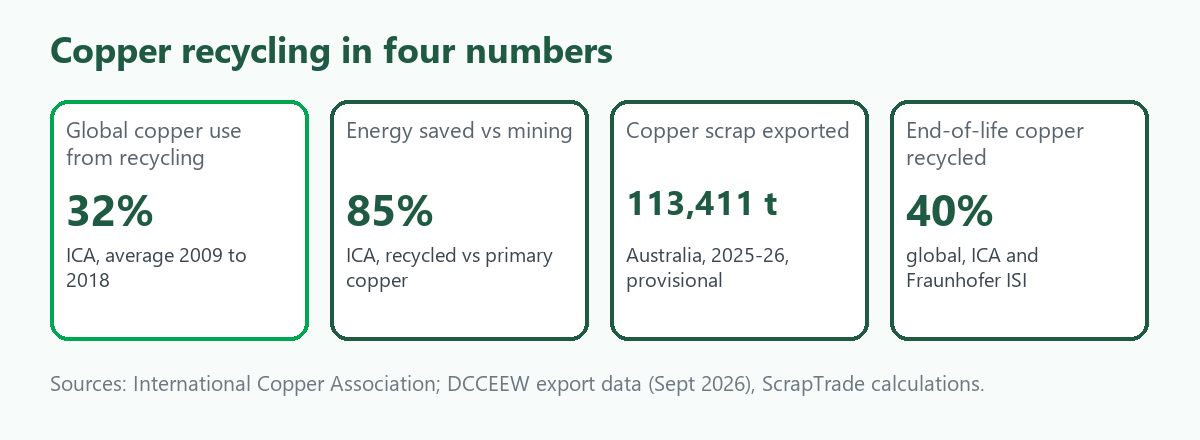
That long life matters. The International Copper Association (ICA) estimates that of the 690 million tonnes of copper produced in the last hundred years, about two-thirds is still in use, and that copper often stays in use for decades before it can be recycled. The ICA gives it as one of two reasons the loop cannot fully close, the other being rising demand. Nearly 70 percent of copper goes into electrical and communications uses, and copper has the highest electrical conductivity of any metal except silver, which is why it is in your wall.
Safety comes first at this step. Never cut or pull wire that could be live, and leave electrical work to a licensed electrician. Do not burn the insulation off to get at the copper, since burning plastic gives off toxic fumes and burning waste is banned or restricted in many places.
Step 2: Someone collects it
The wire is gathered by whoever has it. An electrician or builder may keep an offcut bin, a demolition crew may strip a site, and a householder may have a tub of leads in the shed. Scrap collectors and wreckers also pull copper out of cars, air conditioners and old machines.
At this point the seller has a choice: sell the wire as it is, insulated, or strip the plastic off by hand or with a machine and sell the bare copper. Stripping can be worth it if you have a lot of wire and a good stripper, and it is a waste of time on thin or short pieces. Our guide to stripping copper wire sets out when it pays.
Step 3: The yard checks, grades and weighs it
At the yard, the wire is weighed and checked. The yard wants to know what is inside the insulation, because copper-coated aluminium and other lookalikes are not copper, and because the cleaner and heavier the copper, the more it is worth.
Yards typically sort wire into grades, such as bare bright copper wire, stripped mixed copper and insulated wire. Different yards use their own names, and the same wire can be graded differently from one yard to the next, so ask what the grade means and what the yard pays for it. The payout is a percentage of the world price: the London Metal Exchange (LME) benchmark for copper was US$14,560 a tonne on 29 October 2026, or about A$20,640 at the Reserve Bank's rate that day. A yard pays a share of that figure, and the share depends on the grade. We show how to check an offer in Scrap Yard Copper Prices: How to Check an Offer.
Yards that buy from the public are often required to record who sold the material. The rules differ by state and we cover Queensland and Western Australia in Scrap Metal in Queensland and Scrap Metal in Western Australia.
Step 4: A chopper separates the copper from the plastic
Insulated wire is where the machines come in. In a typical wire processing plant, the cable is fed into a hopper and chopped into small pieces. One manufacturer describes a granulating chamber with three rotating knives and two fixed ones. The chopped material is blown through a separation chamber, where air and gravity pull the heavy copper away from the light plastic. The result is clean copper granules, which the trade calls chops.
Thin wire needs finer chopping, because the copper is tightly bound to its insulation. Industry sources describe two stages: a gravity table, which uses vibration and a flow of air or water to separate the heavy metal, and then an electrostatic separator, which catches the finest bits of copper that remain. The plastic, often PVC, can then be melted and turned into pellets for reuse, according to one industry description. Granulation can turn a hard-to-sell line, insulated wire, into a cleaner product that a buyer will pay more for.
Step 5: Some of it leaves Australia
Here is the part that surprises people. A lot of Australian copper scrap is sold overseas. Government export records show that in 2025-26 Australia exported 113,411 tonnes of copper scrap, with a declared value of A$1.23 billion (provisional). China took 34.4 percent of the tonnes, Thailand 25.5 percent and India 15.2 percent, as we show in Buying Copper and Aluminium Scrap in Australia.
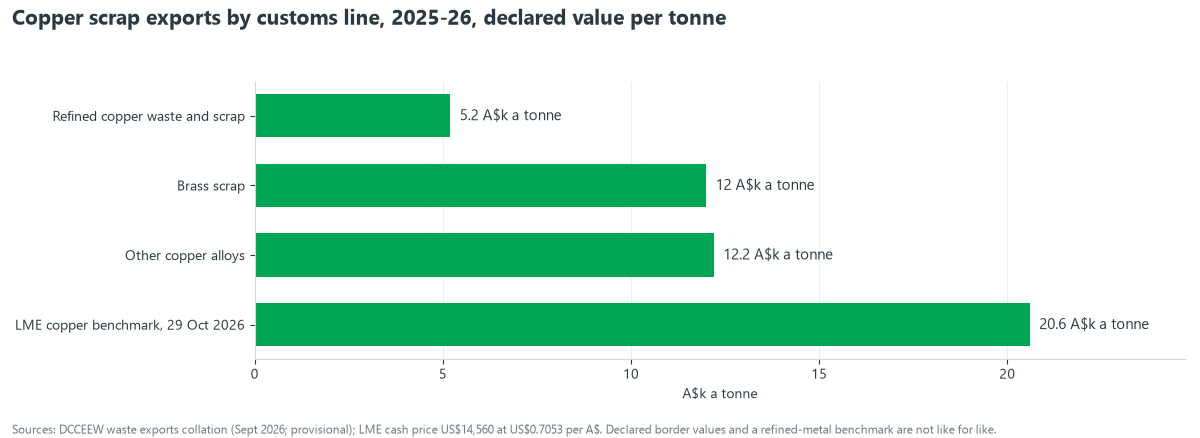
The records split copper scrap into customs lines. In 2025-26, refined copper waste and scrap had a declared value of A$5,236 a tonne, brass A$12,049 and other copper alloys A$12,243. Those are border declarations for mixed shipments, not prices, and the lines do not say which one holds insulated wire, so do not use them to value a load. But they show how much the value of copper scrap depends on what it is.
We could not find a source that says how much copper scrap is melted in Australia and how much overseas, so we do not give a split.
Step 6: A refiner melts it and a cable maker draws it into wire
At a smelter or refinery, the copper is melted and refined. The ICA says there is no difference in quality between recycled and mined copper, so they can be used interchangeably, and some copper products are made entirely from recycled copper. The refined metal is typically cast into a thick rod, and the rod is drawn through a series of dies, which stretch it into thinner and thinner wire. A cable maker then coats the wire with plastic insulation and bundles it into cable.
How much of a new cable is recycled copper? It varies. One undated article quoted Nexans, described as a Montreal-based cable maker, as using about 14 percent recycled metal in its copper rod, with a goal of 20 percent, so the answer for any one cable is rarely 100 percent. The wire in your wall, in the end, was probably made from a mix of mined and recycled copper.
Why does the industry bother? The ICA says recycling copper needs 85 percent less energy than primary production. It also notes that recycling complex copper scrap, such as electronic waste, recovers other metals including gold, silver, nickel, tin, lead and zinc.
How much copper is really recycled?
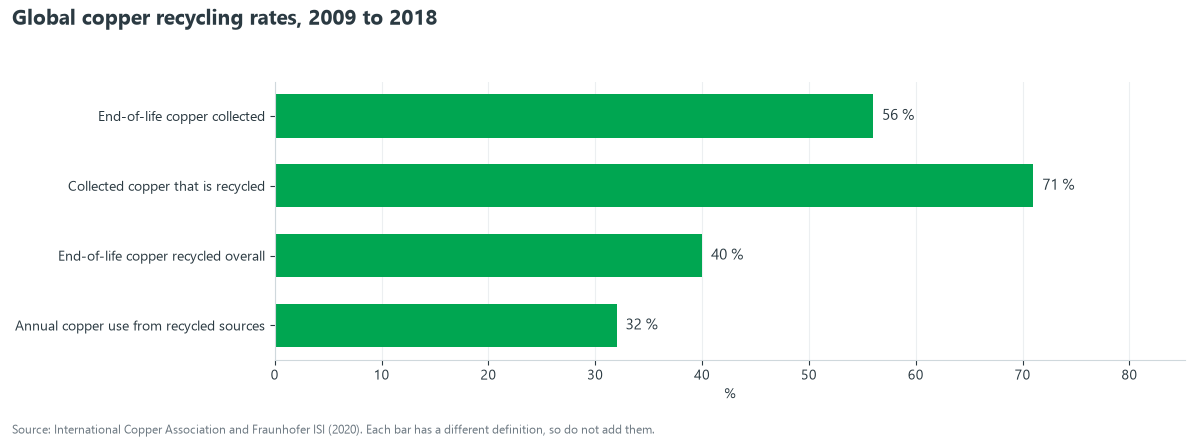
Globally, the ICA and the Fraunhofer Institute estimate that between 2009 and 2018, 32 percent of annual copper use came from recycled sources, about 8.7 million tonnes a year out of 26.7 million. For the copper in products at the end of their lives, 56 percent was collected, 71 percent of what was collected was recycled, and 40 percent of all end-of-life copper was recycled in the end.
Read those carefully. The biggest gap is collection: 44 percent of end-of-life copper was never collected, which is 44 of the 60 points lost, and the other 16 were lost in processing. So one of the most useful things anyone can do with old copper is to make sure it reaches a yard. We did not find a national figure for Australia.
What this means for you
- If you are a householder or tradesperson: keep copper wire out of the bin and sell it to a yard. Separate bare copper from insulated wire, and from copper-coated lookalikes, before you go.
- If you collect wire: weigh your own load, ask each yard how it grades and what share of the benchmark it pays, and compare at least two. If you run a lot of cable, find out whether a chopper or granulator would pay for itself.
- If you run a yard or business with a lot of copper: keep your grades clean and consistent, since buyers pay for purity and for repeatable quality. You can list your copper on the ScrapTrade marketplace or create a free account.
For another loop that depends on grading and collection, read Where a Car Battery Goes After You Hand It In.
To follow one converter from the exhaust to a refiner and back into a new car, read Where an Old Catalytic Converter Goes.
What we could not verify
- Where your own wire goes. Yards sell to different buyers, so no single route is true for every load.
- How much Australian copper scrap is melted at home. We found no current figure.
- An Australian recycling rate for copper. The rates shown are global, for 2009 to 2018.
- Which customs line holds insulated wire. The export figures are context, not a price list.
- The Nexans figure. It comes from an undated article, and we do not know whether it applies to Australia.
- What yards pay today. The grade names and shares differ by yard, and we publish no yard prices.
Frequently asked questions
Is it worth stripping copper wire before selling it?
Sometimes. Bare copper is worth more per kilogram than insulated wire, but stripping takes time and the plastic weighs something, so the answer depends on the gauge, the quantity and the tools you have. See our stripping guide.
How is copper separated from the plastic?
Machines chop the wire into small pieces, then use air, gravity and electrostatic separation to split the heavy copper from the light plastic.
Is recycled copper as good as new copper?
Yes. The International Copper Association says there is no difference in quality between recycled and mined copper.
Why is copper wire often exported?
Overseas refineries and cable makers have strong demand for scrap. Government records show Australia exported 113,411 tonnes of copper scrap in 2025-26, mostly to China, Thailand and India.
Sources
- International Copper Association, Copper Recycling brief (ICA/Fraunhofer ISI, 2020; ICA/IWCC, 2021) and Circular Economy page.
- NEXGEN Enterprises, Prospector wire processor, as reported by Recycling Product News.
- Recycling Today, articles on electrostatic separators for cable scrap.
- International Copper Association Australia, "Today's waste is tomorrow's energy" (undated).
- London Metal Exchange official cash settlement price, 29 October 2026, as published by Westmetall; Reserve Bank of Australia exchange rate, 29 October 2026.
- Department of Climate Change, Energy, the Environment and Water, Waste exports data collation, September 2026 (ABS records), ScrapTrade calculations, customs lines 74040018, 74040022 and 74040030. The 2025-26 figures are provisional.
This is general information, not financial, safety or legal advice. Process steps are simplified, and plants differ. Declared export values are border declarations, not prices. ScrapTrade operates a scrap marketplace and has a commercial interest in the scrap trade.