

Updated 26 October 2026. The United States is the world's second-largest exporter of ferrous scrap, behind the European Union. For most of the past two decades it shipped steady volumes to Turkey, Mexico, Canada and Asia, and its yards set the tone for global prices. In 2025 that changed. According to BigMint, US ferrous scrap exports fell to 12.1 million tonnes, down 16% from 14.5 million tonnes in 2024 and the lowest level in more than two decades [1]. The cause was not a sudden collapse in demand abroad. It was American steel policy.
This article explains what happened and what it means for sellers in other countries, including Australia. The data are from BigMint, Argus, SteelOrbis, SMM and BIR as cited, and the policy facts come from the Federal Register and law-firm summaries. It is general information and not trade advice.
What the numbers show
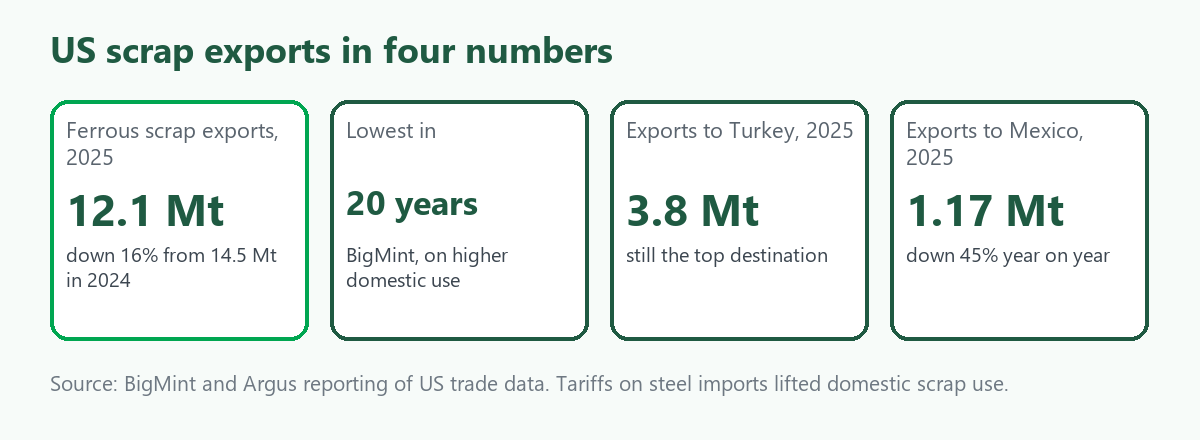
BigMint's account is short. US ferrous scrap exports totalled 12.1 million tonnes in 2025. Turkey remained the biggest destination at 3.8 million tonnes. Exports to Mexico dropped 45% to 1.17 million tonnes [1]. For comparison, the Bureau of International Recycling had the US at 14.417 million tonnes in 2024, with Turkey buying about 4.43 million tonnes and Mexico 2.14 million, down 33.7% [2].
The decline is continuing to show up in 2026 in unexpected ways. Turkey's own customs data, as reported by SteelOrbis, show that US shipments were nonetheless up 10.6% in January to July 2026 to 2.21 million tonnes, making the United States Turkey's top supplier, though SteelOrbis also reported a sharp drop in US-origin material in June [3]. Monthly US export values remain large: SteelOrbis reports US iron and steel scrap exports of 1.16 million tonnes worth US$628 million in May 2026 [4]. So the US remains a major exporter. It is just a less dominant one.
Why it happened: steel tariffs
BigMint attributes the fall mainly to higher steel import tariffs, which strengthened domestic steel production and raised scrap consumption inside the United States. Argus noted that US scrap dealers continued to prefer selling to US mills, which pay higher prices for scrap than buyers abroad [1]. The logic is simple. When the US makes it costlier to import steel, American mills make more steel, they need more scrap, and they bid for the scrap that used to be exported.
Beyond steel: aluminium and copper
- Aluminium. The US generated 7.6 million tonnes of aluminium scrap in 2024. Of that, 76% (5.6 million tonnes) was consumed in the United States and 24% (2 million tonnes) was exported. The Aluminum Association has proposed an export ban on used beverage can scrap, according to SMM [5]. The idea would be to keep more domestic scrap for US remelters.
- Copper. The 50% US tariff on semi-finished copper and copper-intensive products that began on 1 August 2025 did not cover copper scrap or refined copper. The same July 2025 order set a requirement, from 2027, that 25% of high-quality copper scrap produced in the United States be sold in the US, rising to 40% by 2029 [6]. See Copper Prices: Analysis, Risks and Outlook for how this fits with the tariff story.
Taken together, these measures point in one direction: the US government is working to keep scrap at home.
The supply chain risk
One more detail shows how interlinked the trade is. S&P Global has reported that US recyclers depend heavily on imported shredder wear parts, and that the main source of those parts is China, so tariffs on Chinese goods can raise costs for the very machines that process scrap. A tariff exemption for some components had been extended to May 2025, and we could not confirm its status after that [7].
What it means for other sellers
When the biggest competitor is looking inward, the effects spread.
- More room for others. If US scrap is less available abroad, buyers in Turkey, Mexico and Asia look elsewhere. Japan's ferrous exports rose 22.8% in the first ten months of 2025, and Australian volumes reached a record in 2025-26 [8][9].
- Prices can move. A shift in US exports changes the balance of supply at the margin and can affect prices that Australian cargoes receive.
- Rules can change again. US policy on scrap exports is a moving target. A ban on used beverage can exports, or further limits on copper scrap sales, would change the picture for non-ferrous scrap too.
See World Scrap Trade: Top Importers and Exporters for the larger map, Scrap Export Bans: Three Case Studies for what restrictions have done elsewhere, and Australia's Scrap Metal Exports: 2025-26 Data for our own numbers.
Sellers should check the live price calculator as an indicative reference, compare offers on the marketplace and keep their material well sorted.
What to watch
| Signpost | Why it matters |
|---|---|
| US ferrous exports by month and destination | Shows whether the 2025 low is a floor |
| Any US move on beverage-can or other aluminium scrap exports | Would tighten supply abroad |
| The copper scrap sales requirement from 2027 | Would redirect high-quality copper scrap |
| Turkish and Mexican import data | Shows whether buyers are replacing US supply |
| US steel tariff changes | The main driver of the export fall |
Frequently asked questions
How much scrap does the US export?
About 12.1 million tonnes of ferrous scrap in 2025, down 16% from 14.5 million tonnes in 2024 and the lowest in over two decades [1].
Why have US scrap exports fallen?
Higher steel import tariffs strengthened US steelmaking and increased domestic scrap use [1].
Where does US scrap go?
Turkey is the top destination (3.8 million tonnes in 2025), then Mexico (1.17 million tonnes, down 45%) [1].
Does the US tariff apply to scrap?
The 50% copper tariff applies to semi-finished copper products and derivatives, not to scrap or refined copper [6].
Does this affect Australian sellers?
Indirectly, by changing supply and prices in the markets where Australian scrap competes [8][9].
Sources
- BigMint, US scrap exports fall to lowest level in two decades in 2025 on rising domestic consumption; Mysteel, US scrap exports fall to lowest level in two decades in 2025.
- BIR, World Steel Recycling in Figures: January-December 2024 update; Recycling Today, Recycled steel trade patterns shift in 2024.
- SteelOrbis, Turkey's scrap imports recover in January-July 2026; Turkey's scrap imports rise in June 2026 despite sharp drop in US-origin material.
- SteelOrbis, US iron and steel scrap exports up 16 percent in May 2026 from April.
- SMM, America's aluminium scrap: the Aluminum Association's proposal to ban exports of UBC scrap.
- Federal Register, Adjusting Imports of Copper Into the United States; Mayer Brown, Unearthing US vulnerabilities.
- S&P Global, US recyclers concerned about retaliatory tariffs on exports: ReMA (January 2025).
- Yieh Corp, Japan's ferrous scrap exports grow in January-October.
- Department of Climate Change, Energy, the Environment and Water, Waste exports data collation, September 2026 (ABS records), ScrapTrade calculations.
Figures are as reported by the sources named. This article is general information, not financial or trading advice. ScrapTrade operates a scrap marketplace and has a commercial interest in the scrap trade.