

Brass and bronze are the metals people most often mix up, and the mix-up costs money. Both are mainly copper, both are yellow-to-brown and heavy, and a tap, a valve or a bearing could be either. This guide follows old brass taps and bronze fittings from the job site to a yard, a furnace and back into new products. It explains how a yard tells the two apart, why brass scrap has become so much more valuable in the government's export records, where it goes, and how a new rule on lead in plumbing fittings raises a question about what happens next. It is written for plumbers, collectors and yard operators. The export figures are our analysis of government records, and ScrapTrade has a commercial interest in the scrap trade.
Step 1: The metal comes out
Brass is mainly copper and zinc. Bronze is copper with tin or other elements. They turn up in the same places: taps, valves and plumbing fittings, door hardware, and in older machinery as bushings and bearings. A plumber replacing a bathroom or a builder stripping a building ends up with a bucket of fittings, and a factory clean-out can produce a bin of turnings or offcuts.
Brass in particular is a plumbing metal. According to the Copper Development Association, as cited by the United States Geological Survey, copper and copper alloy products in the United States are used in building construction (42 percent), electrical and electronic products (23 percent), transport equipment (18 percent), consumer and general products (10 percent) and industrial machinery (7 percent). Those are American shares, but they show how much of this metal sits inside buildings, waiting to be taken out.
Step 2: A plumber or collector gathers it
Tradespeople keep brass and bronze apart from other scrap because it is worth more than steel or aluminium. A plumber may keep a tub of taps and valves, a collector buys a box from a renovator, and a demolition crew pulls fittings from a stripped building. Taps with plastic, rubber or steel still attached are worth less than clean fittings, so the first task is removing what is not metal. We cover what buyers look for in Scrap Brass Prices in Australia: Rods, Fittings and Mixed Brass and what yards pay in Brass Scrap Price per Kg in Australia.
Step 3: The yard sorts it
At the yard, the work is separating brass from bronze from everything else. Colour is the first hint: yellow suggests brass and a reddish-brown suggests bronze or red brass, but oxidation can mislead. A magnet only finds steel and iron attached to the fitting and does not tell brass from bronze. Our guide Bronze vs Brass Scrap sets out the checks.
The trade has its own code words. A reprint of a 1998 scrap specifications circular, which we found through a secondary source, lists "honey" as yellow brass, "ebony" as composition or red brass, "grape" as cocks and faucets, and "eland" and "elias" as bronze solids with low and high lead. Check the current circular before you trade on any of these terms, because the definitions have been revised since. Rough compositions quoted by trade pages are about 60 to 70 percent copper in yellow brass and 85 to 90 percent in red brass, and copper content is the reason red brass is usually priced higher. Those figures come from commercial pages, not from a specification.
Step 4: It is sold on, often overseas
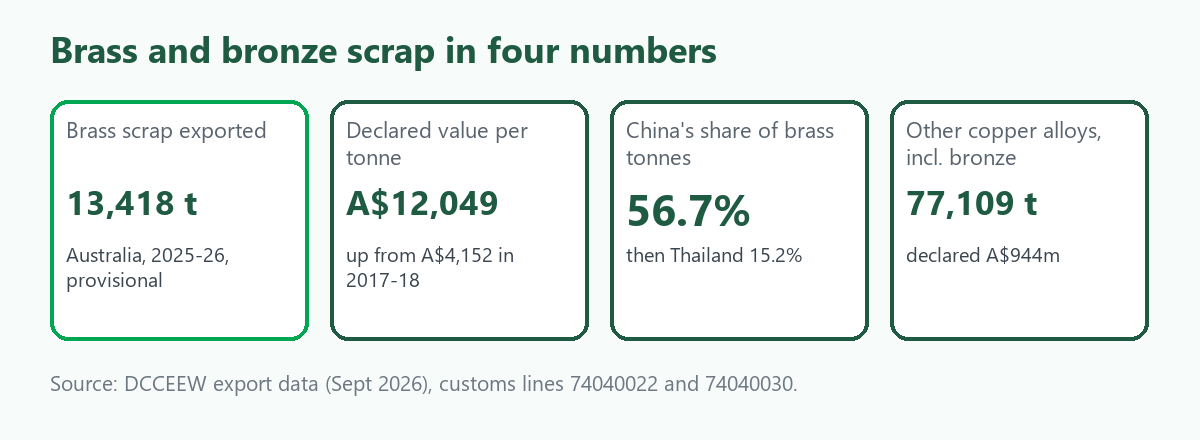
A yard sells to a trader, a smelter or an exporter. Government export records have a customs line for brass scrap, and another for copper alloy scrap that is not brass, which includes bronze. In 2025-26 (provisional), Australia exported 13,418 tonnes of brass scrap with a declared value of A$161.7 million, or about A$12,049 a tonne. The other line, copper alloys other than brass, was 77,109 tonnes at A$944.1 million, or about A$12,243 a tonne. Bronze is in that second line, but so are other alloys, so we cannot say how much of it is bronze.
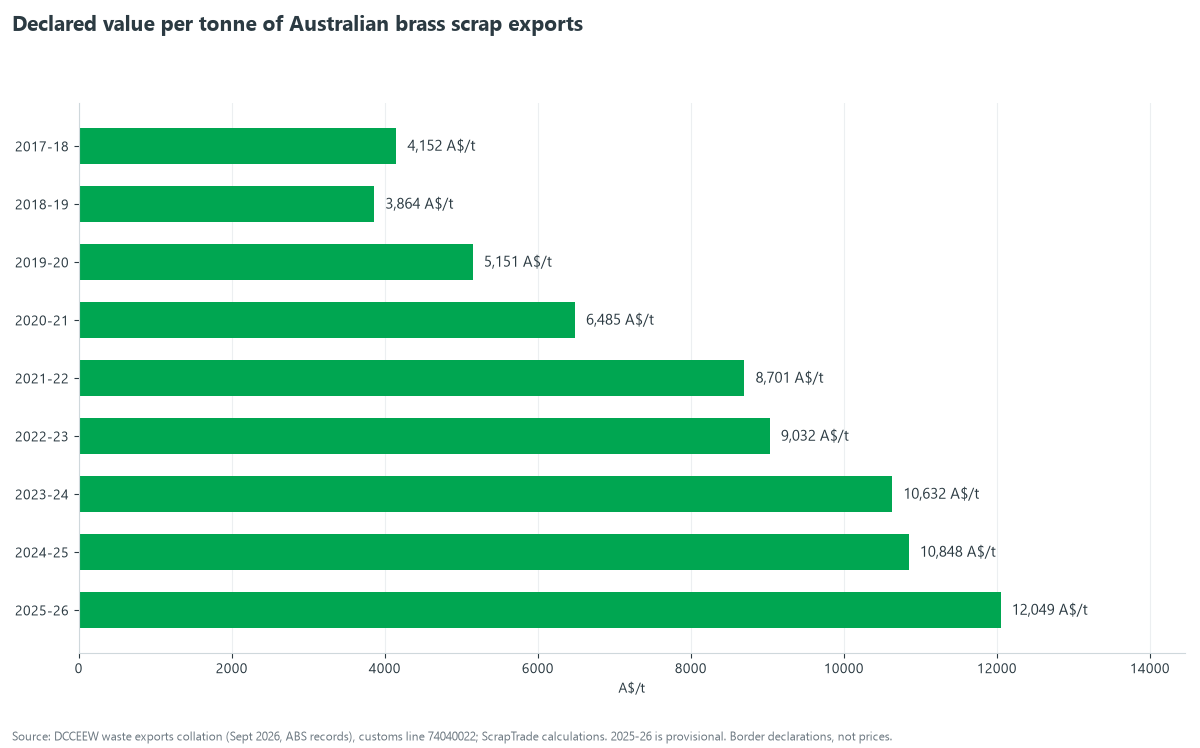
The story in the brass line is the value. In 2017-18 it was 22,293 tonnes at about A$4,152 a tonne. In 2025-26 it was 13,418 tonnes, down about 40 percent, at about A$12,049 a tonne, nearly three times as much. The other copper alloy line shows the same shape, going from 36,097 tonnes at A$4,833 a tonne to 77,109 tonnes at A$12,243. These are border declarations, not prices, and we cannot say from the records what caused the change. The simplest explanation is the copper price, since both alloys are mostly copper, but the data does not prove it.
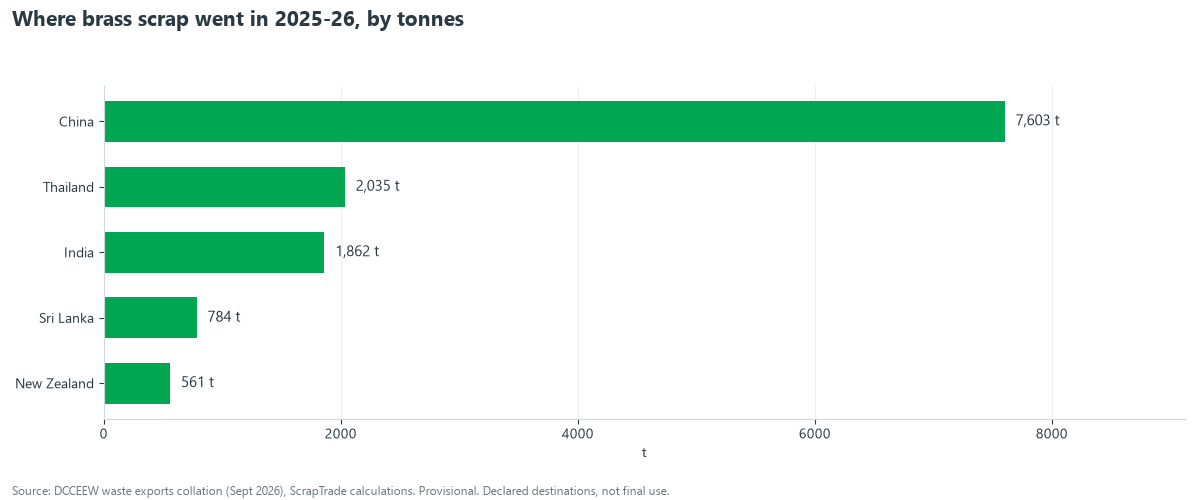
China took 56.7 percent of the brass tonnes in 2025-26, Thailand 15.2 percent, India 13.9 percent, Sri Lanka 5.8 percent and New Zealand 4.2 percent. Victoria, New South Wales and Queensland supplied about 4,000, 3,750 and 3,400 tonnes. For the other alloys, China took 38.7 percent and Thailand 24.2 percent. For the copper side of the story, see Where Old Copper Wire Goes After You Sell It.
Step 5: A furnace melts it into ingot
Brass is melted in a furnace, and the molten metal is cleaned and cast. The most detailed description we found is a 1990 case study of an American ingot maker in Alabama, published by the equipment company Kason. Scrap brass is loaded into rotary furnaces and melted. Borax is added, and impurities rise as slag, which is skimmed off. The brass is cast into ingots, which are sold to makers of plumbing fixtures and other hardware. The slag still traps small beads of brass, so the plant crushed and screened it to recover them. It is an old, American example, so treat it as the method and not as a picture of an Australian plant.
Zinc is the awkward part. An older mineral yearbook says zinc losses occur mainly in the casting shop's ashes, in the slag from melting scrap brass, and in material spilled on the floor, which is one reason mixed scrap needs sorting before it is melted. Another source, a 1994 Copper Development Association document, says brass for extrusion and hot stamping is normally made from a melt of scrap of similar composition. So sorted scrap is the raw material, which is why yards sort.
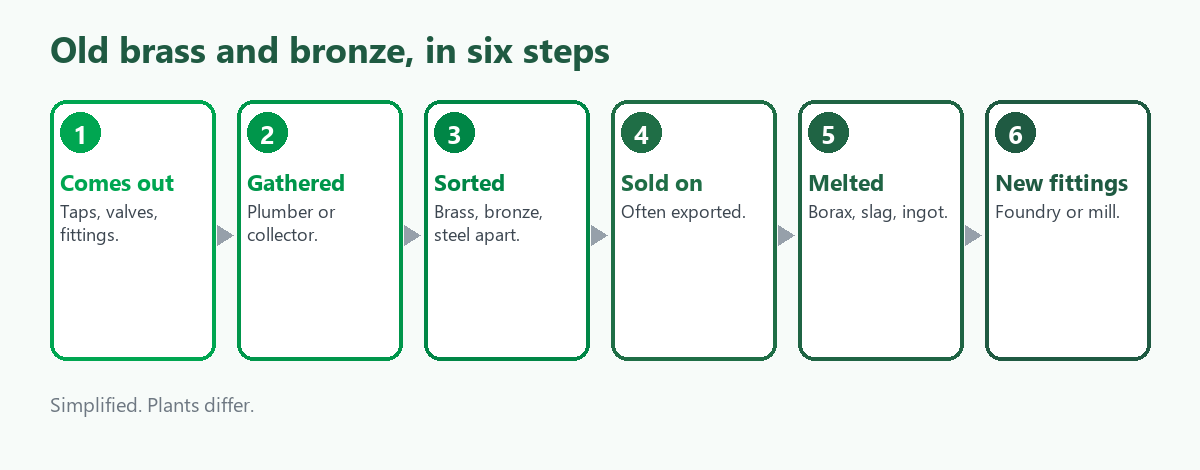
Step 6: It comes back as fittings and rod
The ingot is sold to foundries and mills. A foundry casts taps, valves and fittings. A brass mill extrudes rod, which is machined into parts. In the United States, the Geological Survey estimates that brass and wire-rod mills accounted for about 80 percent of the copper recovered from scrap in 2025, and that scrap supplied about 30 percent of the American copper supply. Those are US figures. We found no equivalent for Australia, and no source naming an Australian brass ingot maker or foundry, so we do not say where Australian brass scrap is melted.
A new rule changes what is in new brass
Australia has just tightened what new plumbing brass can contain. The Australian Building Codes Board says copper alloy plumbing products with more than 0.25 percent lead are no longer authorised for drinking water. From 1 May 2026, manufacturers may only produce products with the Lead Free WaterMark. Installation of existing WaterMark products may continue until 30 April 2028, and from 1 May 2028 only lead-free products are authorised. The Board says the rules are not retrospective, so existing spare parts remain suitable for existing products, and that states and territories may vary the dates.
A valve supplier says that older alloys commonly used for valves exceed the new limit and that low-lead alternatives are now used instead. That raises a question we cannot answer: whether and how brass scrap from older taps, which may contain more lead, is blended or sorted into new lead-free products. We found no source on it. If you buy or sell plumbing brass, ask your buyer how they handle it.
How much really comes back?
We found no Australian recycling rate for brass or bronze. The United States figures above show scrap is a major input to brass making, but they are American and relate to copper as a whole. The metal's high value is the likely reason scrap gets collected, and a trade source says the high residual value of brass scrap creates a strong recycling incentive, though that is an industry view and not a measured rate.
What this means for you
- If you are a plumber or renovator: keep brass and bronze separate from steel and aluminium, take off plastic, rubber and steel parts, and sell it by weight to a buyer who explains the grade. Compare at least two buyers.
- If you collect scrap: learn the colour and weight differences, do not assume a yellow fitting is brass, and record mixed material as mixed.
- If you run a yard or buy plumbing brass in bulk: keep your grades clean and your records consistent, and ask suppliers about lead-bearing stock. You can list brass on the ScrapTrade marketplace or create a free account.
For the stainless steel journey, from the job site to the mill, see Where Old Stainless Steel Goes After Selling.
For old laptops, TVs and circuit boards, from the drop-off point to the refiner, see Where Old Electronics Go After You Hand Them In.
What we could not verify
- Where your own brass goes. Yards sell to different buyers.
- How much of the other copper alloy line is bronze. It also holds other alloys.
- What caused the rise in declared value per tonne. The records show the change, not the reason.
- Who melts brass in Australia, and the share melted here. We found no source.
- An Australian recycling rate for brass or bronze.
- How the lead-free rules affect scrap. We found no source.
- The trade code words and compositions. They come from a secondary reprint and commercial pages.
- What yards pay today. The A$12,049 a tonne is a declared export value.
Frequently asked questions
What is the difference between brass and bronze?
Brass is mainly copper and zinc, and bronze is copper with tin or other elements. Colour can hint at the difference, but only markings, specifications or testing are reliable.
Is brass worth more than copper?
It depends on the grade and how clean the load is, and the customs lines in the export records are not comparable like for like, so check a current offer. Brass is generally worth far more than steel. We publish no yard prices.
Can brass be recycled again and again?
Yes. Brass is melted, cleaned and cast, and scrap is the normal raw material for many brass products, though zinc is lost in the process and sorted scrap works best.
Do the new lead-free rules mean old taps are worthless?
We found nothing saying so. The rules apply to new products for drinking water. Existing products can stay installed, and we could not find how scrap from them is treated.
Sources
- Department of Climate Change, Energy, the Environment and Water, Waste exports data collation, September 2026 (ABS records), ScrapTrade calculations, customs lines 74040022 (brass) and 74040030 (other copper alloys). The 2025-26 figures are provisional.
- U.S. Geological Survey, Mineral Commodity Summaries 2026, Copper (recycling and Copper Development Association end-use shares).
- Kason Corporation, "Kason Separator Recovers Brass From Waste Slag", Screen Tips, Fall 1990 (American Brass, Headland, Alabama).
- U.S. Bureau of Mines, Minerals Yearbook (1944), secondary metals chapter, as surfaced in search results (zinc losses); Copper Development Association, Recycling of Copper (1994), as surfaced in search results.
- Reprint of the Institute of Scrap Recycling Industries scrap specifications circular (1998), and trade composition pages, via search results (secondary sources).
- Australian Building Codes Board, "Update: Transition to lead free plumbing products", 19 May 2026.
- ScrapTrade, Bronze vs Brass Scrap.
This is general information, not financial or legal advice. Process steps are simplified, and plants differ. Declared export values are border declarations, not prices. ScrapTrade operates a scrap marketplace and has a commercial interest in the scrap trade.