

This is an opinion article. It reflects the author's view, not a forecast, and ScrapTrade has a commercial interest in the scrap trade. Facts are as at the morning of 3 November 2026.
War, inflation and AI-driven job cuts are stacking up at the same time. I cannot promise a market collapse, and no forecaster I have read does. But a recycler who plans for one loses little if it never comes, and a recycler who does not can lose the business if it does.
What a fall looks like in scrap
Imagine you are holding 500 tonnes of steel scrap that you bought last month, and your buyer's offer is suddenly a third lower. That is not only a thought experiment. In the second half of 2008, as the financial crisis spread and steel mills cut output, SteelOrbis reported that by 10 November US heavy melting scrap (HMS I) was down about US$430 per long ton from its July peak, to US$100 to 110. Mills were shutting plants and export demand had softened. Scrap is a derived trade: when the people who buy steel and metal stop buying, the price of the material at the bottom of the chain falls first and fastest.
Three pressures at once
The first is war and energy. The US-Iran war is in its eighth month, the Strait of Hormuz is effectively blockaded, and Brent crude has swung between roughly US$70 and US$120 since just before it began, according to CBS News. The IMF's October outlook still expects global growth of 3.1 percent this year, but it says energy-importing economies outside the technology supply chain face the hardest outlook, and it lists further escalation in conflicts as a downside risk. We set out how this reaches scrap prices in War, Oil and Inflation: What Moves Scrap Prices.
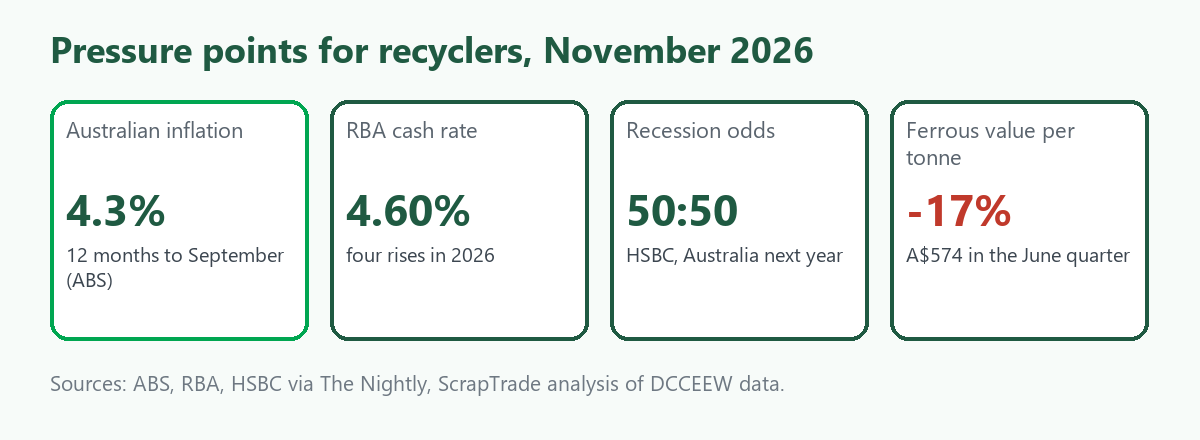
The second is inflation and interest rates. Australian inflation was 4.3 percent in the year to September, according to the Bureau of Statistics, and the Reserve Bank has lifted its cash rate four times this year to 4.60 percent. HSBC's chief economist, Paul Bloxham, puts the chance of an Australian recession next year at 50:50 and expects unemployment to rise from 4.7 percent to 5.1 percent by early 2027. He expects a fifth rate rise at the Reserve Bank's meeting on 3 November, and we will update this article when the decision is out.
The third is AI and jobs. IMF managing director Kristalina Georgieva told the Bangkok annual meetings that AI will augment, downgrade or eliminate about 40 percent of jobs worldwide over time, with new entrants to the workforce most exposed, according to reports of her remarks. Challenger, Gray and Christmas counted 112,713 announced US job cuts attributed to AI from January to July, about a quarter of all announced cuts. The IMF also lists a reassessment of expectations about AI as a downside risk, and on 30 October copper fell as a tech and AI share sell-off and rate worries hit markets, according to Trading Economics. If AI spending or valuations turn, the effect would not stop at technology shares. It would reach investment, building and the consumer spending that ends up as demand for steel, copper and aluminium. That link is my argument, not a finding.
Why scrap feels it first
The buyers of Australian scrap are already cautious. The Bureau of International Recycling's ferrous division reported in May that India's recycled steel imports fell from 430,000 tonnes in January to between 250,000 and 300,000 in March, that Bangladesh's first quarter imports were down about 25 percent, and that Turkey's tight monetary policy was holding back mills. Our own analysis of government export records shows the same strain in a different form. In the June quarter Australia exported 914,456 tonnes of metal scrap, the most in nine quarters, but the declared value of ferrous scrap per tonne fell 17 percent on a year earlier, to A$574. A market selling more tonnes for less money per tonne is a market running to stand still. The full numbers are in the Australia Scrap Export Tracker, and these are declared export values, not yard prices.
Quick check: if the price of the metal in your yard fell by 30 percent tomorrow, what would it cost you? For an invented example, 200 tonnes bought at A$600 a tonne would lose A$36,000. Then ask what your cash, your credit and your payment terms would look like on that day.
What could prove me wrong
The IMF's baseline is growth of 3.1 percent this year and 3.4 percent next, not a collapse. Challenger says AI is reshaping how organisations operate but is not eliminating jobs across the labour market overall, and total announced US job cuts from January to July were down 41 percent on a year earlier. Copper reached a record in September on demand for power grids and data centres, and aluminium supply is tight after the attacks on Gulf smelters. A peace deal would ease energy and freight costs. Several of these forces point the other way, and a recycler who sells copper or aluminium may do well even if steel struggles. A downturn is a risk to plan for, not a prediction I can prove.
Seven things to do before it turns
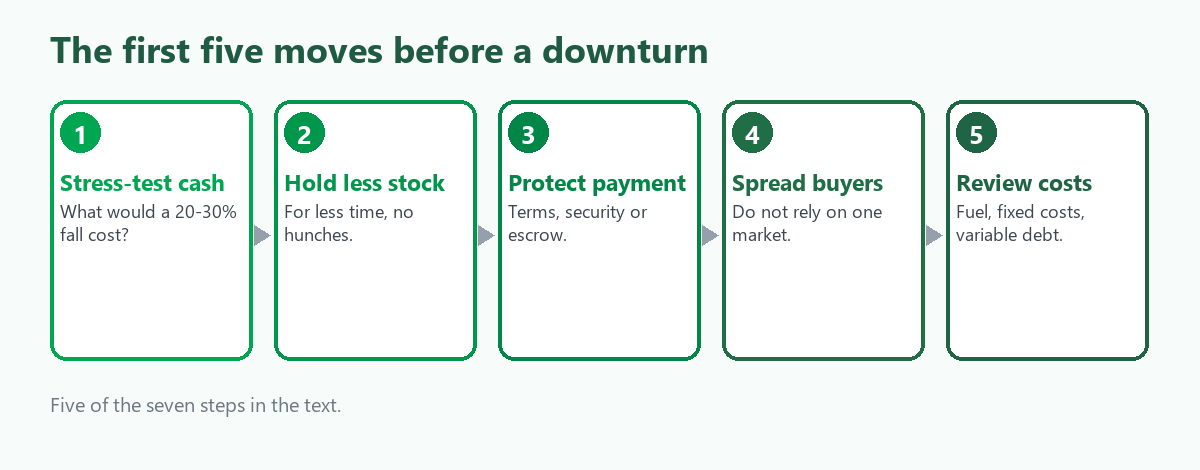
- Stress-test your cash. Work out how many days of stock you hold and what a 20 to 30 percent fall would do to it.
- Shorten how long you hold stock, and stop buying on a hunch about where prices are going.
- Check who owes you. In a downturn the risk is not only a lower price but a buyer who cannot pay, so protect payment with terms, security or an escrow arrangement.
- Spread your buyers and markets. India, Bangladesh and Turkey are cautious, so do not depend on one. See Bangladesh vs Indonesia vs Vietnam: Australian Scrap Buyers.
- Put validity periods and price adjustments into quotes and contracts, and price freight explicitly. Check offers against the benchmark prices in A$ per kg and the live prices.
- Review costs and debt. Fuel is up 23.6 percent on a year and rates are still rising, so fixed costs and variable-rate loans deserve a look now.
- Keep your people and your sorting skills if you can, since skilled staff are slow to rebuild after a fall.
Full disclosure: I lead content strategy at ScrapTrade, a global online marketplace for scrap metal and recyclables. It does not buy, store or move material. It offers listings that can sell at a fixed price, by auction or in answer to a buyer's request, verified traders, live reference prices and a 5% buyer deposit held in escrow. I mention it because it is the model I know best, and because a downturn would hit our volumes too. You can browse the marketplace or create a free account.
Try this: next time you are quoted a price for scrap, ask three questions. How long is this price valid? What happens to it if the ship is delayed or the market moves? When and how will I be paid, and what protects me if the buyer cannot pay? A fair buyer will answer all three without fuss.
Plan for the fall, hope for the best
Nobody can say whether this ends in a collapse, a slow grind or a quick recovery. Scrap has always been a trade of judgement under uncertainty. The recyclers who come through are usually those who asked, before the price turned, what they would do if it did.
What we could not verify
- Whether a downturn is coming. This is an opinion, and the experts cited give a range of views, not a collapse call.
- The Reserve Bank's decision of 3 November, which was not out when we wrote this.
- Georgieva's remarks and the HSBC forecast, which we have from press reports, not from the originals.
- A link between AI job cuts and scrap demand. It is plausible, not measured.
- Yard prices. We publish none, and the export values here are not prices.
Sources
- SteelOrbis, "Have US scrap prices hit bottom yet?", 10 November 2008.
- CBS News, live updates on the US-Iran war, 2 November 2026.
- International Monetary Fund, World Economic Outlook, October 2026.
- Australian Bureau of Statistics, Consumer Price Index, released 28 October 2026. Reserve Bank of Australia, cash rate target.
- The Nightly and The New Daily, HSBC's Paul Bloxham on Australian recession risk, 30 and 31 October 2026.
- Fortune and other reports of Kristalina Georgieva's remarks at the IMF-World Bank annual meetings, 13 October 2026.
- Challenger, Gray and Christmas, July 2026 job cuts report, published 6 August 2026.
- Trading Economics, copper, 30 October to 3 November 2026.
- SteelOrbis summary of the Bureau of International Recycling Ferrous Division report, 20 May 2026.
- Department of Climate Change, Energy, the Environment and Water, Waste exports data collation, September 2026 (ABS records), ScrapTrade calculations. The 2025-26 figures are provisional.
Alif Vasaya is Head of Content Strategies at ScrapTrade. This is general information, not financial advice. ScrapTrade operates a scrap marketplace and has a commercial interest in the scrap trade.