

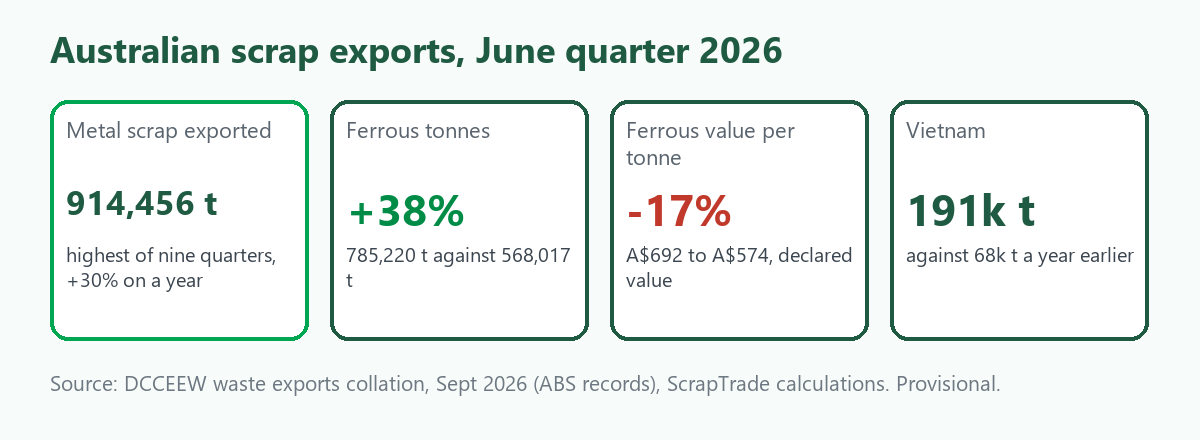
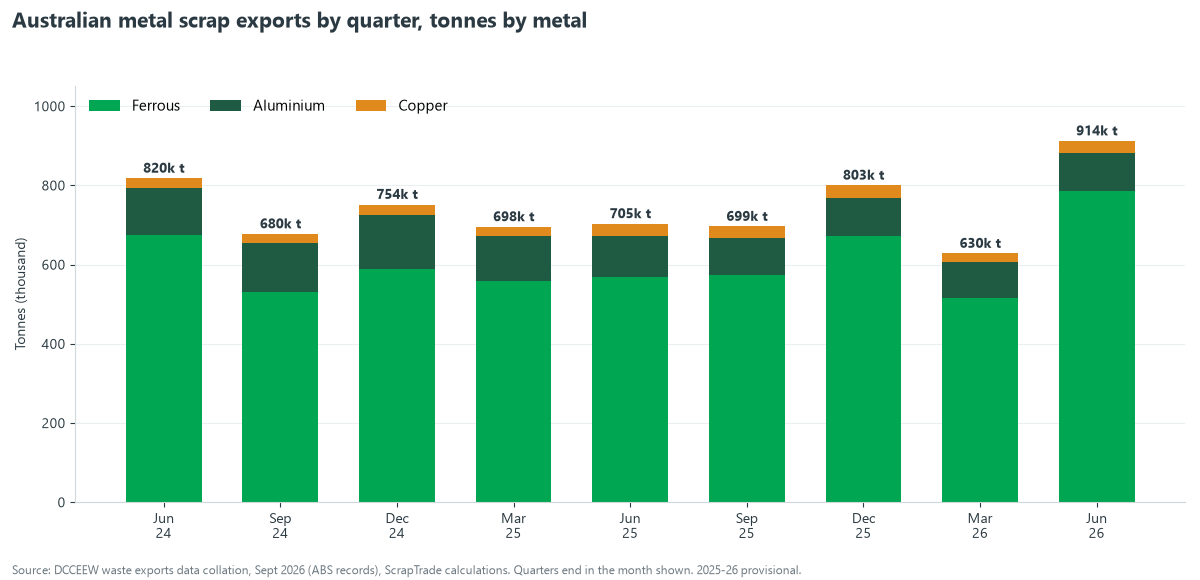
Australia exported 914,456 tonnes of metal scrap in the June quarter 2026 (April to June), the highest of the last nine quarters and 30% more than a year earlier. The declared value rose only 5%, because almost all of the extra tonnage was ferrous scrap, and ferrous scrap is worth about a seventh as much per tonne as aluminium and a sixteenth as much as copper. This is the first edition of our quarterly tracker. It covers what the government's export records show for the quarter: tonnes and declared value by metal, where the scrap went, which states and ports shipped it, and what to be careful of when you read it. It is built from the same data, with the same exclusion, as Reading Australia's Scrap Export Data Properly. We have a commercial interest in the scrap trade.
The quarter in numbers
| June quarter 2026 | Tonnes | vs March quarter | vs June quarter 2025 | Declared value per tonne | vs a year earlier |
|---|---|---|---|---|---|
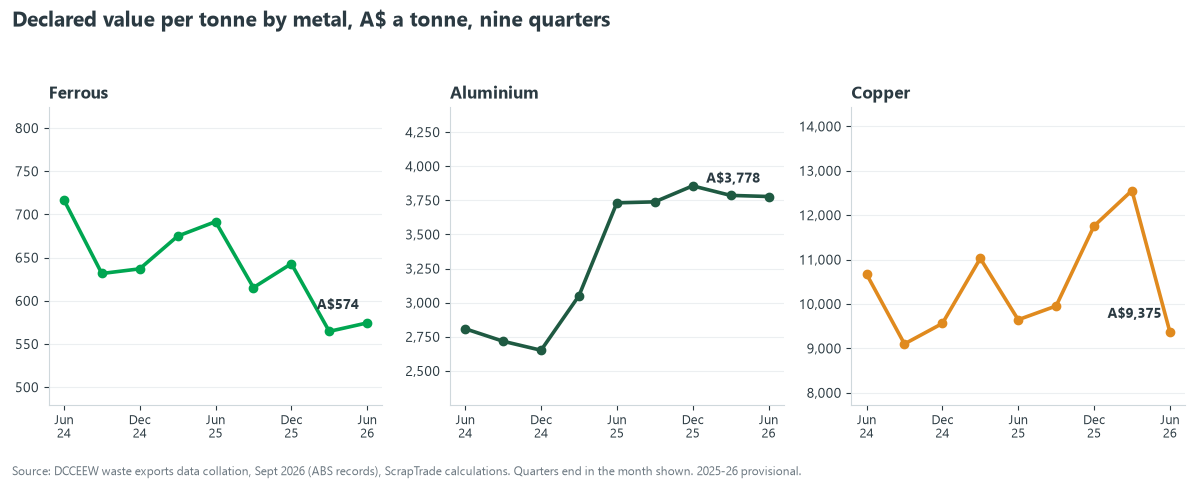
| Ferrous | 785,220 | +52% | +38% | A$574 | -17% |
| Aluminium | 97,429 | +8% | -6% | A$3,778 | +1% |
| Copper and alloys | 30,189 | +38% | -4% | A$9,375 | -3% |
| All metals | 914,456 | +45% | +30% | A$1,215 | -21% |
Declared value for all metals was A$1,190.4 million, up 21% on the March quarter and 5% on a year earlier. The all-metals value per tonne excludes precious metals, which were 601 tonnes worth A$80.2 million in the quarter and would distort an average. The fall in the all-metals figure from A$1,543 to A$1,215 is a change in mix, not a fall in what any metal is worth: ferrous scrap was 86% of the quarter's tonnes, against 81% a year earlier, and the average of a cheap metal pulls the whole figure down. The only metal whose value per tonne fell clearly is ferrous. We cover why mixes mislead in the data guide.
What moved
Ferrous tonnes surged. The 785,220 tonnes of ferrous scrap are the most of any quarter in the nine we compare. It followed the weakest quarter in the series: the March quarter 2026 was 630,437 tonnes in total, with only 119,316 tonnes in January. Exports then climbed each month: 284,792 tonnes in April, 304,861 in May and 324,803 in June. No single record explains it. The largest was 31,029 tonnes, 3.4% of the quarter, from Queensland to Bangladesh at about A$441 a tonne.
Aluminium has held its new level. Declared value per tonne has stayed between A$3,732 and A$3,856 in each of the last five quarters, after rising from A$3,051 in the March quarter 2025. Tonnes were 97,429, within about 90,000 to 104,000 in each of the last five quarters. Aluminium cans, which drove the step up, were 24,989 tonnes, close to the 23,890 to 28,112 range of the previous three quarters and 38% below a year earlier. We cover the change in Australia's Aluminium Can Exports Halved.
Copper value per tonne is volatile. It rose to A$12,555 in the March quarter and fell back to A$9,375, close to a year earlier. The mix of copper alloys, brass and refined waste changes from quarter to quarter and moves the average, so a swing of this size is not on its own a price signal.
Where it went
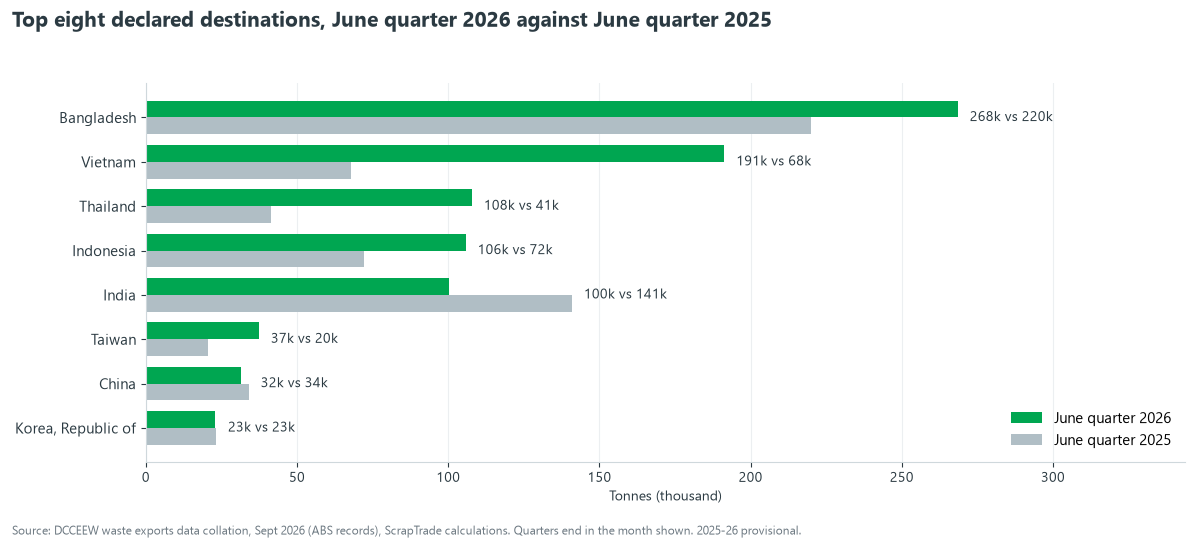
| Destination (tonnes) | June quarter 2026 | June quarter 2025 | Change |
|---|---|---|---|
| Bangladesh | 268,472 | 219,872 | +22% |
| Vietnam | 191,243 | 67,750 | +182% |
| Thailand | 107,772 | 41,446 | +160% |
| Indonesia | 105,707 | 71,967 | +47% |
| India | 100,340 | 140,862 | -29% |
| Taiwan | 37,365 | 20,445 | +83% |
| China | 31,607 | 34,001 | -7% |
Vietnam and Thailand together took about 190,000 tonnes more than a year earlier, and almost all of Vietnam's 191,243 tonnes was ferrous (189,809 tonnes against 66,899 a year earlier). India fell 40,521 tonnes. Saudi Arabia took 40,483 tonnes in the June quarter 2025 and 60,846 in the September quarter 2025, then 6,000 in the December quarter and nothing since. These are declared destinations at export, not where the metal is finally used. For how the markets compare, see Bangladesh vs Indonesia vs Vietnam: Australian Scrap Buyers.
Which states and ports
| State of origin (tonnes) | June quarter 2026 | June quarter 2025 | Change |
|---|---|---|---|
| Western Australia | 264,746 | 151,637 | +75% |
| Queensland | 253,266 | 258,405 | -2% |
| Victoria | 177,687 | 149,346 | +19% |
| New South Wales | 123,458 | 103,828 | +19% |
| South Australia | 68,488 | 36,379 | +88% |
| Northern Territory | 19,067 | 3,452 | +452% |
Western Australia overtook Queensland for the quarter and accounts for 113,109 of the 209,000 extra tonnes. The ports show the same shift: Fremantle loaded 176,144 tonnes (+69%), Port Hedland 52,933 (+106%), Port Adelaide 69,620 (+83%) and Mackay 39,691 (+127%), while Brisbane, the largest, was flat at 214,076 (-2%) and Townsville fell 29%. The full-year picture is in Scrap Metal in Western Australia: Rules, Data, Scrap Metal in Queensland: Rules and Data and Australian Scrap Export Ports: Who Ships What.
How to read this tracker
- A quarter is lumpy. Scrap leaves in shipments of tens of thousands of tonnes, so a shipment that slips from one quarter to the next moves the totals. Look at the nine-quarter chart, not one bar.
- Declared value is not a price. It is the border value of a mixed shipment. For a price you can check, use Scrap Metal Benchmark Prices in A$ per kg, the live prices or the Australia scrap calculator.
- The latest year is provisional. The government can revise 2025-26.
- We exclude one record. The March 2025 entry of 92,400 tonnes of aluminium, almost certainly a recording error, is left out of every figure here, as in our other posts. It falls outside this quarter but affects the year-earlier comparisons for aluminium.
- Quarters are Australian financial quarters. The June quarter is April to June.
What this means for sellers and buyers
- Sellers of ferrous scrap: high export volumes alongside a lower declared value per tonne are not, on their own, a signal that yard prices fell. Ask buyers for a price on your grade and compare it with the benchmark.
- Buyers abroad: supply leaving Australia has been strongest to Bangladesh, Vietnam, Thailand and Indonesia. If you buy from Australia, read Buying Scrap From Australia: A Buyer's Guide.
- Anyone listing material: browse the marketplace to see what buyers are asking for, or create a free account.
For how the Iran war, oil and inflation reach metal prices, see: War, Oil and Inflation: What Moves Scrap Prices.
For an opinion on planning for a downturn, see: Why Recyclers Should Plan for a Downturn Now.
What we could not verify
- Why ferrous tonnes rose so sharply. The data shows where the extra tonnes went, not why.
- Why Saudi Arabia stopped. Three quarters of large flows were followed by none.
- Whether the June quarter 2026 will be revised. It is provisional.
- Yard prices. We publish none, and these values are not prices.
When this will be updated
We will publish the next edition when the government releases data covering the September quarter 2026. We do not know the release date.
Frequently asked questions
How much scrap metal did Australia export in the June quarter 2026?
914,456 tonnes with a declared value of A$1,190.4 million, of which 785,220 tonnes was ferrous (provisional figures).
Where does Australian scrap go?
In the June quarter 2026, mainly Bangladesh (268,472 tonnes), Vietnam (191,243), Thailand (107,772), Indonesia (105,707) and India (100,340).
Why did the value per tonne fall?
For all metals, because ferrous scrap was a larger share of the tonnes. Ferrous scrap itself fell 17% to A$574 a tonne in declared value, a border figure and not a yard price.
Which state exports the most scrap?
Over 2025-26, Queensland (28.2% of tonnes), then Western Australia (26.1%). In the June quarter 2026 Western Australia was ahead, with 264,746 tonnes against 253,266.
Sources
- Department of Climate Change, Energy, the Environment and Water, Waste exports data collation, September 2026 (ABS records), ScrapTrade calculations. Metals category, quarters to June 2026. The 2025-26 figures are provisional.
This is general information, not financial advice. Declared export values are border declarations for mixed shipments, not prices. ScrapTrade operates a scrap marketplace and has a commercial interest in the scrap trade.