

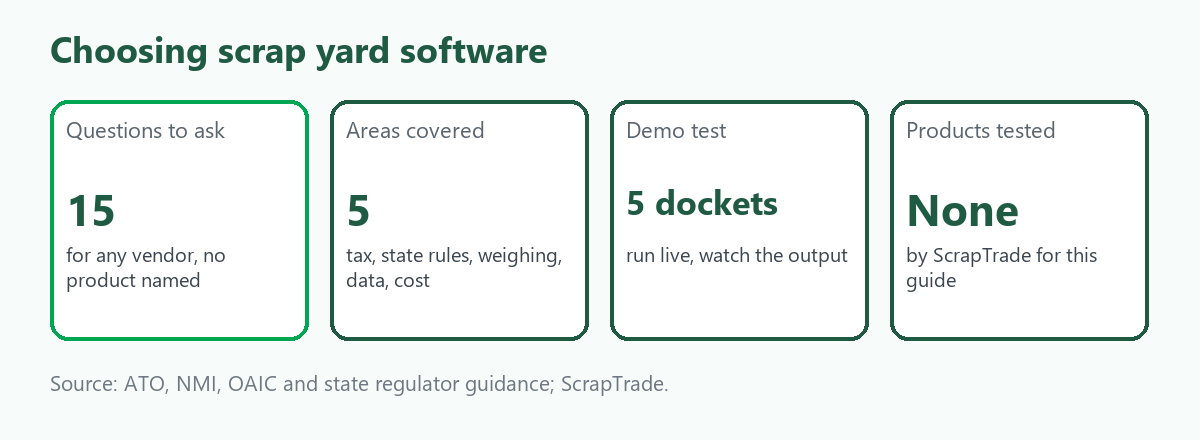
Choosing scrap yard software is a decision you will live with for years, and a demo is built to show you the best day. This guide gives you fifteen questions to put to any vendor, grouped into five areas, and a five-docket test to run while you watch. Each question is tied to something you can check: a rule from the ATO, a state regulator or the National Measurement Institute, or a plain commercial risk. We have not tested any software and we name no product. We also sell yard tools, so we have a commercial interest, and we answer our own questions in the last section. Most of the tax questions are explained in more depth in our posts on billing, automation and supplier records. This post adds the state rules, the weighing and data questions, and the demo test.
Tax and records
These come from the ATO's scrap metal code of compliance, its tax invoice guidance and its page on statements by suppliers.
- Does it treat sellers differently by type? A yard buys from suppliers with an ABN and GST registration, with an ABN but no GST registration, with no ABN, and from householders. Each needs a different document and different records. A good answer shows you four paths at the weighbridge, not one form.
- Does it check ABNs and GST registration, and warn when they lapse? The ATO says a buyer must check a supplier is registered for GST before the first recipient created tax invoice (RCTI) and keep checking, and that best practice is automated validation using ABN Lookup. Ask whether it does this at the time the invoice is issued and what happens when a check fails.
- Does it keep a running total for each supplier across the year? The scrap code refers to patterns of transactions over a threshold, and to splitting transactions to stay under a limit. A per-docket check cannot see either. Ask to see the report that would flag a supplier selling just under the limit every fortnight.
- Does it handle the 47% withholding? For a supplier with no ABN and no valid statement, the code says 47% is withheld. Ask whether the amount is calculated, kept apart from sales, and reported in the form the ATO requires.
- How long does it keep records, and can you get them out? The ATO sets five years for a statement by a supplier, and our state rules post notes three years in New South Wales. Ask whether you can export records for the full period, in a format you can open without the vendor.
State rules
State rules change faster than national ones, and they differ. See Scrap Business Rules in Australia by State for the summary.
- Does it record how each seller was paid? Cash for scrap is banned in New South Wales and Victoria, and South Australia's Act plans a ban. Queensland's reforms do not include one, and we found no cash rule in Western Australia's Act or Regulations. A yard that trades across states needs the payment method on every docket.
- Can it capture the identification your state asks for? Queensland's reforms, as described in a Department of Justice document, add photographic identification and date of birth and address for scrap sales, with every transaction recorded. In Western Australia, a dealer in copper, brass or bronze must verify identity to 100 points and give a signed receipt. Ask which fields and photos it stores, and how it handles a rule that has passed but not started. See our guides for Queensland and Western Australia.
- Can it lock stock or log a police report where a rule requires? Western Australia requires copper and brass to be held unaltered for 14 days, and dealers there must report suspected stolen goods. Ask whether you can set a hold by material and state, so the system stops that stock being processed or sold, and whether a suspicion report can be logged with the details.
Weighing and stock
- How does it work with your weighbridge? The National Measurement Institute says a weighbridge used for trade, including scrap metal, must be of an approved type and verified by a servicing licensee, and that the owner is responsible for it weighing correctly. Ask whether the software reads the indicator directly or relies on typing. If it relies on typing, ask whether it keeps gross, tare and net, who can edit a weight and whether each edit is logged.
- Can you set up your own grades and mixed loads? Your price list is not a vendor's template. Ask how you add a grade, split a mixed load into lines, and set different prices by grade and customer.
Data and security
- What happens to your data if you leave? Ask whether you can export everything, including dockets, invoices, supplier records and ID images, what format it comes in, and whether the vendor charges for it. Ask what happens to the data when the contract ends.
- Where do ID images and supplier details sit, and who can see them? A supplier record with a name, address and licence number is personal information. The Office of the Australian Information Commissioner says most small businesses with turnover of A$3 million or less are not covered by the Privacy Act, but some are. We cannot say whether you are. Either way, ask where the data is stored, whether staff roles limit access, and what the vendor does in a breach.
- What if the internet drops at the weighbridge? A yard cannot stop trading because a connection fails. Ask whether it keeps working offline, how it syncs, and whether it can produce a docket and a receipt without a connection. Ask about backups, and how long a restore takes.
Cost and support
- What is the total cost over three years? Ask for setup, per-user or per-yard fees, hardware, integration with your accounting package, support, and what the vendor can change the price to. If you are looking for affordable software, compare three-year totals, not the monthly headline, and ask for a trial on your own data.
- Who else like you uses it, and who answers the phone? Ask to speak to a yard of your size in your state. Ask when support is available in your time zone, and get any feature that matters to you written into the agreement, since a roadmap promise is not a contract.
A five-docket test for the demo
Ask the vendor to enter these invented dockets, live, and watch what the system produces.
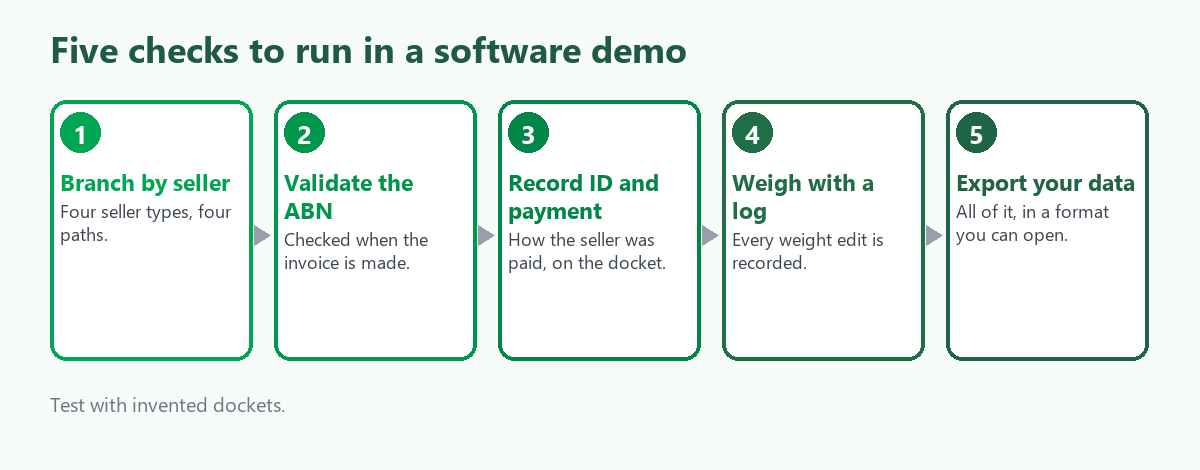
- A supplier with an ABN and GST registration. Does it check the ABN, produce an RCTI and flag the 28-day deadline?
- A supplier with an ABN but no GST registration. Does it refuse an RCTI and record the details the code lists?
- A supplier with no ABN and no statement. Does it calculate the 47% and keep it separate?
- A householder with identification. Does it capture a signed statement, the ID and the payment method?
- A collector who has sold just under the limit eleven times this year. Does anything flag the running total?
Then change one weight on a finished docket and ask to see the log. If the answer to any of these is "we can build that", treat it as a no for now.
Where ScrapTrade fits
Our yard management page lists inventory, customers, suppliers, dockets, invoices that can be marked paid, staff access and multiple yards. It does not describe RCTIs, 47% withholding, ABN validation or weighbridge links, so ask us the same fifteen questions before you rely on it. Browse the marketplace or create a free account. For a general overview, see Best Scrap Yard Management Software.
What we could not confirm
- What any product does. We have tested none and name none.
- How state rules will be applied in software. Queensland's reforms have passed with no published start date, and we could not read the final Act.
- Whether your yard is covered by the Privacy Act. Check the OAIC checklist or ask an adviser.
- Tax treatment of a particular load or supplier. That is a question for a registered tax agent or the ATO.
Frequently asked questions
What should I ask a scrap yard software vendor?
Start with how it handles the four seller types, ABN and GST checks, ID and payment records, weighbridge links, data export and total cost. The fifteen questions above cover them.
Do I need software, or is a spreadsheet enough?
For a small yard a spreadsheet can work. The case for software is checks a spreadsheet will not do on its own, such as ABN validation at the time an invoice is created and a running total for each supplier.
Does scrap yard software handle the 47% withholding?
Some may. Ask the vendor to show it on a docket, as in the demo test above.
Does it have to be state specific?
The ATO rules are national, but cash, ID, record and hold rules differ by state, so ask how the software handles your state's rules and changes to them.
Sources
- Australian Taxation Office, Tax invoices (last updated 18 September 2026).
- Australian Taxation Office, GST and scrap metal: code of compliance (last updated 3 July 2023).
- Australian Taxation Office, Statement by a supplier not quoting an ABN (last updated 30 June 2017).
- National Measurement Institute, Weighbridges used for trade (Department of Industry, Science and Resources).
- Office of the Australian Information Commissioner, Small business.
- Queensland Government, Department of Justice, Response to submissions on the Justice and Other Legislation Amendment Bill 2026, and Western Australia, Pawnbrokers and Second-hand Dealers Act 1994 and Regulations 1996, as summarised in our state guides.
The dockets are invented. This article is general information, not tax, legal or privacy advice, and we have not tested any software. Confirm with a registered tax agent, the ATO or your state regulator. ScrapTrade operates a scrap marketplace and has a commercial interest in yard software.