

Scrap metal rules in Western Australia are different from the other states, and they are easy to misread. The state has no scrap metal law of its own. Scrap is regulated, where it is regulated at all, through the Pawnbrokers and Second-hand Dealers Act 1994 and its Regulations, and the Regulations say that most scrap metal is not covered. This guide sets out what the law says, from the official text, which metals fall in and out of scope, what dealers and sellers must do for the metals that are covered, and what government export data shows about scrap from the state. It does not replace advice from WA Police, and it is not legal advice. We have a commercial interest in the scrap trade.
What the law covers
The Act regulates "second-hand dealers": people conducting the business of buying, selling or exchanging second-hand goods, meaning goods that have been worn or otherwise used, other than classes the Regulations exclude. WA Police license them. The Regulations, as at 11 June 2025, list the goods that are not treated as second-hand goods. For scrap, the relevant entries are:
- "Ferrous and non-ferrous scrap metals (but not gold, silver, copper or copper alloy, including bronze and brass)." So scrap steel, iron, aluminium, lead, zinc and similar metals are outside the Act. Gold, silver, copper, brass and bronze are inside it.
- "Cans of any kind."
- Motor vehicles and their parts, with some accessories excepted.
- Large white goods, such as fridges and washing machines.
- Goods collected under a local government recycling scheme.
- Goods other than jewellery bought to manufacture another article from them. We have not seen how this is applied to copper bought for manufacturing, so check if it matters to you.
Put plainly, a business that buys only steel and aluminium does not appear to be a second-hand dealer under this Act, while one that buys copper, brass or bronze scrap does. Other laws may apply to either, including waste, environmental and local government rules that we have not covered here. The Regulations were amended in 2020 (SL 2020/147), and a third-party industry update says that change brought copper into scope. We could not check that against an official source, and rely only on the current text.
What dealers must do for the covered metals
If you deal in the metals that are covered, the Act (as at 31 March 2025) requires:
- A licence. Acting as a second-hand dealer without one is an offence, with a maximum penalty of A$5,000 and 12 months' imprisonment for an individual and A$20,000 for a company. Only natural persons can hold a licence, though a person can hold it for a partnership or company they are a partner or officer of. A licence applies to listed premises and cannot be transferred.
- Identification of every seller. The dealer must ascertain the seller's full name and current residential address and verify identity by a prescribed means. The Regulations set this at 100 points of ID, where, for example, a current Australian driver's licence or an Australian passport with photo is worth 75 points. Penalty: up to A$5,000 and 12 months' imprisonment for an individual.
- A record of each contract. Sequential contract number, name and address, the ID used and its number, date and time, a description of the goods including brand and serial number where they apply, what was paid, who accepted the goods, and where they are kept. Penalty up to A$5,000.
- A signed receipt. A receipt and a copy, signed by both parties, with the receipt given to the seller. Penalty up to A$2,000.
- A 14 day hold. Second-hand goods must be kept for at least 14 days after they are obtained, without altering their form except by marking or labelling, and at licensed premises. That means copper cannot be stripped, melted or baled into a different form during the period. Penalty up to A$5,000 and 12 months' imprisonment for an individual.
- Reporting. A dealer who suspects goods may have been stolen must inform police without delay and describe the goods and the seller. Penalty up to A$2,000.
Licence fees. The Regulations as at 11 June 2025 set the fee for a second-hand dealer's licence by expected transactions in a year: A$1,394 for a year at up to 49 transactions, A$2,789 for 50 to 149, and A$5,577 for 150 or more, with higher amounts for two and three year terms. These fees may have been indexed since. WA Police list their licensing contact on their licence page, last updated on 12 May 2026.
What we did not find: a cash rule
We searched the text of the Act and the Regulations for "cash" and "cheque" and found neither word. As far as those two documents go, they do not ban paying cash for scrap, and they contain no rule on how a dealer must pay. One industry site we saw says there is an absolute cash ban in WA citing a 2011 amendment, and another says there is none. We cannot reconcile those, and we did not check other WA laws, so we cannot say that no cash rule exists anywhere. Payment by bank transfer leaves a record in any case. For how this works elsewhere, see our guide to paying cash for scrap.
What to do in Western Australia
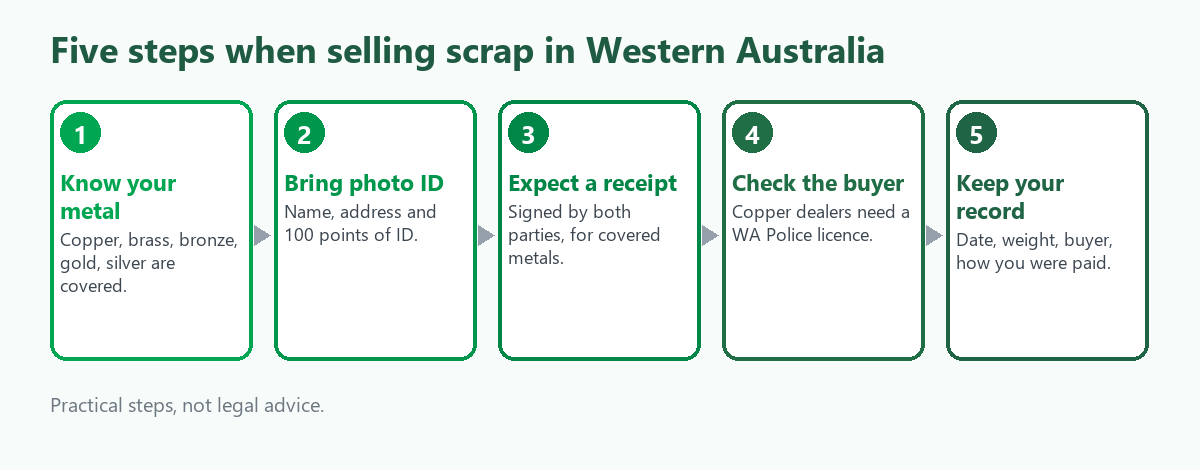
- Work out which metal you have. Copper, brass, bronze, gold and silver are covered; steel and aluminium are not.
- Bring photo ID if you are selling copper or brass, and expect to give your name and address. Ask the buyer what they need before you arrive.
- Expect a signed receipt for covered metals, and keep your copy.
- Check the buyer is licensed if you are selling copper, brass or bronze. If you are unsure, ask WA Police Licensing Enforcement.
- Keep your own record of each sale: date, material, weight, photos, buyer's name and how you were paid.
- If you buy copper or brass, build the record, receipt and 14 day hold into your process. See Scrap Yard Billing: What the Software Must Do.
- If you work as a broker or agent, ask WA Police whether the Act covers your role. See Become a Scrap Broker or Agent in Australia. For how WA compares with other states, see Scrap Business Rules in Australia by State and our Queensland and South Australia guides.
We found no 2026 proposal to change the WA law. Queensland and South Australia have both recently changed or planned changes to theirs.
How much scrap leaves Western Australia
The next sections use the Australian Government's waste exports data, which records declared tonnes and value by state of origin. The 2025-26 figures are provisional, and values are declared at the border for mixed shipments. They are not prices you will be paid. We exclude one record that is almost certainly a recording error, as explained in Reading Australia's Scrap Export Data Properly.
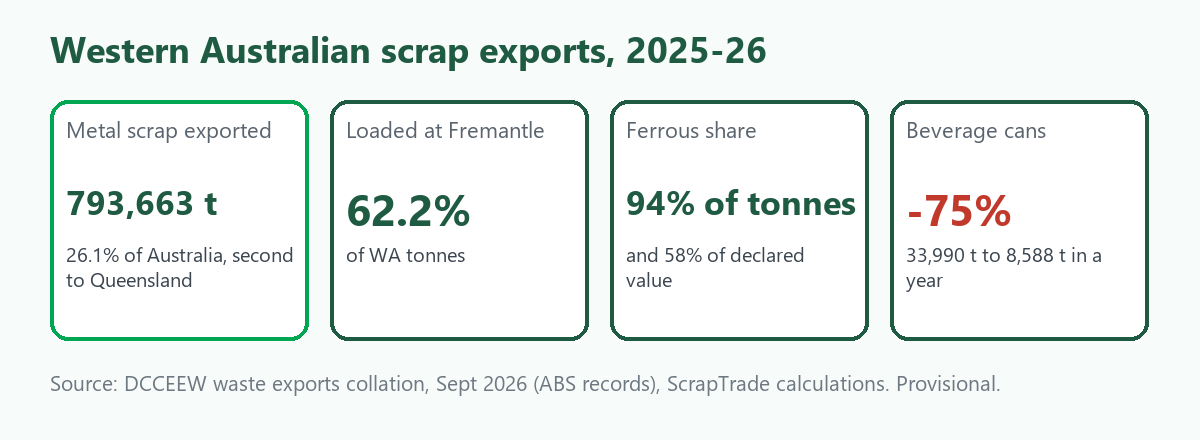
In 2025-26, Western Australia exported 793,663 tonnes of metal scrap with a declared value of A$788.6 million. That is 26.1% of the Australian total, the second largest share after Queensland.
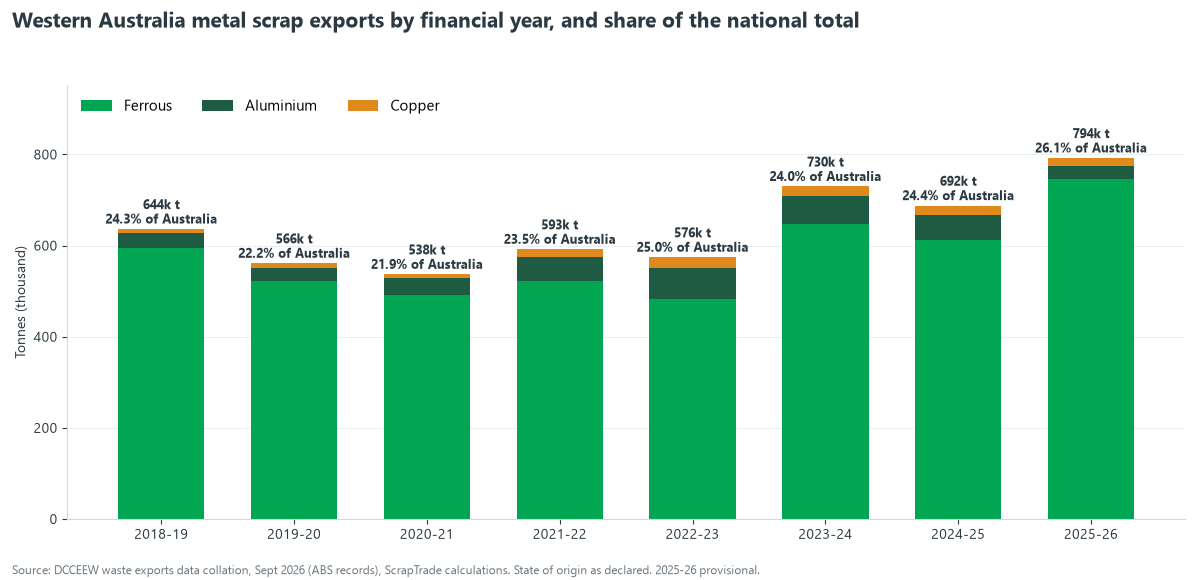
Volumes have grown. They rose from 538,086 tonnes in 2020-21 to 793,663 in 2025-26, up 47%, and the state's share of the national total from 21.9% to 26.1%. Ferrous scrap drove it, up from 482,825 tonnes in 2022-23 to 745,932 in 2025-26. Aluminium went the other way, from 69,010 tonnes in 2022-23 to 29,357, down 57%, helped by a 75% fall in beverage cans, from 33,990 tonnes to 8,588 in a year. We cover the cans in Australia's Aluminium Can Exports Halved.
What is in it
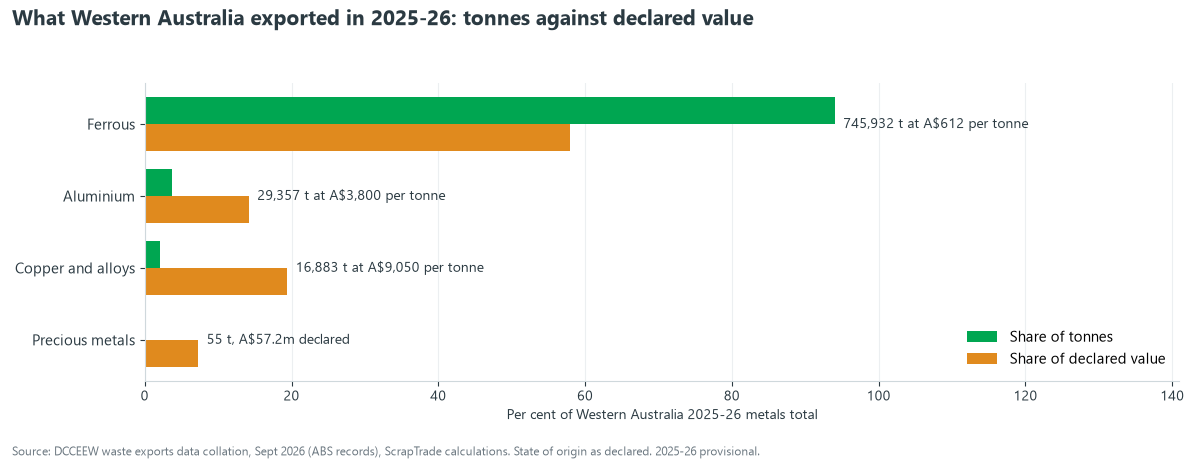
| Metal (2025-26) | Tonnes | Share of tonnes | Declared value | Share of value | Average value per tonne |
|---|---|---|---|---|---|
| Ferrous | 745,932 | 94.0% | A$456.7m | 57.9% | A$612 |
| Aluminium | 29,357 | 3.7% | A$111.6m | 14.1% | A$3,800 |
| Copper and alloys | 16,883 | 2.1% | A$152.8m | 19.4% | A$9,050 |
| Precious metals | 55 | under 0.1% | A$57.2m | 7.3% | not meaningful |
Ferrous scrap is 94% of the tonnes and 58% of the declared value, and WA ships 29% of all the ferrous scrap Australia exports. Copper is small by weight, 2% of tonnes, but 19% of the value, and WA is 15% of national copper exports. Copper from WA went mainly to China (32.5% of its tonnes), Thailand (23.1%), Bangladesh (15.7%) and Indonesia (10.8%).
Export data does not show what dealers buy locally, so we do not read it as the size of the regulated trade. But it does show how the state's scrap divides: the bulk of it, by weight, is ferrous, and the metals the Act covers are a small part of the tonnage. Declared value per tonne for WA copper rose from A$5,845 in 2018-19 to A$9,050, and for aluminium from A$1,771 to A$3,800.
Where WA scrap goes
Material from Western Australia reached 27 countries in 2025-26. The largest destinations by tonnes were Bangladesh (32.5%), Vietnam (29.7%), Indonesia (11.4%), India (9.9%), Thailand (4.5%), Saudi Arabia (4.0%) and Turkey (3.4%). Vietnam takes 29.7% of WA's tonnes, against 15.9% of Australia's ferrous scrap overall. See Bangladesh vs Indonesia vs Vietnam: Australian Scrap Buyers.
Fremantle loaded 62.2% of the state's tonnes, followed by Port Hedland (14.8%), Bunbury (11.4%) and Dampier (8.8%). In all, Fremantle loaded 529,293 tonnes, 93.2% of it from Western Australia, which is 17.4% of all Australian metal scrap exports. For how ports compare, see Australian Scrap Export Ports: Who Ships What. For an older market overview, see Strategic Analysis of the Western Australian Scrap Metal Industry.
Getting a fair price in Western Australia
Export values are context. To judge an offer, use a price you can check.
- Know the benchmark in Australian dollars. See Scrap Metal Benchmark Prices in A$ per kg.
- Use the live prices and calculators. The market prices page, the Australia scrap calculator and the scrap metal calculator give an indicative figure for your material.
- Compare buyers on four points. What price they pay and on what basis, what they deduct, when they pay, and how.
- Sell to more than one buyer. List the lot where several buyers can see it.
Where ScrapTrade fits
ScrapTrade is a marketplace where sellers list scrap and buyers compare offers and negotiate. ScrapTrade holds a 5% buyer deposit in escrow after a bid, and keeps it on hold once the bid is accepted, so the buyer stays committed to the trade. It does not tell you what Western Australian law requires of you. Browse the marketplace or create a free account.
For the latest quarter of export data, see: Australia Scrap Export Tracker: June Qtr 2026.
Before you choose a system, see: Scrap Yard Software: 15 Questions for a Vendor.
What we could not verify
- Other laws that apply to scrap in Western Australia, including waste, environmental, criminal and local government rules. We read only the Act and the Regulations.
- Changes after the versions we read: the Act as at 31 March 2025 and the Regulations as at 11 June 2025.
- Current licence fees, which may have been indexed.
- How WA Police apply the scope list in practice. The WA Police licence page we read does not discuss scrap.
- Whether a cash rule exists outside the Act and Regulations.
- Local yard prices. We publish none, and the export values here are not prices.
- Whether the 2025-26 figures will be revised. They are provisional.
Frequently asked questions
Do scrap metal dealers need a licence in Western Australia?
Dealers in copper, brass, bronze, gold or silver scrap appear to need a second-hand dealer licence from WA Police. The Regulations say that other ferrous and non-ferrous scrap metals are not treated as second-hand goods. Confirm with WA Police for your case.
Do I need ID to sell scrap in Western Australia?
For the covered metals, yes: the dealer must record your name and address and verify your identity to 100 points. For other scrap, the Act does not require it, though many buyers ask anyway.
Is cash banned for scrap in Western Australia?
We found no cash rule in the Act or Regulations. We did not check other WA laws.
Can a dealer cut up copper right after buying it?
For the covered metals, the Act requires second-hand goods to be kept for 14 days without altering their form, apart from marking or labelling.
How much scrap does Western Australia export?
In 2025-26, 793,663 tonnes, 26.1% of the national total, with a declared value of A$788.6 million. Figures are provisional.
Sources
- Western Australia, Pawnbrokers and Second-hand Dealers Act 1994, official version as at 31 March 2025, legislation.wa.gov.au.
- Western Australia, Pawnbrokers and Second-hand Dealers Regulations 1996, official version as at 11 June 2025, legislation.wa.gov.au.
- WA Police Force, Pawnbroker and Second-Hand Dealer Licence, wa.gov.au (last updated 12 May 2026).
- Department of Climate Change, Energy, the Environment and Water, Waste exports data collation, September 2026 (ABS records), ScrapTrade calculations. State of origin and port as declared. The 2025-26 figures are provisional.
This is general information, not legal advice. State laws change, so confirm with WA Police. Declared export values are border declarations for mixed shipments, not prices. ScrapTrade operates a scrap marketplace and has a commercial interest in the scrap trade.