

Updated 27 October 2026. On 21 October 2026 Thailand's Customs Department put forward a proposal to ban imports of steel, copper, aluminium and rubber scrap. It has not become law. No effective date has been announced and the details are still being worked out. But the proposal matters for Australian sellers more than its low profile suggests, because the three metals it names are almost exactly what Australia sells Thailand. This article sets out what has been reported, what the Australian export records show and what we do not yet know. It will be revised as the proposal develops. It is general information, not legal or trading advice.
What has been proposed
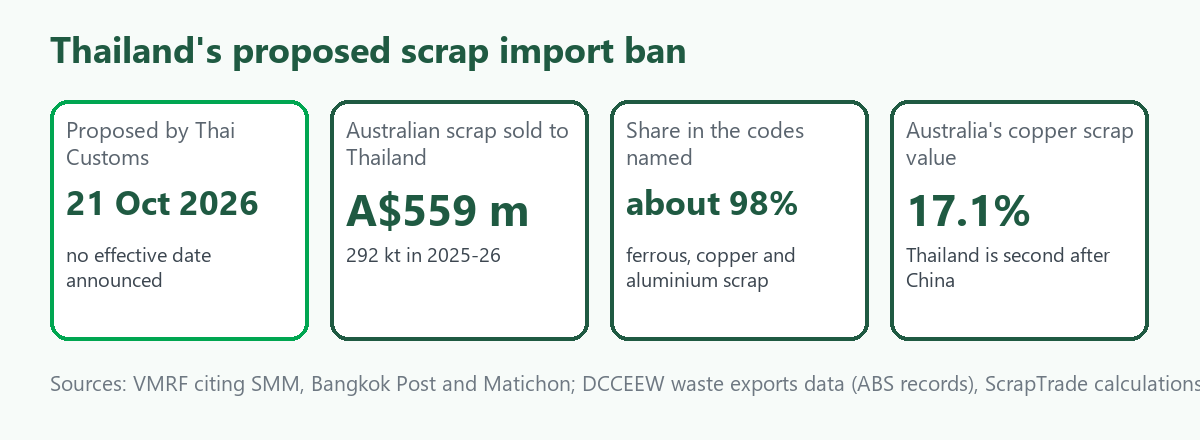
According to a report by the Vietnam Metal Recycling Forum (VMRF), which draws on Shanghai Metals Market (SMM), the Bangkok Post and Thai newspaper Matichon, the Thai Customs Department submitted the proposal to the Department of Foreign Trade under the Ministry of Commerce on 21 October 2026 [1].
- Scope. Ferrous scrap (HS code 7204), copper scrap (7404), aluminium scrap (7602) and rubber scrap (4004) [1].
- Reason. To stop operators using scrap imports to conceal electronic waste and hazardous waste in shipments declared as recyclable. Thai media citing Customs report about 10,029 tonnes of illegally imported e-waste and hazardous waste detected in the year to 30 September 2026, with about 5,290 tonnes returned to the countries of origin [1].
- Status. A proposal only. As of 24 October there was no confirmation that a ban had taken effect, and no effective date. The report says a transition period of six to twelve months has been suggested [1].
- What is already happening. Thai Customs has stepped up physical inspection of containers declared as scrap metal [1].
- What is being discussed in the meantime. A controlled licensing mechanism that would give priority to factories importing raw material directly for their own production, and pre-export inspection to improve traceability. The report links this to 41 domestic smelting and processing facilities that depend on imported raw materials [1].
Thailand's government information portal said on 22 October that controls on hazardous waste would keep tightening but that legal imports of quality-compliant scrap for manufacturing would still be facilitated [1]. That suggests the likely direction is stricter control and licensing, not necessarily the end of all imports, but that is our reading, not an official statement.
How big Thailand's scrap imports are
Matichon, as cited by VMRF, reports that Thailand imported at least 2.76 million tonnes of ferrous, aluminium and copper scrap in January to September 2026, worth about THB 71.2 billion, of which ferrous scrap was about 2.12 million tonnes. The same report puts the average at about 14,600 containers a month [1]. Thailand is also a growing destination for Japanese scrap: SteelOrbis reports that Japan's exports to Thailand were 338,652 tonnes in January to August 2026 against 140,341 tonnes a year earlier [2], and Argus reported that Thai mills, particularly those with Japanese investment, increased their enquiries to Japanese traders in early 2026 [3]. See Japan Scrap Exports: Buyers, Rules, Outlook.
What Australia sells Thailand
Australian export records (DCCEEW's collation of ABS data, our calculations) show that Thailand bought 292,360 tonnes of Australian waste and scrap worth A$559 million in 2025-26, up from 240,717 tonnes and A$516.5 million the year before [4].
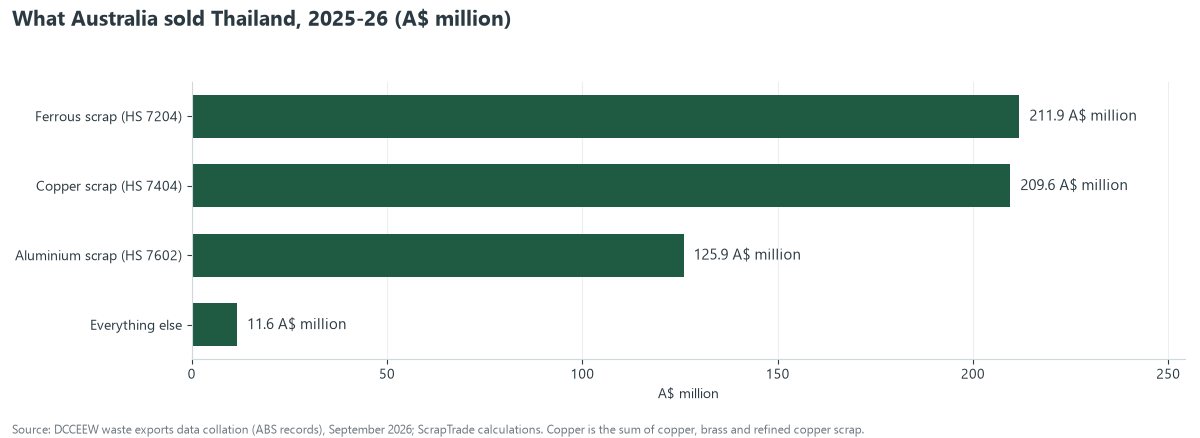
- Ferrous scrap: 198,890 tonnes worth A$211.9 million, up 39% from 143,052 tonnes. Thailand was the third-largest buyer of the main ferrous grade by value (15.8%), behind Bangladesh and Indonesia [4]. Queensland, Victoria and New South Wales were the largest sources, at roughly 55,000, 53,000 and 46,000 tonnes.
- Copper scrap: about 28,900 tonnes worth about A$209.6 million in copper, brass and refined copper scrap combined. Thailand took 17.1% of Australia's copper scrap value, second only to China at 56% [4].
- Aluminium scrap: 34,066 tonnes worth A$125.9 million, 8.8% of Australia's aluminium scrap value [4].
- Everything else: cardboard, tyres and organic waste, about A$11.6 million [4].
Put together, the ferrous, copper and aluminium scrap named in the proposal accounts for about 98% of what Australia sold Thailand by value in 2025-26, a figure we calculated from the export records [4]. Few of Australia's markets are as concentrated in the exact metals a single proposal targets.
What we do not know
- Whether the proposal becomes law. It is a submission from Customs to the Department of Foreign Trade, and the outcome and timing are open.
- What it would cover in practice. A full ban, a licensing system or tighter inspection are all being discussed, and the effects would be very different.
- Whether exemptions would exist for factories that import directly, as the licensing discussion implies.
- How prices would respond. SMM suggested that stricter inspection could lengthen customs clearance and raise logistics costs in the short term, and that tighter supply could support domestic copper and aluminium scrap prices in Thailand. VMRF noted there was not enough evidence that international metal markets had reacted [1]. These are scenarios, not forecasts.
What this means for Australian sellers
- Do not panic and do not ignore it. There is no ban in force, and a transition period is under discussion. But Thailand is a major market for copper and ferrous scrap, so the proposal is worth tracking weekly.
- Expect slower clearance and more inspection now. Physical inspections of scrap containers have already stepped up. Clean, correctly described loads with documentation are less likely to be held. See How a Scrap Export Deal Works, Step by Step.
- Check contract terms. For new Thai sales, make sure the contract says who bears delay, demurrage and return costs if a cargo is held or refused.
- Know your buyer. The licensing idea favours factories that import for their own use. A mill or smelter buyer may be better placed than a trader. Our trust and safety page explains how ScrapTrade verifies counterparties.
- Have alternatives. If Thailand tightens, copper has other buyers such as China, India and South Korea, and ferrous has Bangladesh, Indonesia and Vietnam. See Indonesia: Australia's No. 2 Scrap Buyer, Vietnam Scrap Imports and South Korea's Scrap Market.
- Do not mix in anything that could be waste. The proposal exists because of e-waste concealed in scrap. Batteries, circuit boards and mixed electronic material in a scrap load are the fastest way to a refused container.
For the broader picture, see Australia's Scrap Metal Exports: 2025-26 Data and World Scrap Trade: Top Importers and Exporters. Compare offers on the marketplace.
What to watch
| Signpost | Why it matters |
|---|---|
| An announcement from the Department of Foreign Trade | The step that would turn a proposal into a rule |
| Any stated transition period | Decides how long existing contracts can run |
| Licensing details for factories | Would decide which buyers can keep importing |
| Container inspection delays at Thai ports | The first practical effect |
| Thai copper and aluminium scrap prices | Would show whether supply is tightening |
Frequently asked questions
Has Thailand banned scrap imports?
Not yet. Thai Customs proposed a ban on 21 October 2026 on ferrous, copper, aluminium and rubber scrap, with no effective date announced [1].
Why is Thailand proposing it?
To stop e-waste and hazardous waste being imported in shipments declared as scrap [1].
How much scrap does Australia sell Thailand?
292,360 tonnes worth A$559 million in 2025-26, of which about 98% by value is ferrous, copper and aluminium scrap [4].
Will it affect my current shipments?
No ban is in force, but inspections have increased. Check delivery terms and documents on any new contract.
When will we know more?
When the Department of Foreign Trade announces a decision. We will update this article.
Sources
- Vietnam Metal Recycling Forum, Thailand proposes import ban on steel, copper, aluminium and rubber scrap (24 October 2026), citing SMM (22 October), Bangkok Post (22 October), Matichon (21 October) and the Thai government information portal.
- SteelOrbis, Japan's steel scrap exports down 9.5 percent in January-August 2026.
- Argus, Japan's scrap exports fall in February.
- Department of Climate Change, Energy, the Environment and Water, Waste exports data collation, September 2026 (ABS records), ScrapTrade calculations.
Figures are as reported by the sources named. The proposal is not law and details may change. This article is general information, not legal, customs or trading advice. ScrapTrade operates a scrap marketplace and has a commercial interest in the scrap trade.