

Zinc is a small player in Australian scrap. In 2025-26 the country exported 2,660 tonnes of zinc scrap, against 113,411 tonnes of copper and 377,501 tonnes of aluminium. That makes the zinc market about 2% of copper by weight and under 1% of aluminium. This page gives the zinc benchmark in Australian dollars, shows what customs records say about where zinc scrap goes and from where, and explains what the small size means for a seller. It is not a price list from yards: we found none we could cite for zinc.
The benchmark in A$ a kilogram
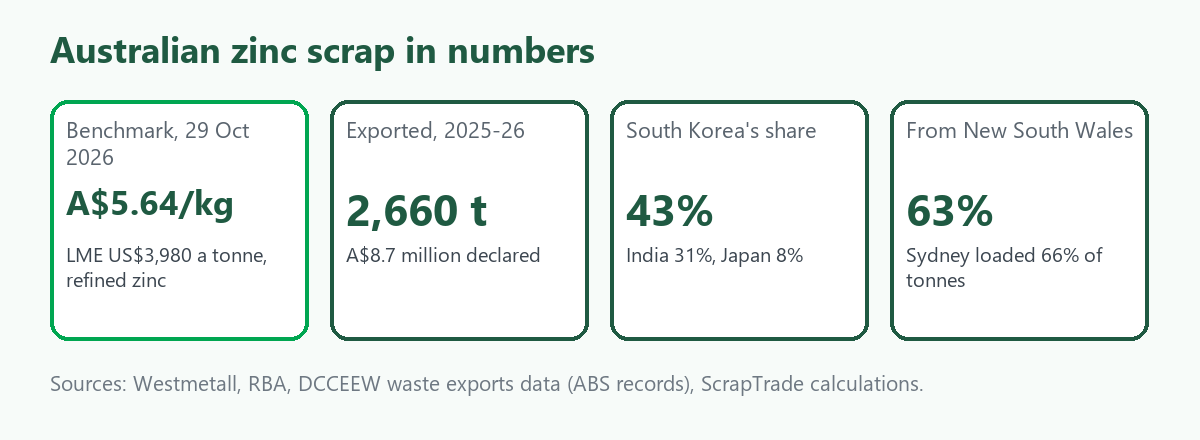
Zinc's world price is set on the London Metal Exchange (LME). The official cash settlement on 29 October 2026 was US$3,980 a tonne [1]. With the Reserve Bank rate of US$0.7053 per A$1 that day [2], the sum is 3,980 / 0.7053 = about A$5,643 a tonne, or A$5.64 a kilogram.
This is refined zinc. Scrap sells below it, though we have no sourced figure for how far. The exchange rate matters here as with every metal: a one US cent rise in the Australian dollar lowers the figure by about 1.4%, or about 8 cents a kilogram. At the benchmark, about 15 kg of zinc reaches the A$82.50 level at which the ATO's scrap code asks a buyer to record your details, as set out in Is Scrap Metal Income Taxable?.
The other metals on the same date are in Scrap Metal Benchmark Prices in A$ per kg.
What the customs data shows
Customs records give the long view. Under AHECC 79020001, zinc waste and scrap excluding primary cells, batteries and accumulators, Australia exported 2,660 tonnes in 2025-26, worth A$8.7 million, or A$3,276 a tonne declared on average [3]. All 2025-26 figures are provisional.
| Year | Tonnes | Declared value a tonne |
|---|---|---|
| 2017-18 | 3,621 | A$2,969 |
| 2021-22 | 5,169 | A$2,883 |
| 2024-25 | 2,324 | A$3,148 |
| 2025-26 | 2,660 | A$3,276 |
Tonnes peaked in 2021-22 and are about half that now, 27% below 2017-18, though 2025-26 was 14% above the year before [3]. The declared value a tonne rose 10% from 2017-18 to 2025-26. These values are yearly averages across shipments and are not comparable with a single day's benchmark, so we do not divide one by the other.
Where it goes
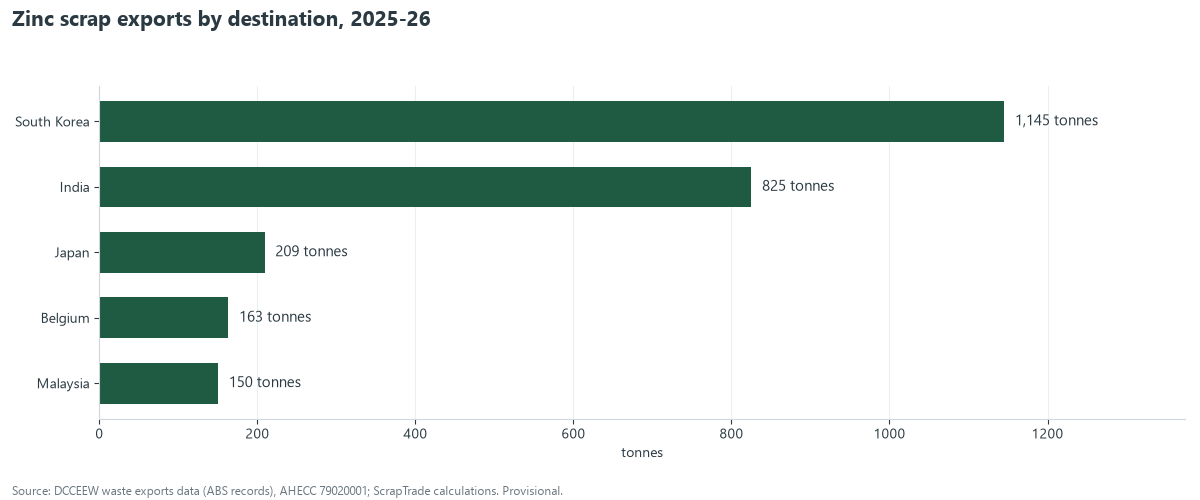
South Korea took 1,145 tonnes in 2025-26, or 43% of the total. India took 825 tonnes (31%), Japan 209 (8%), Belgium 163 (6%) and Malaysia 150 (6%) [3]. New Zealand took 70 tonnes. The order is the same as a year earlier, except that India rose from 24% to 31% of the tonnes and Japan fell from 12% to 8% [3]. The data does not say why.
Where it comes from
New South Wales sent 1,666 tonnes in 2025-26, or 63% of the total, with South Australia next at 363 tonnes and Victoria at 291 [3]. By port, Sydney loaded 1,747 tonnes, or 66%. The concentration means a zinc seller in New South Wales is closer to the export trade than one in other states. We have not tested whether that affects the price a yard offers. For the wider port picture, see Australia's Scrap Export Ports.
What this means for a seller
- Treat a zinc quote as less comparable than a copper quote. With only 2,660 tonnes a year exported, fewer buyers handle zinc, and we found no public yard price to test an offer against. The benchmark is the only reference you can check yourself.
- Ask what share of the benchmark they pay and for which form. We did not find a sourced list of forms and grades, so ask the buyer to describe what they accept.
- Zinc is also an ingredient in brass. If your metal is brass, it is priced as brass, as we explain in Scrap Brass Price Per Kg in Australia.
- Keep records of weight, date and payment. The method for checking an offer against a benchmark is worked through for copper in How Much Is Your Scrap Copper Worth?.
For the general reasons prices move, see Why Scrap Metal Prices Change.
Selling through ScrapTrade
In a thin market the useful thing is reach: a listing that says exactly what you have lets the few buyers who handle zinc find it. ScrapTrade lets you list with photos and pricing preferences and compare buyer offers, as How It Works describes, and its Trust & Safety page says escrow holds payment from deal confirmation until pickup or delivery is confirmed. We cannot say which buyers take zinc. Create a free account to list a load. ScrapTrade has a commercial interest in the scrap trade.
What we could not verify
- Any yard price for zinc scrap we could cite, or how far below the benchmark it sells.
- The forms and grades yards accept, or whether they pay for zinc coatings on other metals.
- Why exports fell from their 2021-22 peak.
- Prices after 29 October 2026.
Frequently asked questions
How much is scrap zinc worth per kg in Australia?
About A$5.64 a kilogram at the benchmark on 29 October 2026, with scrap below that by an unsourced margin [1][2].
Is zinc scrap worth more than lead?
At the benchmark, yes: about A$5.64 a kilogram for zinc against A$2.66 for lead, on 29 October 2026.
Where does Australian zinc scrap go?
Mostly South Korea and India, which took 74% of the tonnes in 2025-26, followed by Japan, Belgium and Malaysia [3].
Why are there so few zinc buyers?
We cannot say. The data shows a small trade, 2,660 tonnes in 2025-26, but not the reason.
Sources
- Westmetall, Official LME prices, 29 October 2026.
- Reserve Bank of Australia, Exchange rates, 29 October 2026 (US$0.7053 per A$1).
- DCCEEW waste exports data (ABS records), AHECC 79020001 (HS 7902), ScrapTrade calculations. 2025-26 figures are provisional.
Figures are indicative and not an offer or advice. ScrapTrade operates a scrap marketplace and has a commercial interest in the scrap trade.