

Updated 28 October 2026. Few scrap stories produce as many confident headlines and as few settled facts as the United States' scrap policy. There are headlines about export bans. There has been no ban. There is a policy on copper scrap and a separate power over critical-mineral scrap, and both are less finished than they sound. This article sets out what is on the public record, what is still undecided and why a seller in Australia should care even though Australia sells almost no metal scrap to the United States. It is general information, not legal or trading advice.
What the proclamation actually says
The foundation is Presidential Proclamation 10962, signed on 30 July 2025 and published in the Federal Register on 5 August 2025 [1]. We read the text. In summary:
- The finding. The Secretary of Commerce concluded, after an investigation under Section 232, that copper imports threaten US national security.
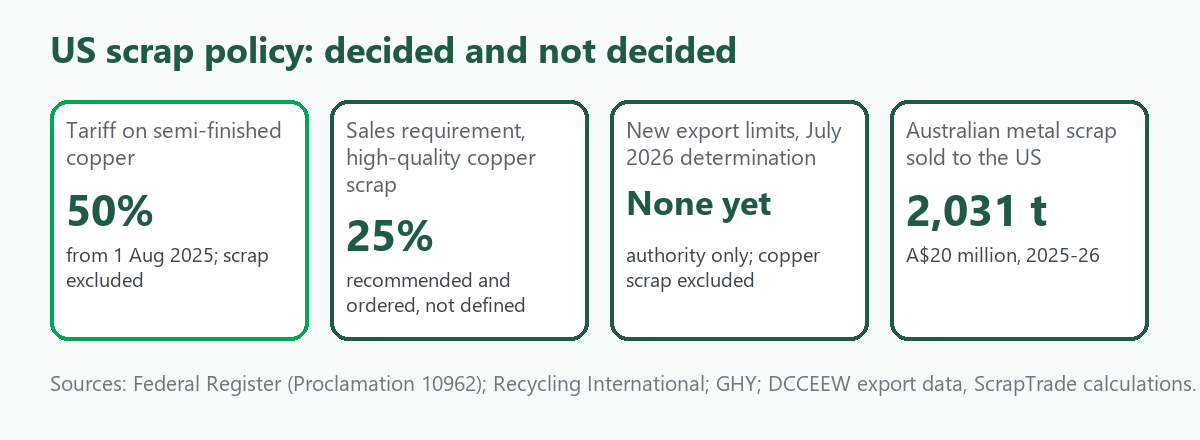
- The tariff. A 50% tariff applies to semi-finished copper products and copper-intensive derivative products from 1 August 2025. Scrap, ores, concentrates, cathodes and anodes are excluded from the tariff, according to Recycling International's reading of the White House announcement [2].
- What Commerce recommended. The proclamation records that the Secretary recommended a phased tariff on refined copper of 15% from 2027 and 30% from 2028, a domestic sales requirement for copper input materials starting at 25% in 2027, a domestic sales requirement of 25% for high-quality copper scrap and export controls for high-quality copper scrap [1].
- What the President ordered. The proclamation finds that copper input materials and high-quality copper scrap meet the criteria of the Defense Production Act, and directs the Secretary to take all appropriate action to implement the domestic sales requirements he recommended. It says the Secretary may issue rules and guidance [1]. It does not direct export controls on scrap. Recycling International reported that the President ignored the recommendation for an export licensing system for high-quality scrap, and the US recycling association ReMA claimed success in persuading the White House that export restrictions were not warranted [2].
So there are two different things here, and they are often mixed up. A domestic sales requirement is a rule that a set share of a material must be sold to US buyers. An export control would restrict shipping it out. The proclamation orders the first to be implemented and does not order the second.
What is still open
- "High-quality" is undefined. ReMA's briefing noted that the White House did not define high-quality scrap and that the association would work with Commerce on the meaning if requirements are put in place [2]. The definition decides who is affected.
- No start date for the scrap requirement. The text we read gives 2027 for the input materials requirement and gives no date for the scrap requirement.
- No implementing rule found. We could not find a Commerce rule putting the scrap requirement into effect. One law-firm analysis, as summarised in search results, found that the proclamation itself was the only Federal Register document mentioning it. We have not seen the underlying analysis, so treat this as a likely but unconfirmed position as of late October 2026.
- The refined copper duty is unresolved. Reporting says Commerce was due to update the President by 30 June 2026 on the case for the refined copper duty. We have not found the outcome.
The second policy: critical-mineral scrap
On 30 July 2026 a Presidential Determination under the Defense Production Act covered "recoverable critical minerals and materials". These include black mass (the powder recovered from used batteries), end-of-life rare-earth permanent magnets, swarf (the offcuts from machining) and other waste and scrap containing critical minerals. Copper scrap is excluded, because it is already covered by Proclamation 10962. The determination gives Commerce authority to restrict exports of these materials, but it does not immediately impose any. Any requirements depend on what Commerce does next [3]. SMM described it as reinforcing the broader trend towards domestic retention of secondary raw materials [4].
Why it matters outside the United States
The United States is one of the world's big sources of copper scrap, and much of it goes to Asia. A rule that kept more of it at home would remove supply from buyers that now rely on it. We should be careful, though: nothing has been implemented, and the effect has not been measured.
What we can say is that US supply to China is already weak. SMM reported that China's copper scrap imports were 1.2415 million tonnes in the first half of 2026, up 8.39%, with Thailand the largest supplier at 200,500 tonnes and Japan second at 198,000. US supply was only 1,300 tonnes in June, down 36.65% on a year earlier, which SMM linked to US-China trade frictions since 2025 [5]. China also faces tight supply of tax-invoiced scrap, which SMM says supports demand for imports [5].
Pricing is affected too. Fastmarkets reported in July 2025 that US copper scrap participants were moving from COMEX to LME pricing after COMEX volatility and the tariff announcement, with the gap between them around US$2,500 to US$2,700 a tonne [6]. See How Scrap Prices Are Set: Benchmarks Explained.
Where Australia fits
Australia's exposure to US policy is indirect. In 2025-26 Australia sold only about 2,000 tonnes of metal scrap to the United States, worth about A$20 million, a tiny share of its 3 million tonnes of metal scrap exports [7]. Australian copper scrap goes elsewhere: China took 38,970 tonnes (34.4% of the weight and 56% of the value), Thailand 28,871 tonnes and India 17,269 tonnes [7]. See Who Buys Australia's Aluminium and Copper Scrap.
The link is through those buyers. China and its suppliers compete for the same copper scrap. If US material became harder to get for them, they would look to others, and Australian sellers are among the others. That is a possibility, not a forecast. It could also be offset by weaker Chinese demand, more supply from other countries or exchange price moves. A scenario table helps keep the possibilities separate.
| If | Then, plausibly | What to watch |
|---|---|---|
| Commerce sets a 25% domestic sales requirement with a narrow "high-quality" definition | Little change in flows, since only the top grades are touched | The definition and the start date |
| The definition is broad | Less US scrap reaches Asia, tightening supply to buyers there | Chinese and Thai import data, discounts to the LME |
| Export controls are later added | A larger drop in US exports, and higher interest in other origins | Any Commerce notice |
| Nothing is implemented | No change from policy | Whether the 2027 date passes |
This table is our reasoning, not a prediction, and the market could do something else.
A wider pattern
The US is not alone. In 2026 several major markets have moved to keep, or to control, scrap.
| Who | What | Status |
|---|---|---|
| United States | Domestic sales requirement for high-quality copper scrap, authority over critical-mineral scrap exports | Ordered or authorised, not implemented as far as we can find |
| European Union | Draft list of countries that could receive metal waste from 21 May 2027 | Draft, consultation, final list not published. See EU Scrap Exports |
| Thailand | Proposed import ban on scrap codes | Proposed 21 October 2026. See Thailand's Scrap Import Ban Proposal |
| India | Debate on removing the 2.5% duty on aluminium scrap and adding a quality standard | No decision found. See India's Scrap Market |
Taken together, the direction is towards more control over where scrap goes and comes from. For sellers, that means more paperwork, more uncertainty and, in places, more opportunity for whoever can supply what the restricted markets need.
What this means for sellers
- Do not trade on headlines. Check whether a policy is decided, ordered, recommended or only proposed. In this case the sales requirement is ordered but not implemented as far as we can find, and no export ban exists.
- Know your exposure. Australian copper scrap goes to China, Thailand and India. Policies that affect their supply or demand affect you.
- Keep more than one buyer. See How to Negotiate a Scrap Deal.
- Watch the definitions. If a "high-quality" scrap rule arrives, grade discipline matters. See Copper Scrap: Grades, Prices and Demand.
- Check the price basis. Quote copper scrap against the benchmark your buyer uses, and the date.
Compare buyers on the marketplace, check indicative prices on the price calculator, or register.
What we could not confirm
- Whether Commerce has issued a rule implementing the copper scrap sales requirement.
- How "high-quality copper scrap" will be defined and when the requirement starts.
- Whether Commerce's June 2026 update led to a decision on the refined copper duty.
- The size of the effect on Asian buyers, since nothing has been implemented.
- One research summary referred to an "April 2026" copper proclamation that does not match the July 2025 proclamation we read. We could not resolve it, so we have not relied on it.
Frequently asked questions
Has the US banned copper scrap exports?
No. The proclamation orders a domestic sales requirement for high-quality copper scrap. Reporting says the President did not adopt Commerce's recommendation of export controls [1][2].
What is a domestic sales requirement?
A rule that a set share of a material must be sold to US buyers. The proclamation recommends 25% for high-quality copper scrap and 25% for copper input materials starting in 2027 [1].
What did the July 2026 determination do?
It gave Commerce authority to restrict exports of recoverable critical minerals and materials, such as black mass, end-of-life magnets and swarf. It does not immediately impose any restrictions and excludes copper scrap [3].
Does this affect Australian scrap sellers?
Indirectly. Australia sells very little metal scrap to the US, but China, Thailand and India buy both US and Australian copper scrap [5][7].
Should I change what I sell?
Not because of this. Nothing has been implemented, so watch for a Commerce rule and a definition of "high-quality scrap".
Sources
- Federal Register, Proclamation 10962: Adjusting Imports of Copper Into the United States (30 July 2025; published 5 August 2025).
- Recycling International, No export controls for US copper scrap (4 August 2025), reporting ReMA's briefing.
- GHY, U.S. to restrict exports of recoverable critical materials (31 July 2026), on the Presidential Determination of 30 July 2026.
- SMM, US moves to restrict critical-mineral scrap exports, but copper scrap is excluded (3 August 2026).
- SMM, Review of China's copper scrap import market in H1 2026 and outlook for H2.
- Fastmarkets, US copper scrap markets look to transition to LME vs COMEX (15 July 2025).
- Department of Climate Change, Energy, the Environment and Water, Waste exports data collation, September 2026 (ABS records), ScrapTrade calculations. The 2025-26 figures are provisional.
Figures and policy positions are as reported by the sources named and may change. The scenarios are our reasoning, not forecasts. This article is general information, not legal or trading advice. ScrapTrade operates a scrap marketplace and has a commercial interest in the scrap trade.