

Updated 26 October 2026. The European Union is the largest exporter of steel scrap in the world, and it is about to decide who gets to buy it. Under a revised waste shipment regulation, from 21 May 2027 metal scrap may go only to non-OECD countries that appear on an authorised list. The European Commission's draft of that list, circulated in September 2026, leaves out several of the biggest buyers of European scrap. Nothing is final, and several of the numbers circulating are secondhand. This profile sets out what the trade looks like, what the draft says and what we cannot yet confirm. It is general information, not trading or legal advice. For the policy argument in more depth see Europe Is Keeping Its Scrap. Who Pays?.
The size of the trade
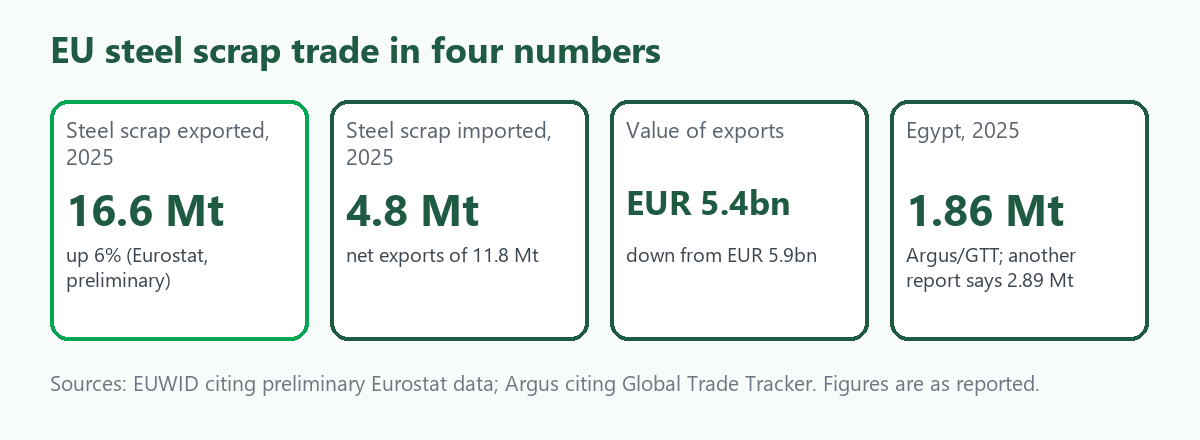
EUWID, reporting preliminary Eurostat data, says EU exports of steel scrap to non-EU countries rose about 6% in 2025 to 16.6 million tonnes. Imports from outside the EU rose 1% to 4.8 million tonnes, leaving net exports of about 11.8 million tonnes. The value of exports fell to about EUR 5.4 billion from EUR 5.9 billion, as the average value per tonne dropped from EUR 376 to EUR 325 [1].
A caution on baselines: EUWID's 2024 figure is 15.6 million tonnes, which fits the 6% rise, while GMK Center, also citing Eurostat, gives 16.72 million tonnes for 2024 and a decline [2]. The two appear to use different product scopes, so compare figures only from the same source.
Aluminium follows its own track. EUWID's German edition reported EU aluminium scrap exports at a record high in 2025 [3]. The metal matters because the Commission has been monitoring ferrous, aluminium and copper scrap exports since July 2025.
How the rules got here
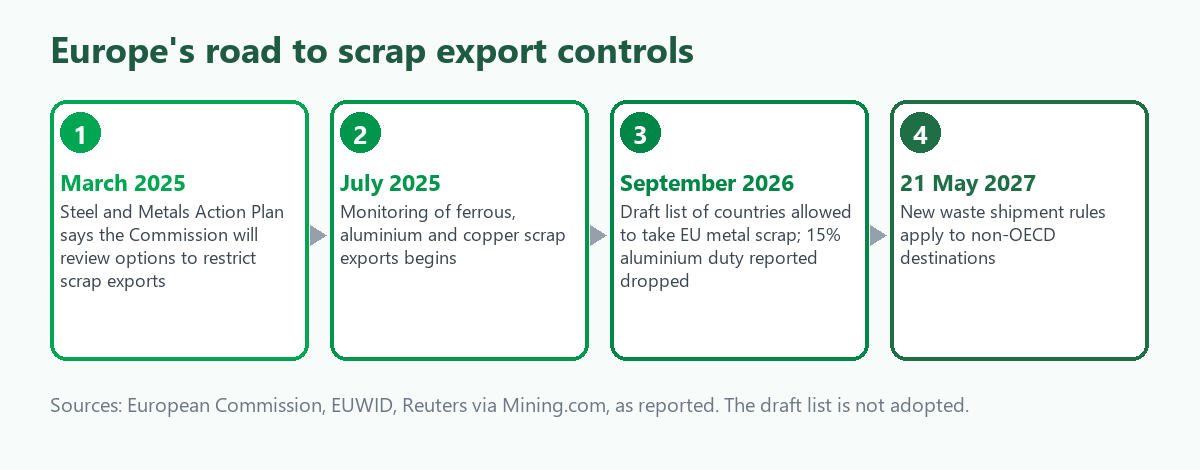
- March 2025. The Steel and Metals Action Plan said the Commission would review options to restrict scrap exports [4].
- July 2025. Monitoring of exports of ferrous, aluminium and copper scrap began [4].
- September 2026. A draft list of countries allowed to receive EU metal scrap circulated [5].
- 21 May 2027. The new waste shipment rules apply, under Regulation (EU) 2024/1157 [4].
Regulation (EU) 2024/1157 is the underlying law. It lets non-OECD countries receive EU waste only if they ask to be included and show they can handle it responsibly. The draft list is the Commission's first attempt to apply that test to metal scrap.
What the draft says
According to Argus, the draft would exclude Egypt, Morocco, India, Pakistan and Bangladesh from receiving EU ferrous scrap. Thirty-two countries sought continued access, and the consultation was due to close on 16 October, with restrictions to start in May 2027 [5]. BIR has warned that the draft could seriously disrupt global recycling markets and is preparing a joint response with Recycling Europe [5].
Two points of caution:
- The draft is not adopted. It can change after consultation, and the final list may look different.
- Reports differ on detail. We have seen the draft described as covering ferrous scrap specifically, and other coverage describes it as listing countries by waste stream. Check the Commission's published text before relying on any one summary.
Who is exposed
Egypt is the clearest case. Argus, citing Global Trade Tracker data, puts Egypt's 2025 imports from the EU at 1.86 million tonnes, while a second Argus report cites 2.89 million tonnes of EU-origin ferrous scrap, almost 80% of Egypt's imports [5][6]. The difference probably reflects scope, but the sources do not reconcile it. Either way, Egypt depends heavily on European supply.
India and Pakistan are less exposed. Argus reports they combine European and UK material with supply from the US, the UAE and elsewhere, and India in particular has a widely diversified base. Bangladesh has already moved almost completely away from European supply [6]. Our own look at India is in India's Scrap Market: Imports, Duties, Rules, and Bangladesh in Bangladesh: Australia's Top Scrap Customer.
The aluminium duty that wasn't
A separate proposal, a 15% duty on aluminium scrap exports, was reported by Reuters via Mining.com to have been dropped, based on anonymous sources [7]. We treat that as a reported outcome and not a confirmed decision. If the final package does include a duty, it would apply to EU exporters, not to Australian ones.
What it means for Australian sellers
The rules govern EU exports, not Australian ones, but they change the market Australian scrap competes in.
- Supply that cannot go east may go elsewhere. If EU scrap is steered towards OECD buyers such as Turkey, more material arrives in that market. See Turkey: The World's Biggest Scrap Importer.
- Excluded buyers need new suppliers. Mills in Egypt, India, Pakistan and Bangladesh that lose European supply will look to other origins, including Australia, as one more reason to read the buyer side before quoting.
- Quality becomes the selling point. A tighter global market rewards sellers with consistent grades and verified loads. See How a Scrap Export Deal Works, Step by Step.
- Do not assume a smooth change. Past bans reshaped trade in ways nobody predicted. See Scrap Export Bans: Three Case Studies.
Compare offers on the marketplace, and see World Scrap Trade: Top Importers and Exporters for the wider picture.
What to watch
| Signpost | Why it matters |
|---|---|
| The final country list | Decides who may buy EU scrap from May 2027 |
| Egyptian import volumes | The most exposed buyer |
| Turkish import mix | Shows whether EU scrap is redirected to OECD buyers |
| Any export duty on aluminium | Would affect the non-ferrous trade |
Frequently asked questions
How much scrap does the EU export?
About 16.6 million tonnes of steel scrap in 2025, up 6%, with net exports of about 11.8 million tonnes [1].
When do the new rules start?
21 May 2027 for non-OECD destinations [4].
Which countries would be excluded?
The draft is reported to exclude Egypt, Morocco, India, Pakistan and Bangladesh. It is not adopted [5].
Is there an EU duty on scrap exports?
A 15% aluminium scrap duty was reported to have been dropped, per anonymous sources [7].
Does this apply to Australian scrap?
No. It governs EU exports, but it changes the market Australian sellers compete in.
Sources
- EUWID, Rebound in EU's ferrous scrap exports and imports in 2025.
- GMK Center, EU exported 13.4 million tonnes of scrap metal in January-October.
- EUWID, EU-Aluschrottexporte 2025 auf Rekordhoch.
- European Commission, Steel and Metals Action Plan (March 2025) and Regulation (EU) 2024/1157, as summarised in Europe Is Keeping Its Scrap. Who Pays?.
- Argus, EU proposes scrap export restrictions to key markets.
- Argus, EU scrap restrictions threaten established trade.
- Reuters via Mining.com, reporting on the dropped aluminium duty, citing anonymous sources.
Figures are as reported by the sources named. The draft list is not adopted and reports differ on detail. This article is general information, not legal or trading advice. ScrapTrade operates a scrap marketplace and has a commercial interest in the scrap trade.