

You finish the baked beans, tip the tuna, or use the last of an aerosol, and the can goes into the bin. Steel cans are the quietest part of the recycling story, because nobody pays you for them and nobody sees where they go. This guide follows one steel food can the whole way: how a magnet finds it, what happens in the sorting plant, why a steel mill wants it, why some leave the country, and what it becomes. It is written for anyone who has wondered whether the can really gets recycled, and for collectors and yard owners who want to know why tin cans are worth so little. The export figures are our analysis of government records, and ScrapTrade has a commercial interest in the scrap trade.
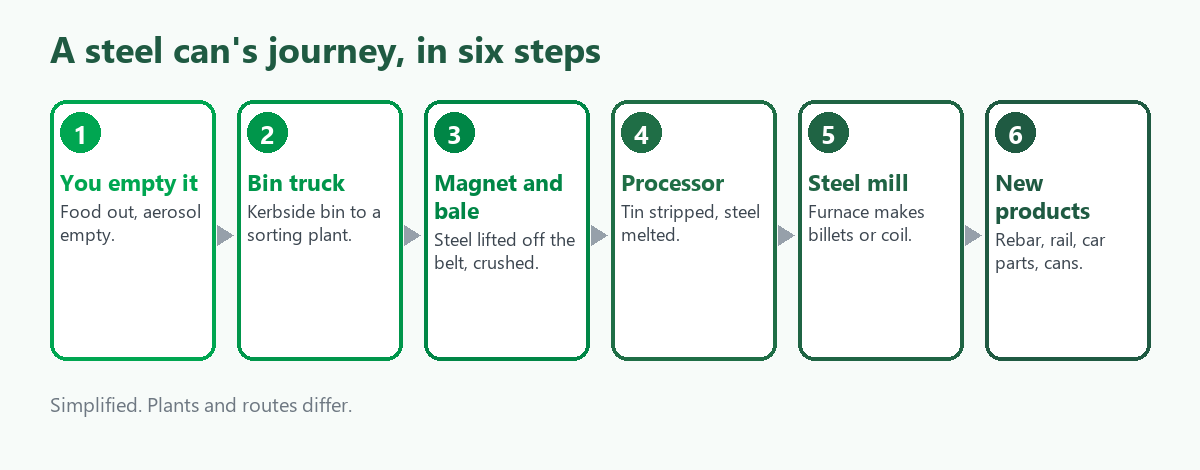
Step 1: You finish with it
What we call a tin can is almost always a steel can with a very thin coating of tin on the inside and outside to stop it rusting. Baked beans, soup, tuna, pet food and tomatoes all come in them. So do aerosol cans, such as deodorant, spray paint and cooking spray, and the steel lids that go with them.
Steel is magnetic, and that is the whole secret of its recycling. Hold a magnet to a can and it sticks, which tells you it is steel, not aluminium. Brisbane City Council's recycling fact sheet says all steel and tin cans can go in the household recycling bin. Empty is what matters. Aerosols should be completely empty, and food cans only need the food out. Visy's recycling leaflet lists empty pet food cans, aerosol cans and tuna cans, lids included, as material it sorts.
Step 2: The truck takes it to a sorting plant
Steel cans are not usually a scrap collector's target. They are light and worth little per kilogram, so a collector's time is usually better spent on heavier steel, copper or aluminium. Our own export analysis later in this guide shows how low the value is. Most tin cans reach the recycler through the kerbside bin, though we could not find a figure for the split.
The truck takes the bin to a materials recovery facility, called an MRF. There the load travels along conveyors mixed with paper, plastic, glass and aluminium. A large magnet lifts the steel off the belt and drops it in its own pile. Aluminium cans are lifted by a different machine, as we explain in Where a Drink Can Goes After You Recycle It.
Step 3: The cans are crushed into bales
The council fact sheet says the steel cans are crushed into blocks called bales. A bale is a dense block that is easy to stack and truck, so the processor pays less to move each tonne. The MRF then sells the bales. Visy says it sells its sorted steel to specialist steel processors and recyclers, and that it handled 24,000 tonnes of steel in the 2023-24 financial year from kerbside and commercial sources.
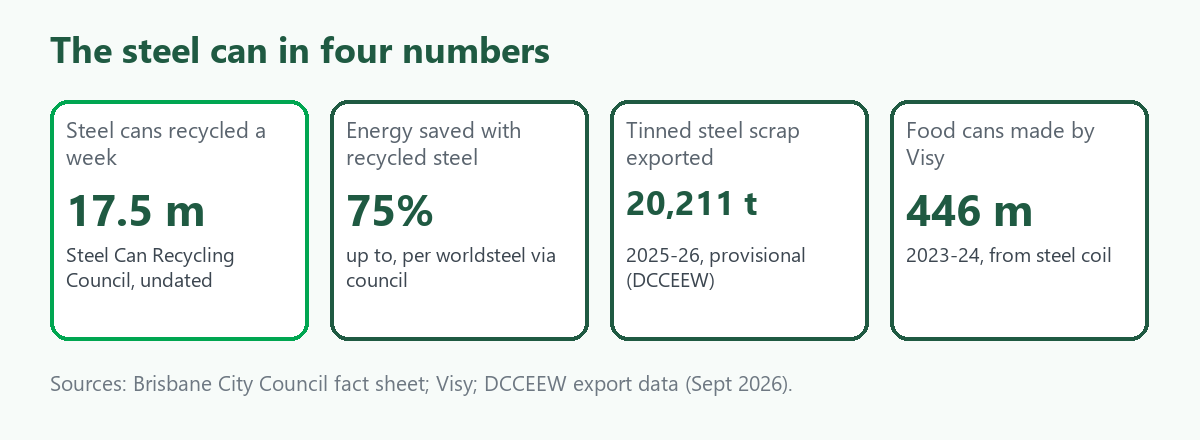
How many cans is that? The Steel Can Recycling Council's Cansmart material, which the Brisbane fact sheet quotes and which we cannot date, says 17.5 million steel cans are recycled every week in Australia.
Step 4: A processor strips the tin and melts it
At a refinery or processor, the tin coating has to be dealt with, because tin is an unwanted impurity in most steel. Brisbane City Council says the tin is removed from steel cans through a process called reverse electroplating, which is electroplating run backwards so that the tin comes off the steel. The clean steel is then melted down and turned into new products.
Not every plant does it this way. Older industry sources say some steel mills can melt tinplate scrap directly without a separate detinning step, and we could not confirm which approach each buyer uses today.
Step 5: A steel mill makes new steel
The cans are melted in a furnace with other scrap. In Australia, the usual route is an electric arc furnace, which uses electricity to melt scrap steel. InfraBuild, Australia's largest long steel maker, runs two of them, at Laverton in Victoria and Rooty Hill in New South Wales, and says it has used the method for almost 40 years. It says recycling steel is possible again and again, and that it can even be upcycled to a higher quality of steel.
What comes out? InfraBuild says its steel billets, which are the long blocks that are rolled into products, become bedding springs, farm fencing and reinforcing bar for projects such as Sydney Metro and Brisbane's Cross River Rail. Visy lists car parts, railway tracks, reinforcing bars for construction and steel coils for food can manufacture as uses of recycled steel from cans.
Why bother? The council fact sheet, citing the World Steel Association, says using recycled steel cans instead of raw materials uses up to 75 percent less energy. It also says each tonne of recycled steel saves 1,131 kilograms of iron ore, 54 kilograms of limestone and 633 kilograms of coal. These are older figures, but the direction is not in doubt.
Step 6: It becomes something new, sometimes a can again
If the steel goes into a coil, it can come back as a food can. Visy says it buys steel coil and makes food cans locally, and that it made 446 million food cans in 2023-24, for products such as baked beans, infant formula, pet food, soups and sauces. If it goes into a billet, it becomes rebar or fencing. A tin can can end up inside a building, a railway line or a car, and one day those will be scrap too.
Why do some tin cans leave Australia?
Not all steel packaging is melted at home. Government export records have a separate customs line for tinned iron or steel scrap, which is the closest thing to a record of steel can scrap leaving the country. In 2025-26 (provisional), Australia exported 20,211 tonnes of it, with a declared value of A$5.6 million, or about A$277 a tonne. That is about 28 cents a kilogram, which explains why collectors do not chase it. It is a border declaration, not a yard price.
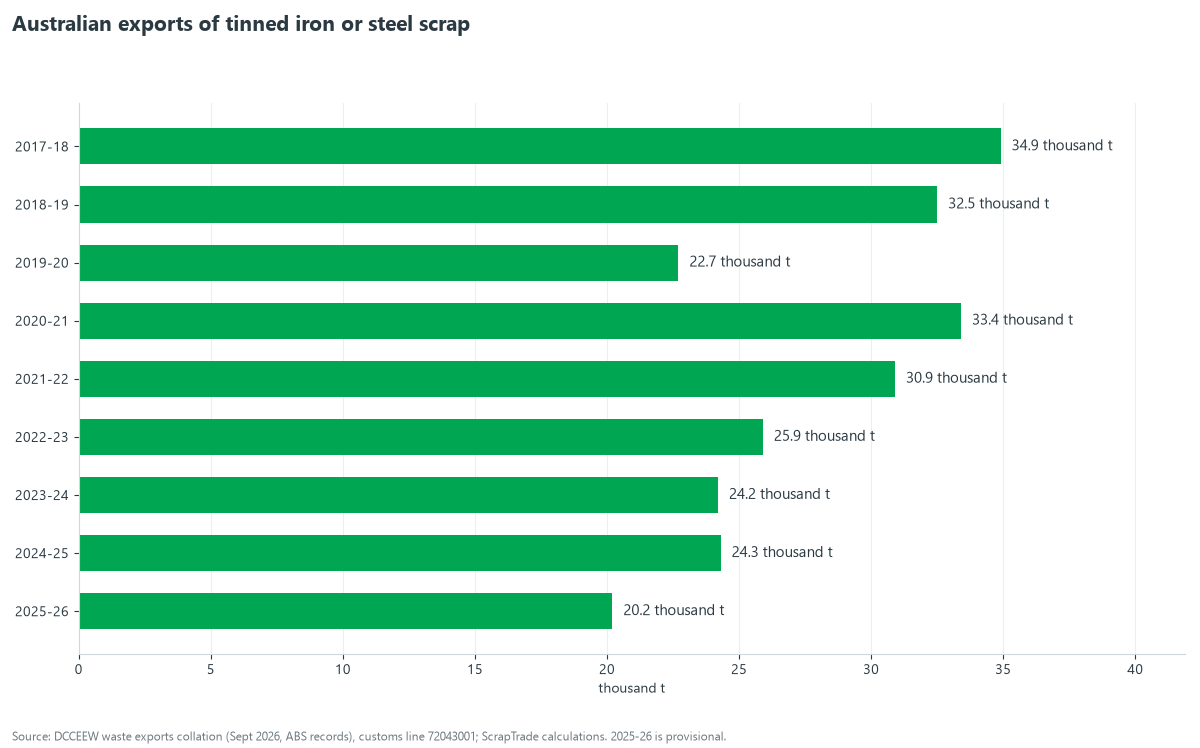
Exports of this line have fallen about 42 percent since 2017-18, when they were 34,891 tonnes, and tinned steel scrap is now less than 1 percent of Australia's ferrous scrap exports. We cannot tell from the data whether that is because less tinplate is being recycled, more is being melted at home, or less is being packed in steel.
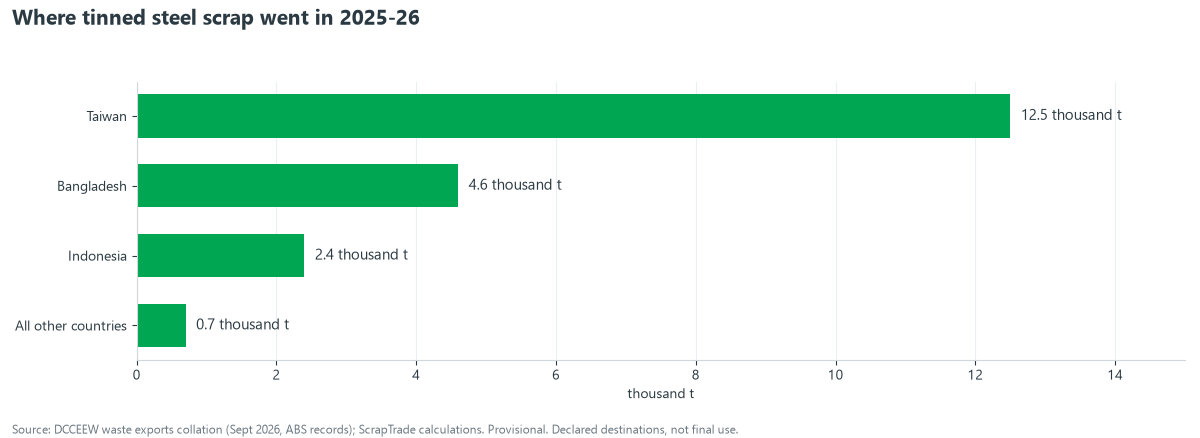
In 2025-26, Taiwan took 62 percent of the tonnes, Bangladesh 22.7 percent and Indonesia 11.8 percent. Most of it came from Victoria (10,973 tonnes), then New South Wales and Queensland. Note that the customs line covers all tinplate scrap, including offcuts from can factories, not only the cans from your bin. For the wider picture of where ferrous scrap goes, see Bangladesh vs Indonesia vs Vietnam: Australian Scrap Buyers, and for how steel scrap is graded, What is Heavy Melt Scrap and How Much Is It Worth in Australia?.
How many steel cans are really recycled?
The honest answer is that we do not have a current national figure. The most recent we found is 51 percent for 2015-16 from the National Recycling and Recovery Survey, up from 34 percent in 2010-11, and the Steel Can Recycling Council reported 56 percent for 2003-04. The two use different methods and are not directly comparable. Compare that with aluminium cans, where a 2023 study found 74 percent are recovered.
A 2005 bin audit reported by the Steel Can Recycling Council found that aerosols and cans with thick contents, such as meat, dairy and fish, often ended up in the garbage. That is old, and we have not found a current measurement, so we do not put a number on it.
What this means for you
- If you are a household: empty the can and put it in the household recycling bin. Make sure an aerosol is completely empty before it goes in.
- If you run a cafe, pub or food business: you go through steel cans by the dozen. Keep them separate from general waste and ask your recycling collector whether they sort steel.
- If you buy and sell scrap steel: tin cans are a low-value line, so the money is in volume and cleanliness, and in selling with the rest of your ferrous load. You can list a ferrous load on the ScrapTrade marketplace or create a free account. Our guide to ferrous and non-ferrous recycling explains how the two families differ.
To follow one length of copper wire from the wall to the yard, a chopper, a refinery and back into new cable, read Where Old Copper Wire Goes After You Sell It.
To follow one converter from the exhaust to a refiner and back into a new car, read Where an Old Catalytic Converter Goes.
What we could not verify
- Where your own can goes. Different sorting plants sell to different processors, and we cannot trace a single can.
- A current national recycling rate. The newest figure we found is for 2015-16.
- How much goes to Australian mills and how much is exported. The export line covers only part of the picture.
- Whether destination buyers detin the cans or melt them directly.
- The date of the Cansmart figure of 17.5 million cans a week, which came from a council fact sheet.
- What yards pay today. We publish no yard prices, and the A$277 a tonne is a declared export value.
Frequently asked questions
Can you recycle tin cans and aerosol cans in the home recycling bin?
Yes. Brisbane City Council says all steel and tin cans can go in the household recycling bin. Make sure aerosols are completely empty.
Do you need to wash tin cans before recycling?
We could not find a rule that applies everywhere. Councils generally ask that the can is empty, and a quick rinse keeps the bin clean, but check your own council's guidance.
Are tin cans made of tin?
Mostly steel. The steel is coated with a thin layer of tin to stop rust, and the tin is removed in recycling.
Is a recycled tin can made into a new can?
Sometimes. Visy says it buys steel coil and makes food cans from it in Australia, but much recycled steel becomes rebar, fencing, rail and car parts.
Sources
- Brisbane City Council, Recycling fact sheet: Steel (citing Cansmart, the World Steel Association and others).
- Visy, Steel Recycling Remade leaflet (FY2024 figures).
- InfraBuild, Steel is infinitely recyclable (media release).
- Department of Climate Change, Energy, the Environment and Water, Waste exports data collation, September 2026 (ABS records), ScrapTrade calculations, customs line 72043001 (waste and scrap of tinned iron or steel). The 2025-26 figures are provisional.
- KS Environmental, summary of the National Recycling and Recovery Survey (2015-16 steel can rate). Sustainability Matters, "SCRC looks under the lid for steel can recycling insights", 12 December 2005 (2003-04 rate and bin audit).
This is general information, not financial or legal advice. Process steps are simplified, and plants differ. Declared export values are border declarations, not prices. ScrapTrade operates a scrap marketplace and has a commercial interest in the scrap trade.