

Updated 27 October 2026. If the European Commission's draft list is adopted as written, one of the markets with the least room to adapt is Morocco. According to Argus, almost every tonne of steel scrap it imports comes from the European Union, its steelmakers melt that scrap in electric arc furnaces and the nearest alternative suppliers are limited. Australia sells Morocco almost nothing, so this is not a market story for Australian sellers. It is a window onto how the EU's decision could move scrap across the world. This profile sets out what the sources say, where they conflict and what is due next. It is general information, not trading advice.
How dependent Morocco is
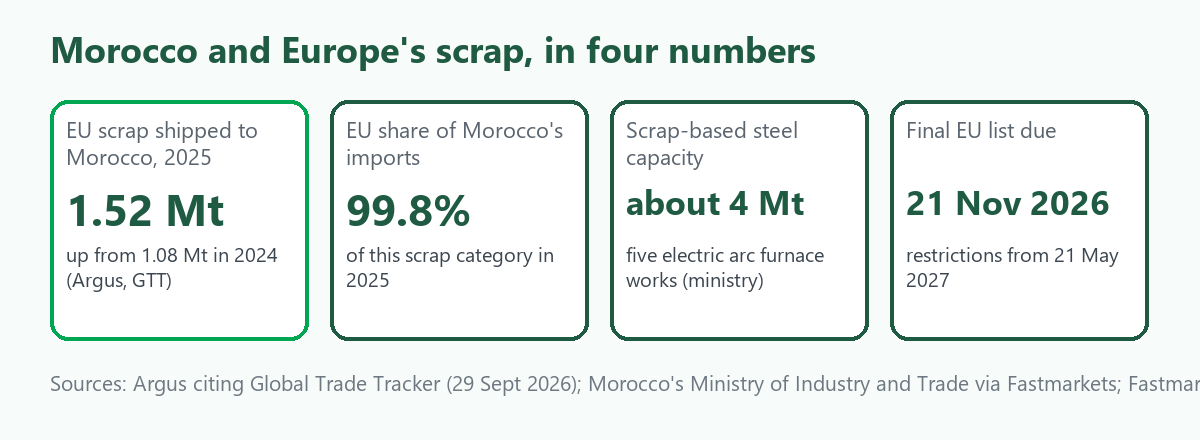
Argus, citing Global Trade Tracker data for HS 7204, reports the following for EU steel scrap shipped to Morocco, in million tonnes: 0.698 in 2022, 0.851 in 2023, 1.084 in 2024, 1.524 in 2025 and 0.860 in the first half of 2026 [1]. The EU's share of Morocco's imports in this category was 97.2% in 2022, 85.3% in 2023, 99.2% in 2024, 99.8% in 2025 and 99.5% in the first half of 2026 [1].
A different source gives a higher 2026 figure. Eurometal, citing Eurostat's export-side data, reports that Morocco imported 1.08 million tonnes of EU steel scrap in the first half of 2026, up 44.9% on a year earlier [2]. That is above Argus's 0.86 million tonnes for the same half-year. Export and import records often differ, but the gap is large. Either figure shows heavy and growing reliance on Europe.
What the draft says
The European Commission's draft list, open for consultation from 18 September to 16 October 2026 and attracting 161 responses, would not authorise Morocco to receive EU metal scrap from 21 May 2027 [3][4]. The Bureau of International Recycling (BIR) notes that Egypt, India and Morocco may appear on the draft list for other materials, but that they are not proposed for authorisation to receive metals. Of the countries that applied to receive metal waste, only Moldova, Montenegro, North Macedonia, Serbia and Ukraine are proposed for authorisation for certain metal streams [4]. A final list must be published by 21 November 2026, according to Fastmarkets [3].
The draft is not adopted. On 19 October BIR asked the Commission to extend the consultation to at least eight weeks, to no earlier than 13 November, and to reassess the evidence behind the restrictions. The Commission had not responded when Fastmarkets reported it [3]. We do not know whether an extension has been granted.
What Morocco's steelmakers say
Morocco's Ministry of Industry and Trade told Fastmarkets that the country has five scrap-based electric arc furnace steelworks with combined liquid steel capacity of about 4 million tonnes a year, and warned that excluding EU metal waste would destabilise the industry [3].
Argus reports further arguments from Moroccan mills [1]:
- Decarbonisation. A Moroccan mill said the restrictions could undermine the EU's wider decarbonisation objectives.
- Gas and alternatives. A lack of domestic gas limits direct reduced iron production, and DRI and pig iron could cover at most about 20% of the metallic charge.
- Ports. Port handling limits make nearby supply important.
- The UK as a fallback. A local steelmaker sees the United Kingdom as the main alternative but worries that the UK could introduce similar measures. For that debate see UK Scrap Exports: Buyers and Steel Strategy.
These are the producers' own arguments, reported by trade press. Several steel groups take the opposite view: Eurofer, Finarvedi and several national steel associations support keeping more scrap in the EU, while raising concerns about misuse of the end-of-waste rules, circumvention through OECD countries and weak border controls [3]. Galloo France estimated that European steel scrap supply has exceeded domestic demand by about 15 million tonnes a year on average over the past decade [3].
A separate report says Morocco also uses domestic retention measures and export controls to keep scrap for its own steelmakers and foundries [5]. We could not confirm the details, so we do not rely on it.
Australia and Morocco
Australian export records (DCCEEW's collation of ABS data) show only five entries for Morocco across all nine years of data, totalling about A$43,000, and none for metals: plastics waste in 2017-18 and 2019-20, a printing machine in 2018-19 and a few grams of worn textiles in 2025-26 [6]. There is no Australian ferrous, aluminium or copper scrap trade with Morocco in the records.
That is the sensible reading for sellers: Morocco's supply chain is European, and it is a short-haul market in a way Australia cannot match. Our Egyptian profile reached the same conclusion: Egypt's Scrap Market and the EU Draft List.
What it means for Australian sellers
- Do not plan around Morocco. Nothing in our data suggests a route for Australian metal scrap there.
- Watch the knock-on effects. If EU scrap is redirected to Turkey or other OECD buyers, prices in those markets move. See Turkey: The World's Biggest Scrap Importer.
- Watch the buyers who need new supply. Egypt, Morocco, India, Pakistan and Bangladesh are all outside the draft's metal authorisations. Those with room to switch may turn to Asia-Pacific origins. See Pakistan Scrap Imports and Bangladesh: Australia's Top Scrap Customer.
- Read the full picture. EU Scrap Exports: Volumes, Rules and Duties covers the EU side.
Compare offers on the marketplace.
What to watch
| Signpost | Why it matters |
|---|---|
| Whether the consultation is extended past 13 November | Decides how long the debate stays open |
| The final list, due by 21 November | Decides who can buy EU metal scrap from May 2027 |
| UK scrap export policy | Morocco's named alternative |
| Moroccan import volumes in 2027 | Show whether mills find substitutes |
Frequently asked questions
How much EU scrap does Morocco buy?
About 1.52 million tonnes in 2025, 99.8% of its imports in that category, according to Argus [1].
Is Morocco banned from receiving EU scrap?
Not yet. The draft list does not propose it for metals and the final list is due by 21 November 2026 [3].
When would restrictions start?
21 May 2027 for excluded destinations [4].
Does Australia export scrap to Morocco?
No metal scrap appears in the Australian records [6].
Why do the 2026 figures differ?
Argus uses import-side data and Eurostat export-side data, and they often differ [1][2].
Sources
- Argus, EU scrap restrictions threaten established trade (29 September 2026), citing Global Trade Tracker data.
- Eurometal, EU scrap restrictions to non-OECD nations could wreak havoc on ferrous trade flows: sources, citing Eurostat.
- Fastmarkets, BIR urges Commission to reassess steel scrap export ban list, extend consultation (October 2026).
- Recycling International, EU deadline for non-OECD scrap approval looms.
- 7news Morocco, EU imports of Moroccan minerals more than double in value, mentioned for context only.
- Department of Climate Change, Energy, the Environment and Water, Waste exports data collation, September 2026 (ABS records), ScrapTrade calculations.
Figures are as reported by the sources named and some conflict. The draft list is not adopted. This article is general information, not legal or trading advice. ScrapTrade operates a scrap marketplace and has a commercial interest in the scrap trade.