

Updated 26 October 2026. The United Kingdom is a small steelmaker and a large scrap exporter. It generates far more steel scrap than its own mills can melt, so most of it goes abroad, and for the past few years the single biggest destination has been Turkey. In March 2026 the government published a Steel Strategy that wants a bigger share of the steel used in Britain to be made in Britain. That has opened a debate the scrap trade knows well: should more of the scrap stay home? This profile covers the numbers, the policy and the arguments on both sides. It is general information, not trading advice.
How much the UK exports
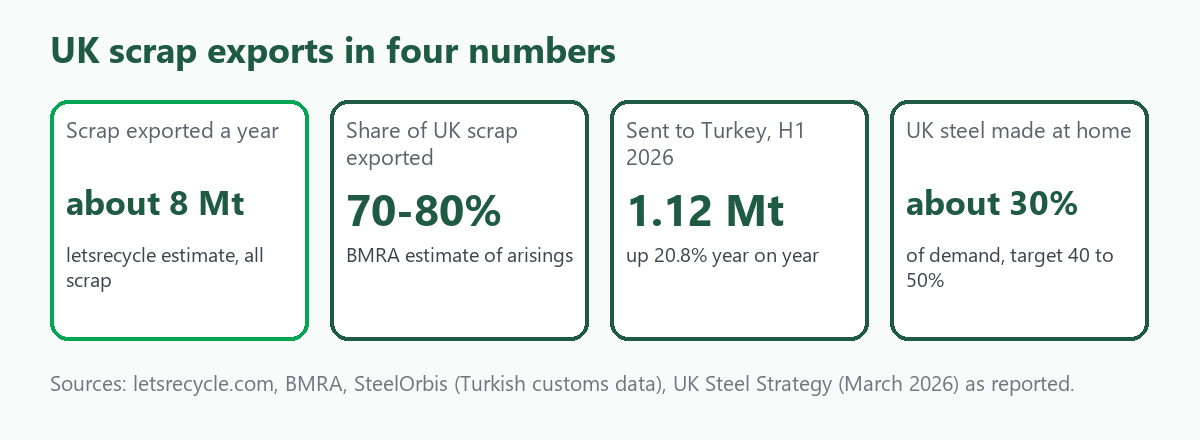
Letsrecycle estimates that the UK exports around eight million tonnes of scrap every year across all metals [1]. The British Metals Recycling Association (BMRA) describes it as a share of what is collected: between 70% and 80% of all scrap arisings are exported [2]. The exact tonnage depends on what is counted, because ferrous scrap, aluminium, copper and other metals are reported differently, so treat the eight million figure as an order of magnitude rather than a precise total.
Who buys it
Turkey is the largest buyer of British ferrous scrap. SteelOrbis, reporting Turkish customs data, says the UK supplied 1.12 million tonnes to Turkey in the first half of 2026, up 20.8% on a year earlier, behind the United States at 1.77 million tonnes and the Netherlands at 1.20 million tonnes. In June alone the UK sent 175,418 tonnes, making it the second-largest supplier that month [3]. In 2024, according to GMK Center citing Turkish statistics, the United States led Turkey's suppliers at 4.53 million tonnes, followed by the Netherlands and the United Kingdom, in a year when Turkey's total imports were 20.09 million tonnes [4].
That concentration is the core of the policy question. A trade that depends heavily on one buyer is exposed to that buyer's demand, and Turkey's demand has been uneven. See Turkey: The World's Biggest Scrap Importer.
The Steel Strategy
The government's Steel Strategy, published on 19 March 2026, sets an ambition for steel used in the UK to be made in the UK. Domestic production meets about 30% of demand and ministers want 40% to 50% over the long term [5]. Several parts matter for scrap:
- Electric arc furnaces. The strategy backs arc furnace steelmaking, which melts scrap, as the future of the industry.
- A Scrap Working Group. A cross-government group was promised by May 2026, with a stated focus on a resilient, cost-effective and high-quality scrap supply for domestic steelmaking [5].
- Trade measures on steel. From 1 July 2026 import quotas fall by 60%, with imports above them facing a 50% tariff [5].
- Funding. Up to GBP 2.5 billion of support, with the National Wealth Fund as the main vehicle [5].
The strategy does not restrict scrap exports. The BMRA welcomed it and noted that it imposes no export restrictions, while asking for recyclers to be properly represented on the working group [2].
The argument over exports
The debate is practical rather than ideological.
The case for keeping more scrap. If the UK wants arc furnaces, they need scrap, and exporting 70% to 80% of it means local mills compete with foreign buyers for their own raw material. Letsrecycle's analysis frames the question as whether Britain should keep more of it [1].
The case against restrictions. The industry points out that the UK produces much more steel scrap than its present capacity can use, so a restriction would leave material with nowhere to go. In a letter to government, the metals recycling industry estimated that preventing exports to Turkey alone would cost GBP 2.16 billion in gross value added and 6,834 direct and indirect jobs [6]. These are industry estimates, not independent analysis, and should be read that way.
Both sides can be right at once. Without new furnaces there is no domestic demand for the extra scrap, and without a market for scrap there is less reason to build furnaces. The working group exists to look at that gap.
Aluminium is a separate story
The ferrous debate is the loudest, but aluminium is the sharper one. Reuters, citing the manufacturers' group Make UK, reported that UK exports of aluminium waste and scrap reached 624,314 tonnes in the prior year, and the group warned that this could threaten supply for defence and automotive manufacturers [7]. The picture is consistent with other countries: where scrap is valuable and strategic, manufacturers ask for it to stay.
What it means for Australian sellers
- UK policy is a demand signal for arc furnaces, not yet a supply cut. Nothing in the strategy changes what UK yards can export today.
- Turkey is the shared market. British, American, Dutch and Australian sellers all feed it, so a change in UK flows would be felt in Turkish bids.
- The direction is clear. The UK, the EU, the US and Japan are each asking how much scrap should leave. See Europe Is Keeping Its Scrap. Who Pays? and Scrap Export Bans: Three Case Studies.
- Documentation matters either way. Buyers worldwide prefer sellers who can show grade and provenance. See How a Scrap Export Deal Works, Step by Step.
For the full map, see World Scrap Trade: Top Importers and Exporters and Australia's Scrap Metal Exports: 2025-26 Data. You can compare offers on the marketplace.
What to watch
| Signpost | Why it matters |
|---|---|
| Scrap Working Group findings | The first formal view on whether exports should be limited |
| Monthly UK shipments to Turkey | Shows whether the 2026 rise continues |
| New UK arc furnace investment | Creates the domestic demand the strategy needs |
| UK aluminium scrap policy | The metal where restrictions look most likely |
Frequently asked questions
How much scrap does the UK export?
About eight million tonnes a year across all metals, by letsrecycle's estimate. The BMRA says 70% to 80% of arisings are exported [1][2].
Who buys UK scrap?
Turkey is the main buyer of ferrous scrap. It took 1.12 million tonnes in the first half of 2026 [3].
Is the UK banning scrap exports?
No. The March 2026 Steel Strategy imposes no export restrictions, but it creates a working group to look at scrap supply [2][5].
What is the UK's steel self-sufficiency?
About 30% of demand is met by UK production, with a long-term target of 40% to 50% [5].
Why does aluminium matter here?
Manufacturers have warned that large aluminium scrap exports could squeeze domestic supply [7].
Sources
- letsrecycle.com, Export analysis: should Britain keep more scrap metal?.
- BMRA, UK Steel Strategy: how it impacts metal recyclers; Trade association members say it is a risky move to impede the export of recycled metal.
- SteelOrbis, Turkey's scrap imports rise in June 2026 despite sharp drop in US-origin material, 31 percent increase in H1.
- GMK Center, Turkey increased scrap imports by 6.7% y/y in 2024.
- letsrecycle.com, UK Steel Strategy confirms scrap working group and import curbs (19 March 2026).
- letsrecycle.com, Metals recyclers warn export restrictions could trigger significant job losses. Figures are industry estimates.
- Reuters via MarketScreener, Soaring scrap aluminium exports threaten UK defence, auto supply chains, industry group says.
Figures are as reported by the sources named. Industry estimates are labelled as such. This article is general information, not financial or trading advice. ScrapTrade operates a scrap marketplace and has a commercial interest in the scrap trade.