

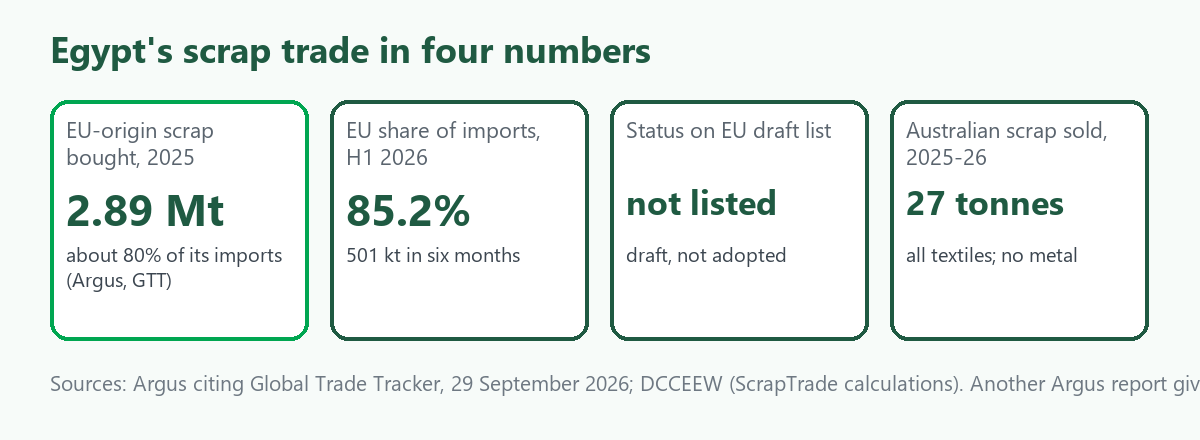
Updated 27 October 2026. Of the countries named in the European Commission's draft scrap export list, few depend on Europe as much as Egypt. According to Argus, Egypt bought 2.89 million tonnes of EU-origin ferrous scrap in 2025, almost 80% of everything it imported [1]. If the draft becomes law, that supply line is cut from 21 May 2027. This profile explains why Egypt is so exposed, what the figures say, where the sources disagree and why Australian sellers, who sell Egypt almost nothing, should still pay attention. It is general information, not trading advice.
What the data say
Argus, citing Global Trade Tracker data for HS code 7204, reports the following [1]:
- Egypt imported 2.89 million tonnes of EU-origin scrap in 2025, nearly 80% of its total scrap imports.
- The EU share of Egypt's imports was 79.2% in 2022, 24.8% in 2023, 80.3% in 2024, 79.6% in 2025 and 85.2% in the first half of 2026.
- In the first half of 2026 EU-origin imports were 501,000 tonnes.
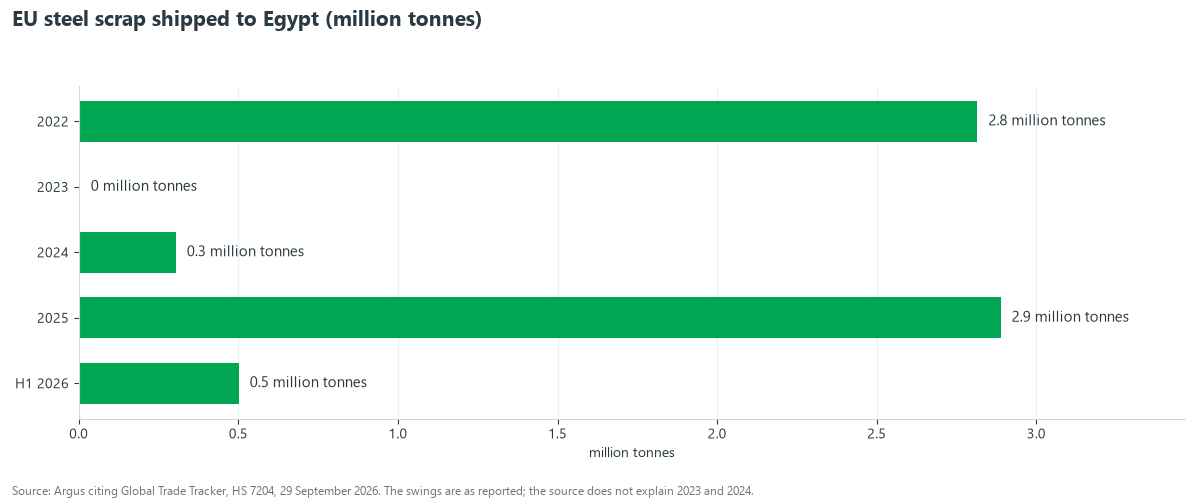
The series swings. EU shipments to Egypt were 2.815 million tonnes in 2022, almost nothing in 2023 and 304,000 tonnes in 2024, then back to 2.888 million tonnes in 2025 [1]. Argus does not explain 2023 and 2024, and the EU share figures sit oddly beside the tonnage in those years, so we report the numbers as published and do not draw a conclusion about the cause. The practical point is that Egyptian demand for European scrap is not steady.
The figures conflict. An earlier Argus report put Egypt's 2025 imports at 1.86 million tonnes and 947,000 tonnes in January to July 2026, up 34% [2]. The difference from 2.89 million tonnes is large, probably a matter of scope, but the sources do not reconcile it. We use 2.89 million tonnes for the EU-origin figure because it comes with a full time series, and flag the other.
A third set of figures points the other way for 2026. Eurometal, citing Eurostat's export-side data, reports that the EU shipped 2.12 million tonnes of steel scrap to Egypt in the first half of 2026, up 59.7% on a year earlier, and 1.08 million tonnes to Morocco, up 44.9%. That is far above the 501,000 tonnes Argus gives for the same half-year from Global Trade Tracker's import-side data. Export and import records often differ, but a gap this wide means the 2026 figure in this article should be treated as uncertain. If Eurostat is right, Egypt's dependence on European scrap grew in 2026, which raises its exposure to the draft list.
The market behind it
Egypt is one of the largest steel producers in the Arab region. The Arab Iron and Steel Union, citing worldsteel, reports Egyptian crude steel output of 4.253 million tonnes in January to May 2025, down 5.1% on a year earlier [3]. We could not verify what share of its steel is made from scrap, so we make no claim about that. What the trade data does show is that European scrap is its main import and that Egypt's mills have been exposed to swings in it.
Egypt has also been protecting its own steel sector. SteelOrbis reports that a safeguard duty of 13% of CIF value with a US$70 a tonne minimum applies to billet imports, stepping down after September with quarterly reviews [4]. That is a policy aimed at billets rather than scrap, but it shows the government supports local steelmaking.
The EU draft
Argus reports that Egypt is not authorised to receive EU ferrous scrap under the draft list, which would take effect on 21 May 2027, and calls Egypt and Morocco among the most exposed markets [1][2]. The draft is not adopted. The consultation was due to close on 16 October, BIR asked on 19 October for it to be extended to at least 13 November, and Fastmarkets reports that a final list must be published by 21 November 2026. We do not know whether the extension was granted. See EU Scrap Exports: Volumes, Rules and Duties and Europe Is Keeping Its Scrap. Who Pays?.
If the draft stands, Argus says Egyptian mills could turn more to the UK and the US, which already supply them, with Russia and the Americas as possible additions. Russian supply is limited by export quotas and shipping problems [1]. For the UK, that connects to the debate in UK Scrap Exports: Buyers and Steel Strategy.
Australia and Egypt
Australia is almost absent. In 2025-26 Australian exporters sold Egypt just 27 tonnes of waste, all of it textiles and worth A$5,691. In 2024-25 the figure was 10 tonnes. The last meaningful year in our records was 2017-18, with 34,613 tonnes [5]. There are no Australian ferrous or non-ferrous scrap sales to Egypt in the latest data.
That tells you something. Egypt has been a short-haul market for Europe, and for a seller in Australia the distance to the Mediterranean is a heavy cost against European and UK competition, as well as Turkey's. See the shipping costs in the real cost of sourcing scrap abroad.
What it means for Australian sellers
- Do not plan around Egypt. Nothing in our data suggests it becomes a major Australian market, even if the EU draft passes.
- Watch where displaced European scrap goes. If it moves to Turkey or the UK-US channels, prices in those markets shift. See Turkey: The World's Biggest Scrap Importer.
- Watch the buyers that lose EU supply together. Egypt, Morocco, India, Pakistan and Bangladesh are all not listed. Those that need new supplies could look to Asia-Pacific origins. See Pakistan Scrap Imports and Bangladesh: Australia's Top Scrap Customer.
- Expect a transition to be messy. Past restrictions had surprising effects. See Scrap Export Bans: Three Case Studies.
For the wider picture, see World Scrap Trade: Top Importers and Exporters. You can compare offers on the marketplace.
What to watch
| Signpost | Why it matters |
|---|---|
| The final EU country list | Decides whether Egypt can keep buying European scrap |
| Egyptian imports from the UK and US | Show where replacement supply comes from |
| Russian export quotas | Limit one possible replacement |
| Egyptian billet duties | Shape local mills' margins |
Frequently asked questions
How much EU scrap does Egypt buy?
2.89 million tonnes in 2025, nearly 80% of its scrap imports, according to Argus. Another Argus report gives 1.86 million tonnes [1][2].
Is Egypt banned from receiving EU scrap?
Not yet. It is not on the EU's draft list, which is not adopted and would apply from 21 May 2027 [1][2].
Where could Egypt buy instead?
The UK and the US, and possibly Russia and the Americas [1].
Does Australia export scrap to Egypt?
Almost none: 27 tonnes of textiles in 2025-26 [5].
Why do the figures differ?
Different scope and data bases. The sources do not reconcile them [1][2].
Sources
- Argus, EU scrap restrictions threaten established trade (29 September 2026), citing Global Trade Tracker data.
- Argus, EU proposes scrap export restrictions to key markets.
- Arab Iron and Steel Union, Arab Steel Summit news archive, citing worldsteel monthly data (2025).
- SteelOrbis, Egypt sets final duty rates on billet imports.
- Department of Climate Change, Energy, the Environment and Water, Waste exports data collation, September 2026 (ABS records), ScrapTrade calculations.
Figures are as reported by the sources named and some conflict. The EU draft list is not adopted. This article is general information, not legal or trading advice. ScrapTrade operates a scrap marketplace and has a commercial interest in the scrap trade.