

Updated 27 October 2026. South Korea is two markets for scrap, and they move in opposite directions. In ferrous scrap, it was once among the biggest importers in Asia and is now a shrinking buyer that mostly looks to Japan. In aluminium and other non-ferrous scrap, it is one of the most valuable destinations for Australian sellers. Mixing the two up leads to the wrong expectations, so this profile takes them in turn. It is general information, not trading advice.
The ferrous figures come from Argus, citing Global Trade Tracker data. The Australian figures are from the national waste export records (DCCEEW's collation of ABS data) and are our own calculations.
Ferrous scrap: a shrinking buyer
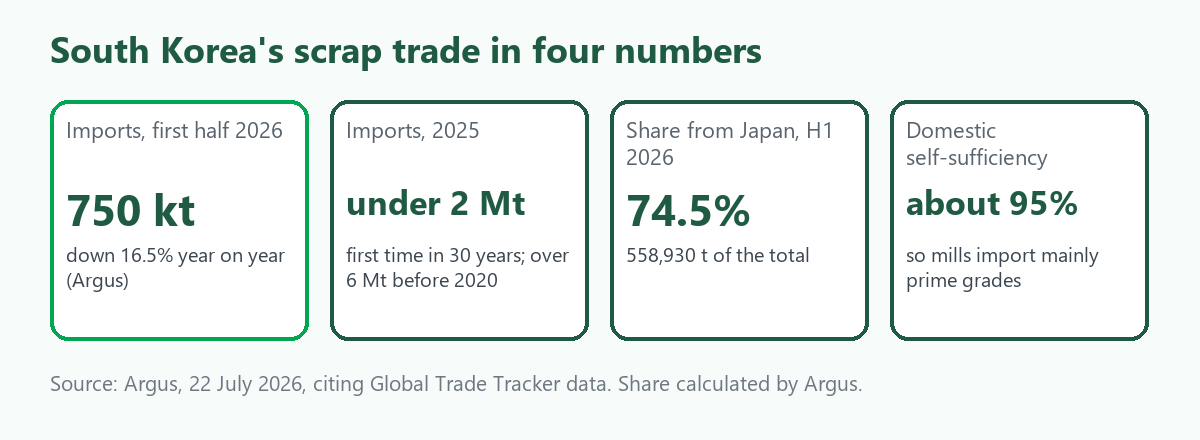
Argus reports that South Korea imported 750,407 tonnes of ferrous scrap in the first half of 2026, down 16.5% on a year earlier and 15.1% on the second half of 2025 [1]. For a longer view, imports were above 6 million tonnes a year before 2020, ran at 4 to 5 million tonnes in 2020 to 2023 and fell below 2 million tonnes in 2025, the first time in 30 years [1].
| Supplier, first half 2026 | Tonnes | Change on a year earlier |
|---|---|---|
| Japan | 558,930 | down 8.6% |
| Thailand | 42,467 | down 19.8% |
| United States | 21,277 | down 82.0% |
| Others | 127,733 | up 9.3% |
Source: Argus [1]. Japan supplied 74.5% of the total.
Argus gives four reasons for the slump:
- Weak steel output. Construction activity is low and cheap imported steel products weigh on local mills.
- A price gap. Domestic scrap has been priced differently from seaborne scrap, and mills have mostly bought at home.
- Self-sufficiency of about 95%. Mills import mainly for prime grades or when overseas prices are competitive.
- Cargo size and currency. Japanese suppliers are favoured because vessel-size rules are more flexible and contracts can be settled in yen. US imports fell because mills avoided deep-sea bulk cargoes, which typically exceed 30,000 tonnes [1].
Mills kept long-term contracts for Japanese scrap but stayed largely out of the spot market for two years, according to Argus. They returned in late May 2026 after domestic prices rose, but interest faded as prices fell again from July [1]. Korea also exports: about 261,000 tonnes in the first half of 2026, mainly to India, Vietnam and Bangladesh [1].
The Japanese side of the trade agrees on direction. SteelOrbis reports Japan's exports to South Korea at 786,172 tonnes in January to August 2026, down 4.8% [2]. See Japan Scrap Exports: Buyers, Rules, Outlook.
Non-ferrous scrap: a top market
Here the picture reverses. In 2025-26 South Korea was the largest destination for Australian waste and scrap by value, at A$1.56 billion, though the tonnage (213,007) was modest [3].
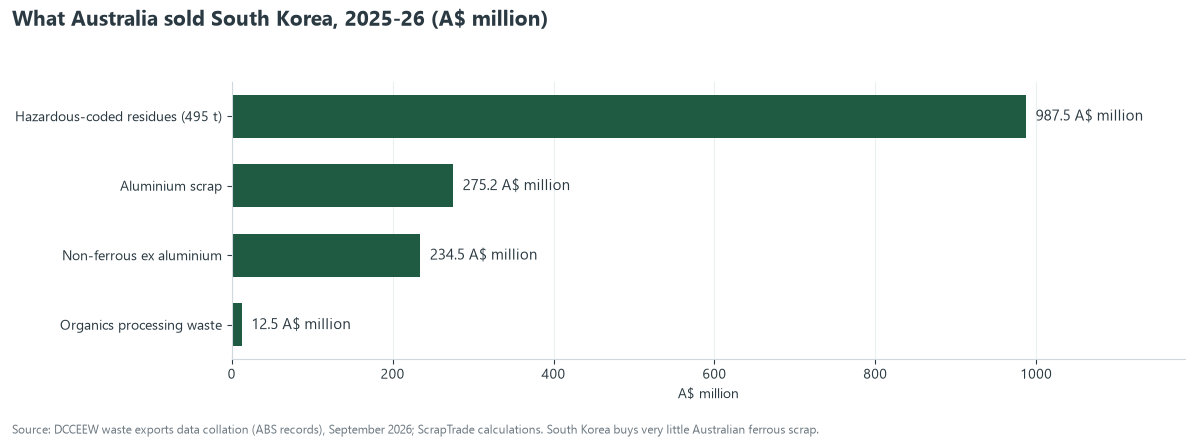
- Aluminium scrap: 82,302 tonnes worth A$275 million, which is 19.2% of Australia's aluminium scrap value and third after India (29.2%) and China (21.2%) [3].
- Other non-ferrous metals (excluding aluminium): A$234 million, 15.3% of the total and second after China [3].
- A hazardous-coded category: 495 tonnes worth A$987.5 million. That is roughly A$2 million a tonne, which tells us it is a very high-value material, but the data record only the classification code and we do not claim to know what is in it [3].
Aluminium volume was lower than the year before (82,302 tonnes against 168,510 in 2024-25), though value rose from A$236 million to A$275 million [3].
On ferrous scrap the reverse holds. South Korea does not appear among the top eight buyers of Australian ferrous scrap in 2025-26, led by Bangladesh at about 805,000 tonnes [3]. The pattern is consistent with the market above: Korean mills are self-sufficient in ordinary steel scrap and spend abroad on materials they cannot easily source.
What it means for Australian sellers
- Do not chase Korean steel scrap. Demand is low and the main supplier is next door in Japan, with yen settlement and flexible vessel sizes. Australia has no advantage there.
- Sell quality non-ferrous. Aluminium and other non-ferrous grades are where Korea pays. Clean, well-sorted, correctly described material matters more than volume. See aluminium scrap grades, prices and demand.
- Think about contract style. Korean buyers have favoured long-term contracts and avoided spot cargo. Repeat, documented supply wins over one-off offers.
- Know the competing demand. India and China compete for the same aluminium. See India's Scrap Market and China's Copper and Aluminium Scrap Rules.
For the wider picture, read World Scrap Trade: Top Importers and Exporters and Australia's Scrap Metal Exports: 2025-26 Data. To check what your material might fetch, use the price calculator, then compare offers on the marketplace.
What to watch
| Signpost | Why it matters |
|---|---|
| Korean steel output and construction | The root cause of weak scrap demand |
| Japan to Korea monthly shipments | Shows whether Japan keeps its three quarters |
| Korean spot buying | A return of mills to spot would open room for others |
| Australian aluminium sales to Korea | Value is up while tonnage is down |
Frequently asked questions
How much scrap does South Korea import?
750,407 tonnes of ferrous scrap in the first half of 2026, and under 2 million tonnes in 2025 [1].
Who supplies South Korea?
Japan supplied 74.5% in the first half of 2026 [1].
Why is Korean demand low?
Weak steel output, cheap steel imports and about 95% self-sufficiency in scrap [1].
Does Australia sell scrap to South Korea?
Yes, mainly aluminium and other non-ferrous scrap, worth A$1.56 billion in 2025-26 including a high-value hazardous-coded category [3].
Is South Korea a good market for steel scrap?
Not at present. Other markets offer more volume.
Sources
- Argus, South Korea's scrap imports drop in 1H (22 July 2026).
- SteelOrbis, Japan's steel scrap exports down 9.5 percent in January-August 2026.
- Department of Climate Change, Energy, the Environment and Water, Waste exports data collation, September 2026 (ABS records), ScrapTrade calculations. See Australia's Scrap Metal Exports: 2025-26 Data.
Figures are as reported by the sources named. This article is general information, not financial or trading advice. ScrapTrade operates a scrap marketplace and has a commercial interest in the scrap trade.