

Updated 26 October 2026. If you sell ferrous scrap into Asia from Australia, you are bidding against Japan whether you know it or not. Japan is the region's nearest large exporter, its shipments to Vietnam, Bangladesh and South Korea are short and cheap to organise, and its grades are well known to mills. That makes Japan the benchmark that Australian offers are measured against. This profile sets out how much Japan exports, where it goes, what changed in 2026 and what a proposed tightening of export rules could mean. It is general information, not trading advice.
The figures come from SteelOrbis, which reports Japanese customs data, with other trade outlets as a cross-check. Where outlets differ we say so.
How much Japan exports
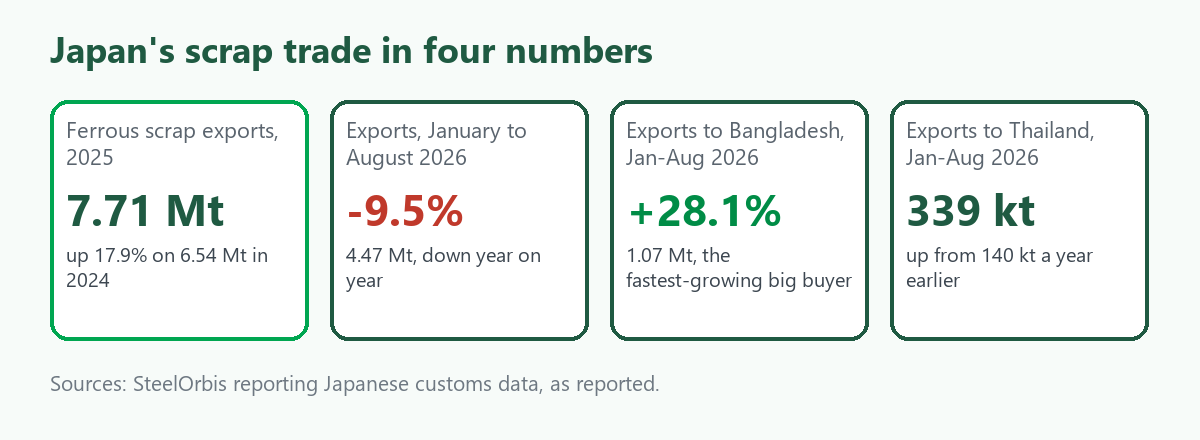
SteelOrbis reports that Japan exported 7.71 million tonnes of ferrous scrap in 2025, up 17.9% on 2024, with Vietnam the top buyer at 3.28 million tonnes, up 26.2% [1]. BigMint puts the 2025 total at about 7.5 million tonnes, up 19% from 6.3 million tonnes and a five-year high [2]. The two outlets use different data bases, but they agree on the direction: 2025 was a strong year. Argus reported that January to September 2025 exports were already 5.67 million tonnes, 21% above the same period of 2024 [3].
What changed in 2026
The momentum did not last. Japan exported 2.35 million tonnes in January to April 2026, down 9.9% [4]. By January to August the total was 4.47 million tonnes, down 9.5%, and August alone was 422,961 tonnes, down 17.4% [5]. The decline has been steady rather than sudden, which suggests softer demand and a slower pace of buying in the main markets, not a single event.
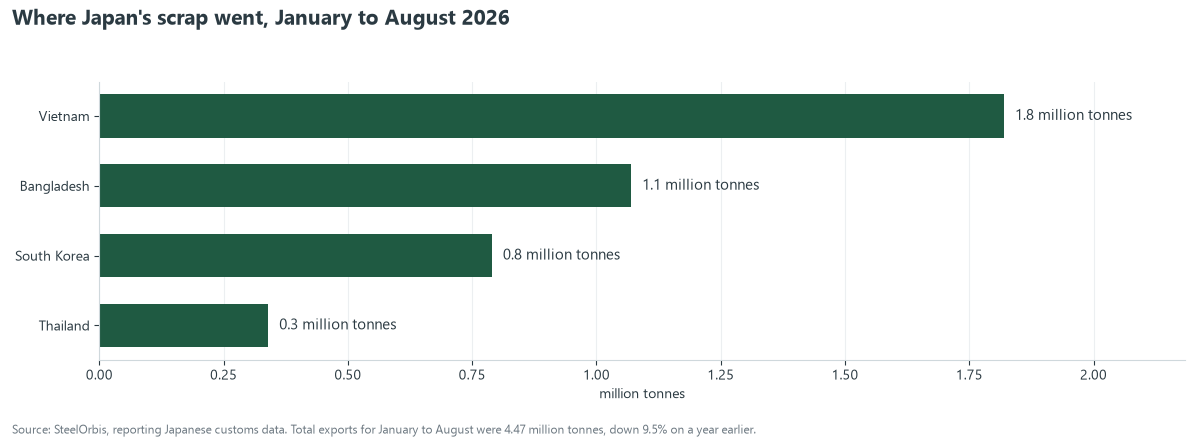
The mix has shifted more than the total.
| Destination, January to August 2026 | Tonnes | Change on a year earlier |
|---|---|---|
| Vietnam | 1.82 million | down 15.8% |
| Bangladesh | 1.07 million | up 28.1% |
| South Korea | 786,172 | down 4.8% |
| Thailand | 338,652 | up from 140,341 |
Source: SteelOrbis [5]. Vietnamese customs data, also reported by SteelOrbis, put Japanese shipments to Vietnam at 1,781,364 tonnes, down 16.9%, about 40,000 tonnes lower than the Japanese figure. The gap is a normal difference between export and import records, not an error in either.
Reading the pattern
Vietnam is still the anchor, but it is buying less. Japan supplied more than half of Vietnam's 2025 imports [6]. In 2026 that share is being tested by cheaper or more flexible offers. Our own profile of Vietnam covers the buyer side: Vietnam Scrap Imports: Suppliers, Prices, Outlook.
Bangladesh is the growth market. Japan's sales there rose 28.1% in eight months. Bangladesh is also Australia's top ferrous scrap customer, which means the two exporters are competing for the same mills. See Bangladesh: Australia's Top Scrap Customer.
Thailand is small but doubled. A rise from about 140,000 to about 339,000 tonnes shows buyers testing new origins. It is too small to change the picture yet.
South Korea is flat to weaker. It is a mature market with its own supply of scrap, and a smaller share of Japan's exports than it once was.
What Japan sells
Japanese exports are known for graded material, with H2, HS and Shindachi among the names buyers use. BigMint expects those high-grade exports to continue in the event of tighter rules, because any restrictions are aimed mainly at low-grade and mixed scrap [7]. For a seller, the lesson is practical: Japan's reputation rests on consistent grading and clean loads, and buyers pay for that reliability.
The proposed rules
According to BigMint, reporting in April 2026, Japan's Ministry of the Environment, working with other agencies, is proposing to tighten export rules for metal scrap, plastic waste, batteries and circuit boards, with stronger monitoring and traceability and penalties for violations [7]. The goals are described as stronger domestic recycling, better environmental compliance and resource security. We could not find a published start date, and the report describes the rules as proposed. If they come in, the likely effect is a levelling off or a gradual easing of volumes, not a ban.
It is the same direction of travel seen in Europe, the United States and the United Kingdom, where governments are asking whether more scrap should stay at home. See Scrap Export Bans: Three Case Studies for what restrictions have done elsewhere, and US Scrap Exports Fall to a 20-Year Low for a case where policy reduced shipments.
What it means for Australian sellers
- Japan sets the price you are compared with. In Vietnam and Bangladesh, Japanese offers are the reference. Know them before you quote.
- A slower Japan is not an empty field. Falling volumes may open room for others, but buyers will still look at quality and delivery first.
- Grade is the differentiator. Japan wins on consistency. Sorting, clean loads and honest descriptions are the cheapest way to compete. See how to grade scrap metal.
- Watch the rules. A confirmed Japanese restriction would reduce competing supply, but would also tell you where the policy mood is heading.
For a wider view, read World Scrap Trade: Top Importers and Exporters and Australia's Scrap Metal Exports: 2025-26 Data. Sellers can compare offers on the marketplace and check an indicative reference on the price calculator.
What to watch
| Signpost | Why it matters |
|---|---|
| Monthly Japanese exports to Vietnam | Shows whether the anchor market keeps shrinking |
| Bangladesh volumes | Shows who is winning the growth market |
| Any dated Japanese export rule | Would change supply for low-grade scrap first |
| Yen and freight moves | Decide how cheap Japanese offers look |
Frequently asked questions
How much scrap does Japan export?
7.71 million tonnes of ferrous scrap in 2025, up 17.9%, according to SteelOrbis. Another outlet estimates about 7.5 million tonnes [1][2].
Where does Japanese scrap go?
Mostly to Vietnam, Bangladesh, South Korea and Thailand [5].
Are Japan's scrap exports falling?
In 2026 yes: down 9.5% in January to August, after a strong 2025 [5].
Is Japan banning scrap exports?
No. It has been reported to be proposing tighter rules, mainly aimed at low-grade and mixed scrap, with no confirmed start date [7].
How does Japan affect Australian sellers?
It competes for the same Asian buyers and sets the reference price in several markets [5][6].
Sources
- SteelOrbis, Japan's steel scrap exports up 17.9 percent in 2025.
- BigMint, Japan to tighten metal scrap, plastic waste export rules; shifts focus to resource security (April 2026).
- Argus, Japan's scrap exports rise as trade flows shift.
- SMM, Japan's ferrous scrap exports decline nearly 10% in Jan-Apr 2026.
- SteelOrbis, Japan's steel scrap exports down 9.5 percent in January-August 2026.
- Argus, Vietnam's ferrous scrap imports rise in 2025.
- BigMint, as in source 2, for the proposed rules and the expected effect on high-grade exports.
Figures are as reported by the sources named. Different outlets use different data bases, so totals vary. This article is general information, not financial or trading advice. ScrapTrade operates a scrap marketplace and has a commercial interest in the scrap trade.