

You finish a soft drink or a beer, and the can goes into a bin, a return machine or a collector's bag. Then it vanishes from your life. This guide follows that one can the whole way: who picks it up, what a scrap yard does with it, why most of it leaves Australia, how it is melted and rolled, and how it comes back as another can on a shop shelf. It is written for anyone who has wondered whether recycling really works, and for people who collect or sell cans and want to see where their material ends up. The national figures come from an industry study published in 2023, which is the latest national study we could find, and ScrapTrade has a commercial interest in the scrap trade.
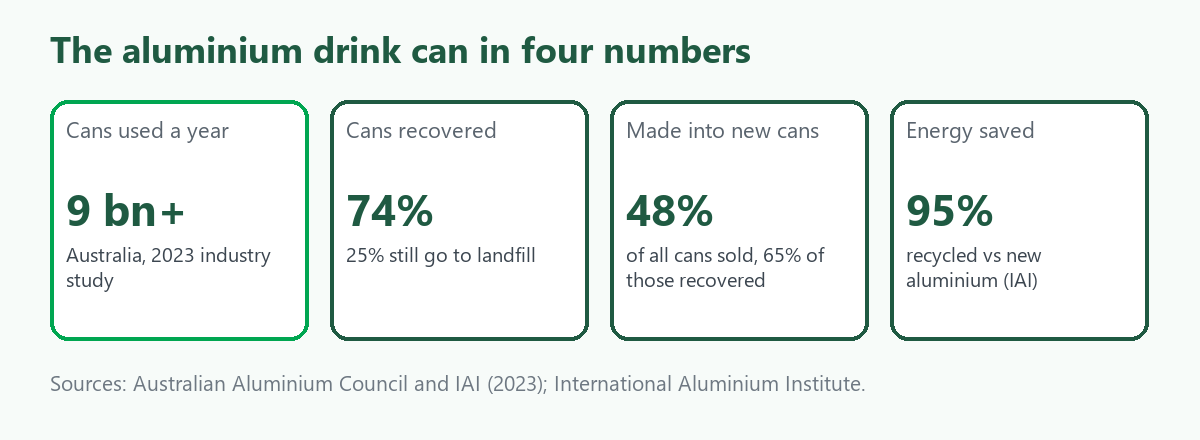
Step 1: You finish the drink
Your can can take one of three routes. It can go into the household recycling bin, it can go to a refund point, or it can be handed to someone who collects cans, such as a sports club, a pub or a scrap collector.
The refund route is the one that pays. Every state and territory now runs a container deposit scheme that pays 10 cents for each eligible container, and Tasmania's scheme, Recycle Rewards, started on 1 May 2025. Return and Earn says containers are separated from other materials when they are collected, which gives a cleaner stream than a mixed bin.
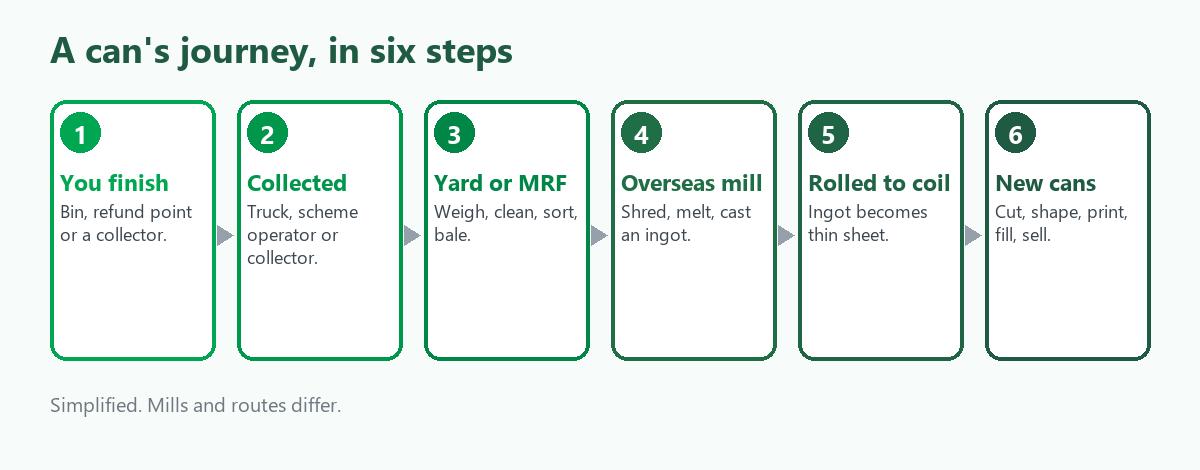
How many cans are we talking about? The Australian Aluminium Council's 2023 study says Australians use more than 9 billion aluminium cans a year, and expects that to reach 11 billion by 2030.
Step 2: Someone collects it
If you used the household bin, a truck takes your can to a sorting plant, called a materials recovery facility or MRF. There it travels along conveyor belts mixed with paper, plastic and glass. Steel cans are pulled out by magnets. Aluminium is not magnetic, so a machine called an eddy current separator does the job: it creates a changing magnetic field that makes aluminium pieces jump off the belt into their own bin. The aluminium is then pressed into compact blocks.
If you used a refund point, your can goes into a container with other cans and is collected by the scheme's operators. If you handed it to a collector, it joins whatever the collector has gathered and travels to a scrap yard.
All three routes matter. The Council's study found that a high proportion of cans are collected through the state deposit schemes and then turned into scrap together with other separately collected cans, before being sent for export.
Step 3: The yard weighs, cleans and bales it
This is the stage most people never see, and it is where the scrap trade lives. A yard that takes cans typically does four things:
- Weighs the load, and pays by the kilogram.
- Checks and cleans the load, taking out steel cans, plastic, food and anything that is not aluminium.
- Bales the cans, which means squashing them under a press into a dense block that is easy to stack and ship.
- Sells the bales to a trader or exporter, or directly to an overseas mill.
Bales matter because cans are light and bulky. Crown Holdings, a can maker, says a standard bale in the United States weighs about 2,200 pounds, roughly a tonne, and holds about 65,000 cans. Australian bale sizes differ, but the idea is the same: more metal per truck and per shipping container means a lower freight cost per tonne.
The trade calls this material UBC, for used beverage cans. For what yards pay for it, see Scrap Aluminium Cans Prices in Australia, and for how a yard fits into the wider chain see How Scrap Metal Recycling Actually Works.
Step 4: The bales leave Australia
Here is the surprise. Very little of the metal is melted in Australia. The Australian Aluminium Council says the country's two aluminium rolling mills closed when the car industry shut about a decade ago, and that took away the local capacity to turn recycled cans back into sheet. So the bales are exported.
Where do they go? The sources we found do not agree exactly. The Council's 2023 release names South Korea, Thailand and Saudi Arabia. The Return and Earn scheme in New South Wales says its cans are sold to smelters overseas, including in the Netherlands and South Korea. Government export records show 102,150 tonnes of aluminium beverage cans left Australia in 2025-26 (provisional), half the level of a few years earlier; we set that out in Australia's Aluminium Can Exports Halved.
The Council's own list of improvements includes better traceability of where exported cans end up, because without it the public cannot easily check the claim that they were recycled.
Step 5: The mill melts and rolls it
At the overseas mill, the baled cans go through a series of steps that turn old cans into aluminium sheet. The Crown description of the process, which we have simplified, runs like this:
- Shred. The bales are broken up and shredded into small pieces.
- Clean. Air blows away light material such as paper and plastic, and magnets take out any steel.
- Burn off the paint. The pieces are heated in a furnace to burn off the paint and lacquer, leaving clean aluminium chips.
- Melt and cast. The chips are melted and poured into a huge block called an ingot. Crown says one ingot of about 27 US tons is made from around 1.5 million cans.
- Reheat and roll. The ingot is reheated and rolled between heavy rollers, back and forth, until it is a thin sheet, which is wound into a giant coil.
Why do it? Energy. The International Aluminium Institute reports that recycled aluminium needs about 8.3 gigajoules of energy a tonne, against 186 for new aluminium made from mined ore, which is a saving of about 95 percent. Return and Earn puts it in everyday terms: recycling 20 cans uses the energy of making one new can.
One detail makes recycling cans harder than it sounds. A can is made of two different alloys: a body alloy and a stronger lid alloy with more magnesium. Both go into the melt together, and the mill has to correct the mix so the new sheet meets the can maker's specification.
Step 6: A can maker turns the coil into new cans
The coil of recycled sheet is delivered to a can factory. There, the sheet is cut into discs and each disc is pressed into a shallow cup. A machine called a body maker then pushes the cup through a set of rings that stretch and thin the walls until it becomes a tall can with a domed bottom. The top is trimmed, the can is washed, coated inside, printed outside and narrowed at the neck. The lid is made separately from its own sheet, scored, and fitted with a ring-pull tab.
Some of this happens in Australia. Visy, which sorts recycling at its own plants, says it buys aluminium coil made from recycled cans and makes beverage cans locally; in the 2023-24 financial year it reported making 2.4 billion cans and taking in 17,000 tonnes of aluminium. A Victorian report on the 10 cent scheme says the baled cans are reprocessed into coil overseas and that the coil comes back to Australia to make new drink cans.
Finally the empty can goes to a bottler or brewer, who fills it, and the lid is sealed on at the filling plant. It is trucked to a shop, and you buy it. The loop is closed.
How long does it take? The Return and Earn scheme says recycling takes four to eight weeks once the cans arrive at the overseas processor. We could not find a reliable end-to-end time from your bin to the shelf.
How many cans really come back?
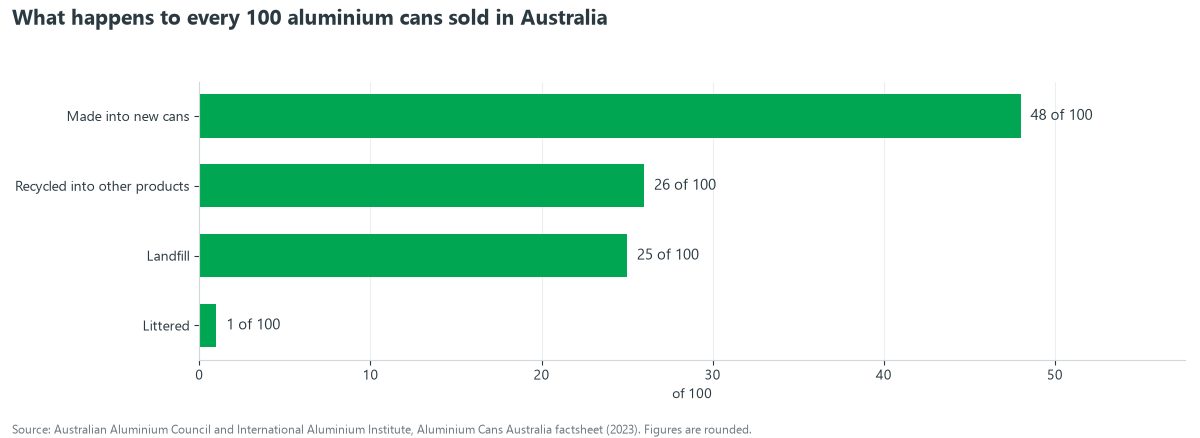
The 2023 study found that 74 percent of aluminium cans sold in Australia are recovered. Of every 100 cans, about 48 are made into new cans, about 26 are recycled into other products, 25 go to landfill and 1 is littered. In other words, about 65 percent of the cans that are recovered end up as new cans. The study estimated about 44,000 tonnes a year are recycled back into cans, out of roughly 92,000 tonnes of can scrap generated each year.
So the loop works, but it leaks. The biggest leak is the can that goes into the general rubbish bin, which is about a quarter of all cans. The study points to better sorting in public places, businesses and apartment blocks as the main places to improve.
What this means for you
- If you are a household: put cans in the household recycling bin loose and empty. Better still, take them to a refund point for 10 cents each.
- If you collect cans: keep them clean and separate from steel cans, and ask your buyer how they are graded and weighed. Our guide to preparing aluminium for the best price per kg covers it.
- If you run a yard, club or business with a lot of cans: weigh them, bale them if you can, and compare buyers before you sell. You can list your cans on the ScrapTrade marketplace to see buyers' offers or create a free account.
The same journey is true of other metals, and the differences are what make each one interesting. Aluminium's trick is that it can be melted again and again without losing its quality, which is why a recycled can is really a can that is on its second, third or tenth trip. For how the other major family works, see Ferrous vs Non-Ferrous Metal Recycling Explained.
To follow one dead battery from the workshop to the yard, a lead recycler and into a new battery, read Where a Car Battery Goes After You Hand It In.
What we could not verify
- Where your own can is melted. Bales from different yards and schemes go to different buyers, so no single answer is true for every can.
- A current national recovery rate. The 74 percent figure is from a 2023 study, and we found no official figure for 2024 or 2025.
- The typical Australian bale weight. The 2,200 pound bale is Crown's United States figure.
- What yards pay today. We publish no yard prices.
- The end-to-end time from bin to shelf. Only the overseas processing time was stated.
Frequently asked questions
Are aluminium cans really recycled in Australia?
They are collected and baled in Australia, but very little is melted here, because Australia has no aluminium rolling mill that can turn them back into sheet. Some of the resulting coil returns to Australia to make new cans.
How many times can an aluminium can be recycled?
In principle, as many times as you like. Aluminium can be melted again without losing its quality, though each trip loses a small amount to dross, coatings and other contamination.
Do I have to rinse a can before recycling it?
An empty can is enough. Mills burn off the paint and lacquer anyway, so what matters most is that the can goes in the right bin and not in the general rubbish.
What is the difference between UBC and aluminium scrap?
UBC means used beverage cans, a single grade made of one type of can. Aluminium scrap is the wider group of aluminium material that includes cans, wheels, window frames, wire and engine parts.
Sources
- Australian Aluminium Council and International Aluminium Institute, Aluminium Cans Australia factsheet and can recycling release, October 2023.
- Return and Earn (New South Wales), container recycling pages.
- Visy, Aluminium Recycling Remade leaflet (FY2024 figures).
- Crown Holdings, Metal Recycling overview.
- International Aluminium Institute, factsheet on the energy saved by recycling aluminium.
- Tasmanian Government, Recycle Rewards FAQs.
- Ballarat Times, "Join the cycle: the journey of your 10-cent containers", 13 November 2025.
- Department of Climate Change, Energy, the Environment and Water, Waste exports data collation, September 2026 (ABS records). The 2025-26 figures are provisional.
This is general information, not financial or legal advice. Process steps are simplified, and mills differ. ScrapTrade operates a scrap marketplace and has a commercial interest in the scrap trade.